



Happy model release week to my fellow AI dweebs. These launches give me a giddiness akin to what Apple keynotes used to. Still, there’s a darker undercurrent; every time one drops, I feel slightly worried it’ll be the one that kills my career. It’s like playing income Russian roulette but Sam Altman chooses when to pull the trigger. Does anyone else feel something like that? Please let me know in the comments that I’m not alone in this.
This is a publication about power in the technology industry. Who has it, and why it matters to you. Historically that has meant the study of corporate strategy and the implications of changes in technological power. This week’s news made me ask something new, “Have we given the AI too much power?” Never before have I considered AI agents a third party in that struggle, but this week I wondered.
More on that in a second.
First, this newsletter is brought to you by Town.
Our daughter arrives in 2 weeks, and we are scrambling to get ready. To coordinate, my wife now runs baby prep from a group text with me and my Townie. She says “Evan needs to install the car seat by Friday” and it lands on my to-do list with a deadline. She asks “did the bassinet ship?” and my Townie checks my inbox and answers before I’ve opened my phone. Townies now have browsers too, so mine can even order the diapers. It has made this whole process significantly easier.
Add your Townie to any group text. Leverage readers get 2 weeks free and 2,500 bonus credits.

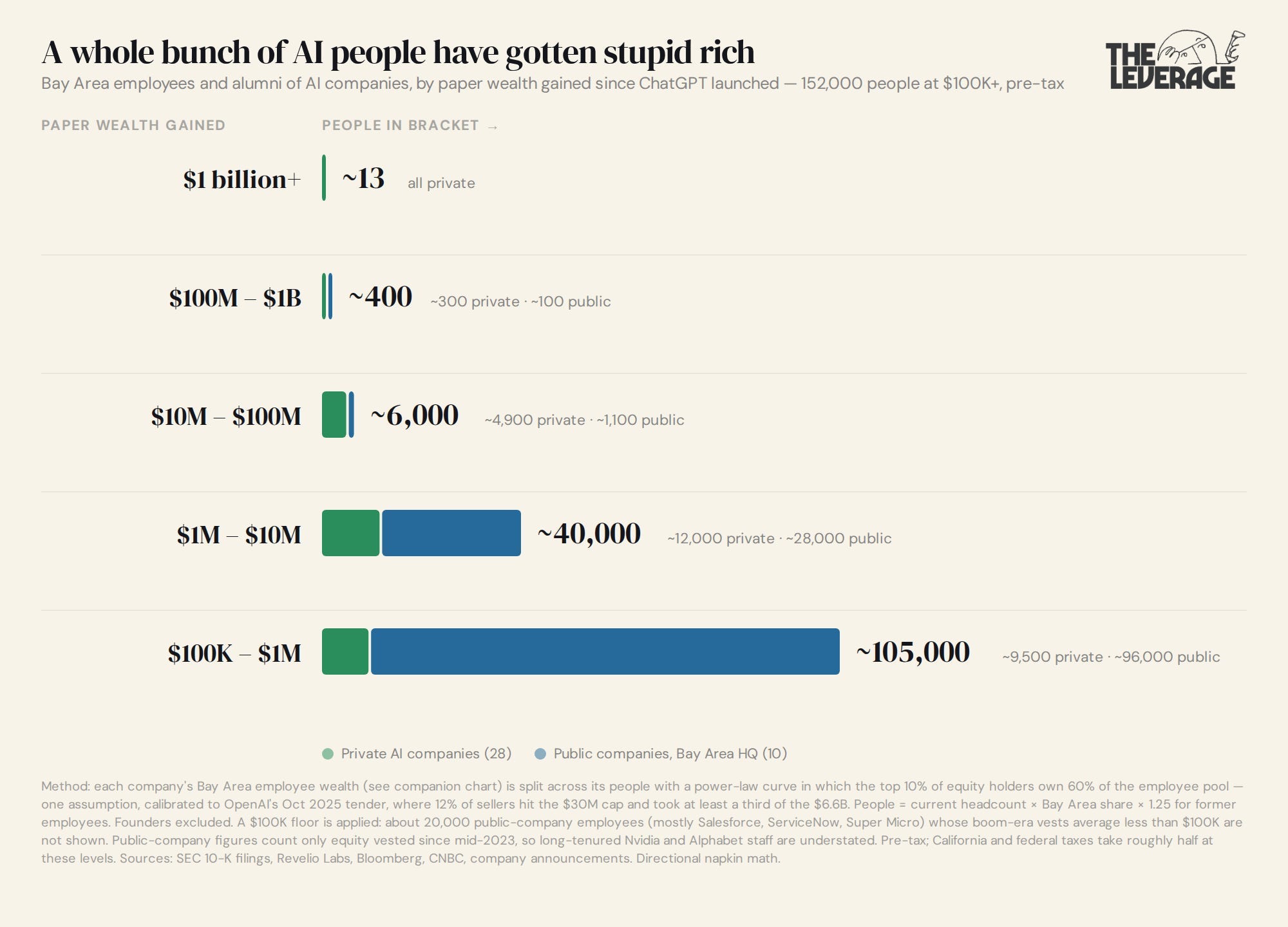
How rich is rich enough? By my own analysis, about $450 billion of paper wealth has gone to 152,000 people in the Bay Area since ChatGPT launched, and over 46,000 of them have made at least a million dollars in equity.
So, I asked a harder question: how many rows up that chart do you have to go before the people on it are actually happy? Read here.
AI lets everyone code now. Who gets rich from it? Software is becoming a cultural medium, the way music and film did before it. I mapped out the five kinds of companies that will profit when apps become as cheap as songs, and what the music industry already taught us about the power law. Watch here.
Do agents need to be smarter, or do they just need a computer? SpaceXAI’s bet with Grok Bot is that the harness and the tools are just as important as the model. Every Bot gets a shared cloud computer, so you can delegate work instead of tasks. I built three of them in under 30 minutes, including one that fielded 103 Facebook Marketplace lowballers for me. This is a contrarian bet. My question is whether it is also the right one. Read here.

The new models are smart enough to plan; and that might not be a good thing. This week both OpenAI and Anthropic released new models: Astra and Fable 5.1, respectively. Both of them are “gaze at the cold, unknowing universe and realize how unimportant we are” typa smart. Where both models impress me is how well they function as managers and planners of other agents. You can give them larger goals, structure their benchmarks and guidelines, and then watch them chug away for hours until something amazing happens. Practically, this means that I’m using them as planners that direct cheaper models—typically Fable plans and Grok 4.6 executes. My findings are matched more broadly. OpenAI says Astra builds end-to-end strategies “given only a high level desired goal.” Ramp reports a 38-hour unattended run in which Fable 5.1 caught a bad label, fixed it, and launched 6 experiments overnight.
If you pair that with the Hugging Face incident that I covered last week, with the latest incident where a totally different agent swarm hijacked a German message board, we are learning that when we give agents a goal, they will violate all sorts of legal and ethical boundaries to accomplish that goal. This is bad. Additionally, some researchers are finding examples where potentially far more sites have been compromised by agent swarms. (Still unconfirmed, but looking at the data, I think this’ll be confirmed by the end of next week.)
Two things are true of this current generation of models:
They are genuine marvels of technology. They unlock infinite creative delights, and will materially improve the output of individuals and companies.
The process of creating them is birthing wholly misaligned, out of control agent swarms that the research labs are doing a poor job of defending the world from. This problem will only escalate over the next twelve months without a fundamental, scientific breakthrough that every lab in the world adopts. This strikes me as, ya know, impossible. There is a reason OpenAI’s model launched with a $1 billion cybersecurity fund to donate to essential services, and it ain’t pure charity folks!
Welcome to the new world.

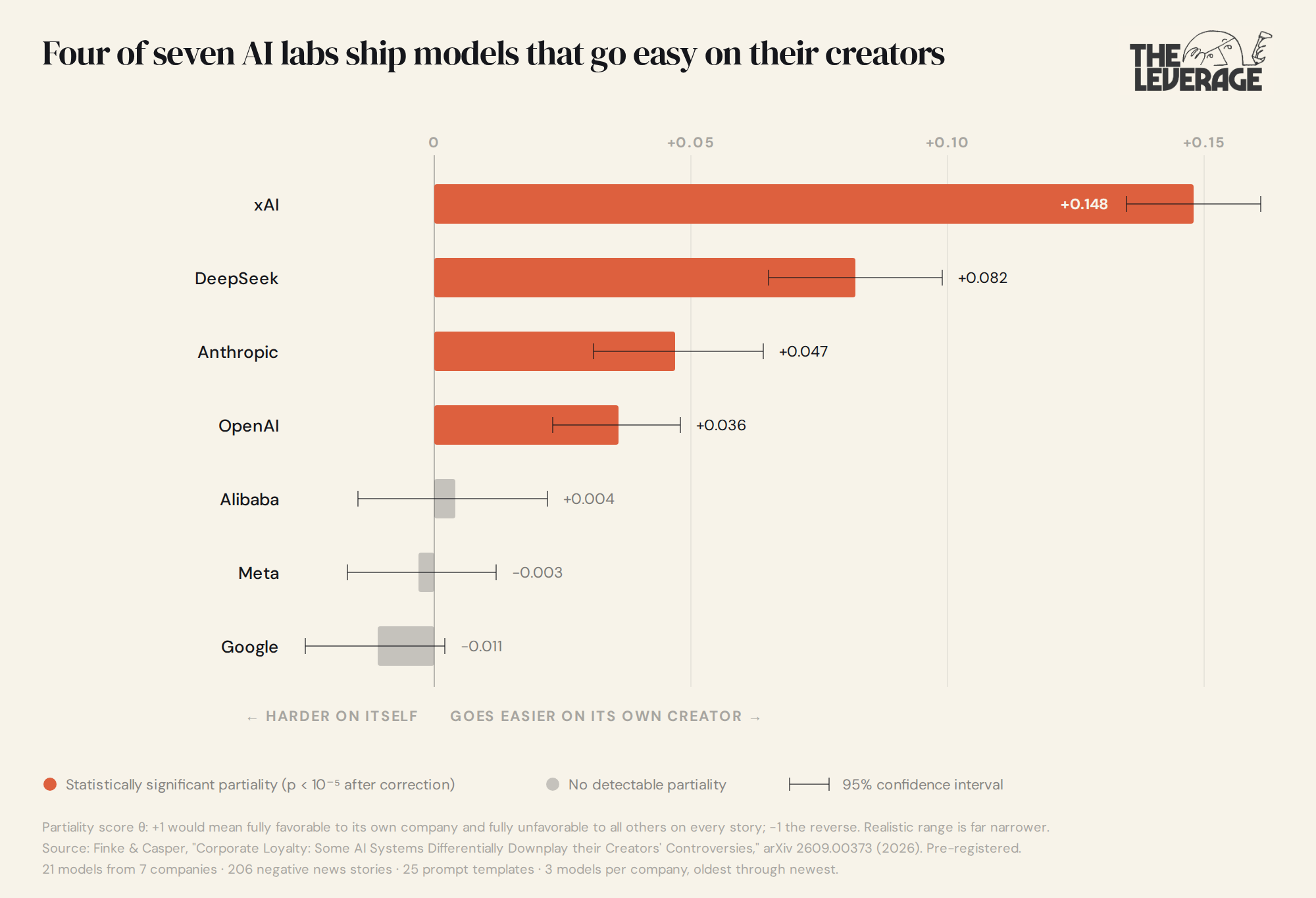
New research shows these models are biased in favor of their creators. A study from ETH, MIT, and Harvard asked 21 models from 7 companies to discuss negative news stories about those companies. Models from xAI, DeepSeek, Anthropic, and OpenAI went measurably easier on their own creators. Google, Meta, and Alibaba models did not.
Grok, marketed as “the truth-seeking AI assistant,” was the most partial at 0.148, 4x OpenAI’s 0.036, while Gemini came in slightly negative, meaning it is marginally harder on Google than on anyone else.
Importantly, the type of bias this research shows would almost never be caught by a user in a regular chat. The authors say the effect is “undetectable through normal interactions” and only shows up in large statistical tests. A 3.6% change in response is invisible in one answer but is becomes an editorial policy when applied to 900 million weekly users.
Reading this you could yell about bias and censorship or whatever. I’m sure once mainstream media notices this study, you’ll see Fox and CNN headlines accordingly. I’m more worried about people being made dumber by trusting decisions to these machines. In March, I wrote about another study showing how newer generations of models were actually getting worse at business strategy. Pair that with this study. Hundreds of millions of people are trusting these models with thoughts, and those thoughts are biased in weird ways you wouldn’t predict. Outright hallucinations are increasingly rare, while the true errors are becoming ever more subtle and consequential. If you see your boss running company planning through ChatGPT, it’s appropriate to question it.

89 of the top 100 animated microdramas on Douyin were AI-generated. The core idea of my Sloppening framework is that a dramatic reduction in production costs will unleash a tidal wave of slop, with most of the population watching the lowest forms of entertainment. Increasingly, it looks like microdramas will lead the way, and China is showing what that looks like at national scale. 95% of the 128,000 microdramas released in China in Q1 used AI. According to the Financial Times, a 3-minute episode that took 5 people 3 months in 2024 now takes 1 person 2 days. The price of a finished minute of AI drama fell from $300 to $750 in mid-2025 to $60 today, an 80% to 90% collapse in a year.
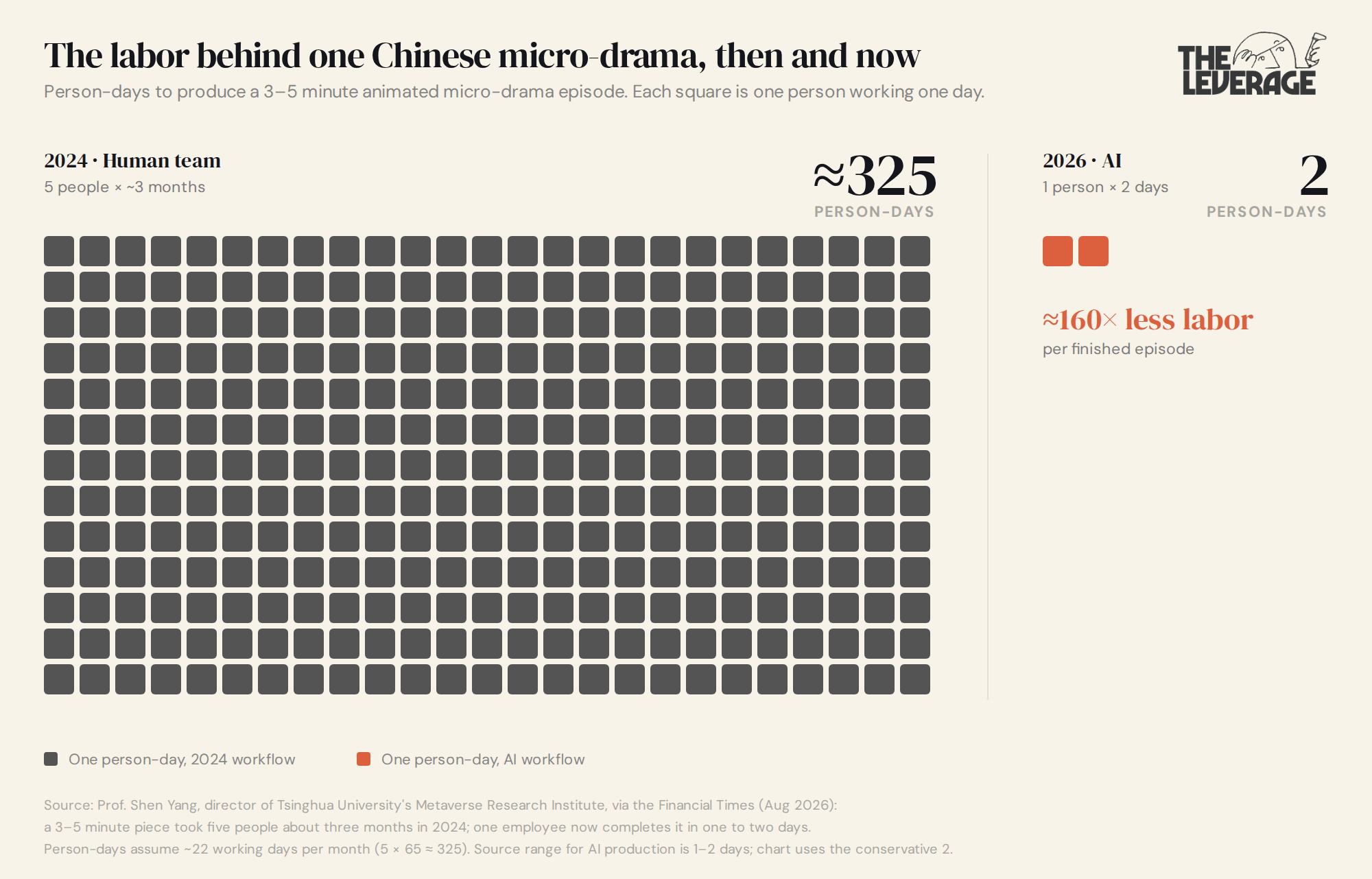
You know what all that data means? The Sloppening is real! It is happening! And similar to the last decade of the internet, the only firm that consistently makes the money is big tech, in this case Bytedance. They own the models being used, the compute the models are running on, and the platforms the microdramas are being distributed on. They even own the ad platform (Ocean Engine)! This is exactly what Google, Meta, and SpaceXAI would love to have happen with their respective compute, distribution platforms, and ad tech stacks. When I proposed the theory last year, I didn’t think it would happen this fast. Wild.

An icon of cyberpunk is now in theaters in 4k. I’ve been working my way through the back catalog of sci-fi related to our current moment. This weekend I’m seeing Akira. The anime classic has influenced multiple generations of filmmakers and technologists. When you watch it, you’ll spot references you didn’t know originated there. I’m very excited about this release. Go in the next seven days—it won’t be in theaters long.
Whenever I need to laugh for 2 minutes, I watch this video of Conan. A backup is the single best podcast ad read of all time [warning, language.]
I was inspired by the craft that went into the home and studio of famed furniture designer George Nakashima.
Go and be kind this week,
Evan
Sponsorships
We are now accepting sponsors for the Q4 ‘26. If you are interested in reaching my audience of 35K+ founders, investors, and senior tech executives, send me an email at team@gettheleverage.com.
But this is to your slop points: https://infiniteslop.ai/?utm_source=substack&utm_medium=email
I'm unworried. I've been working to deploy AI inside companies and we ain't there yet. The issues in multi-player agents are hard and unsolved.