



Live in Silicon Valley long enough and you’ll collect a closet full of shoulda’s. There is the time you ignored the Bitcoin white paper. Or the Twitter DM you missed that turned into a company that would’ve made you $100M. They are an inevitable, painful aspect of the tech industry. However, the AI boom is a particularly intense version of this phenomenon. Never before, in the entirety of human history, has so much wealth been created so quickly in such a small geographical region.
This Scrooge McDuck level of riches has been concentrated in just a few companies, ones that operate with fewer employees than the companies of yesteryear. This scarcity means that the rank and file, not just the founders, are getting stupid rich. This distribution looks like this:
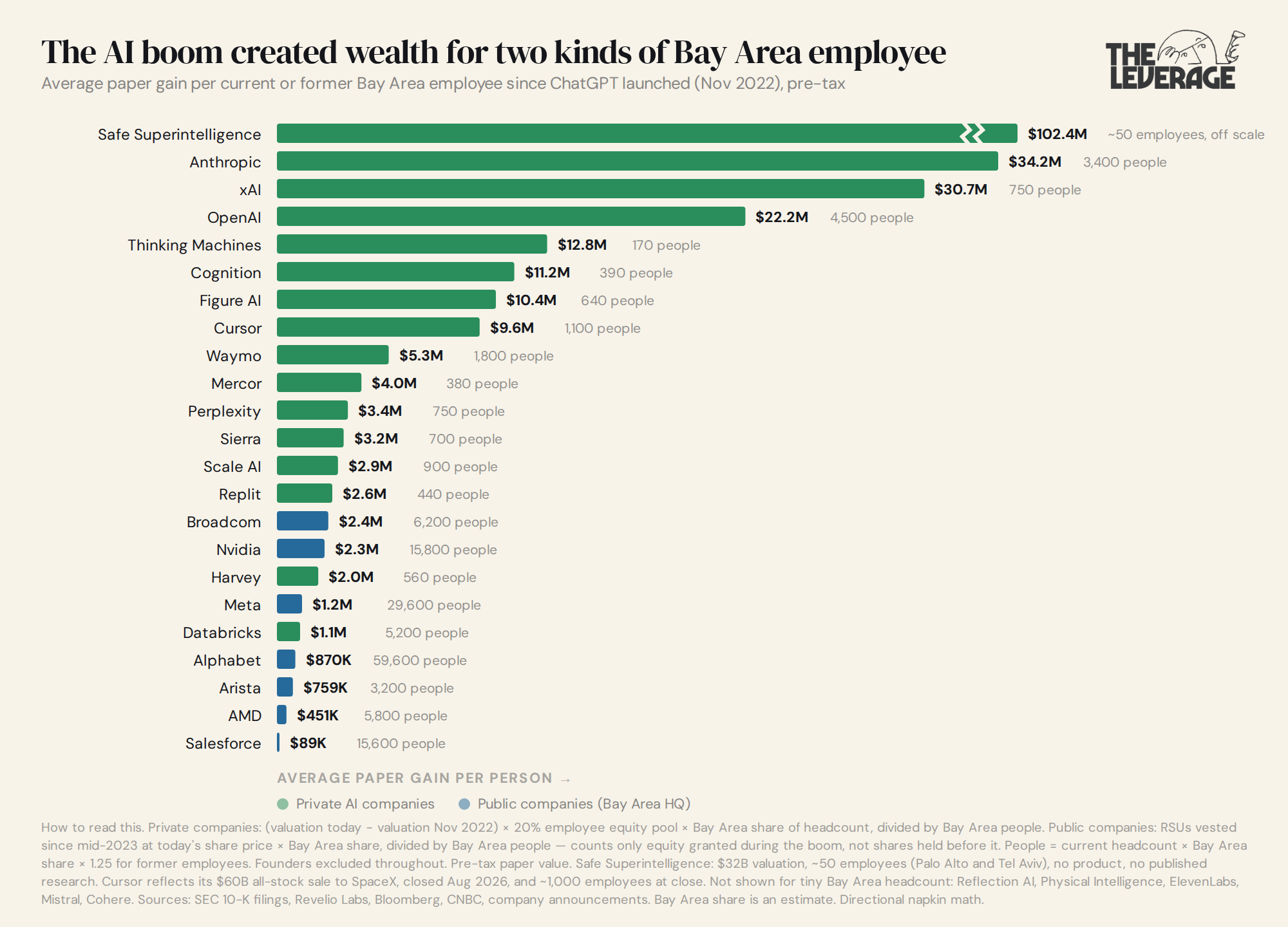
To make this chart, I did some Napkin Math™ on valuation changes that have happened since ChatGPT launched in November 2022. For 28 private AI companies, I took the valuation gain since launch, assumed employees hold 20% of the company (Carta’s benchmark for late-stage US startups), and applied each company’s Bay Area share of headcount. For the 10 public companies leading in AI that are headquartered there, I pulled the market value of RSUs that have vested since mid-2023 from their 10-Ks and marked it to today’s price. Importantly, founders are excluded, and so is anyone who gained less than $100,000.
Add it all up and about $450 billion of paper wealth went to roughly 152,000 people in the Bay Area. Again, this is all wealth that has been created over just the last four years. The 28 private companies produced $300 billion for 26,000 people, and Anthropic and OpenAI account for 72% of it. The 10 public companies produced $145 billion for 125,000 people.
The averages overstate how many people are actually rich. Equity inside these companies is heavily skewed toward early hires, so to count people by wealth level I had to assume how skewed. I used a power law in which the top 10% of a company’s equity holders own 60% of the employee pool. This assumption is based on OpenAI’s October 2025 buyback where 12% of the 600-plus sellers hit the $30 million per-person cap. (You can find the underlying dataset and the assumptions I made here.)
Apply that distribution curve to every company, and who actually got rich looks like this:
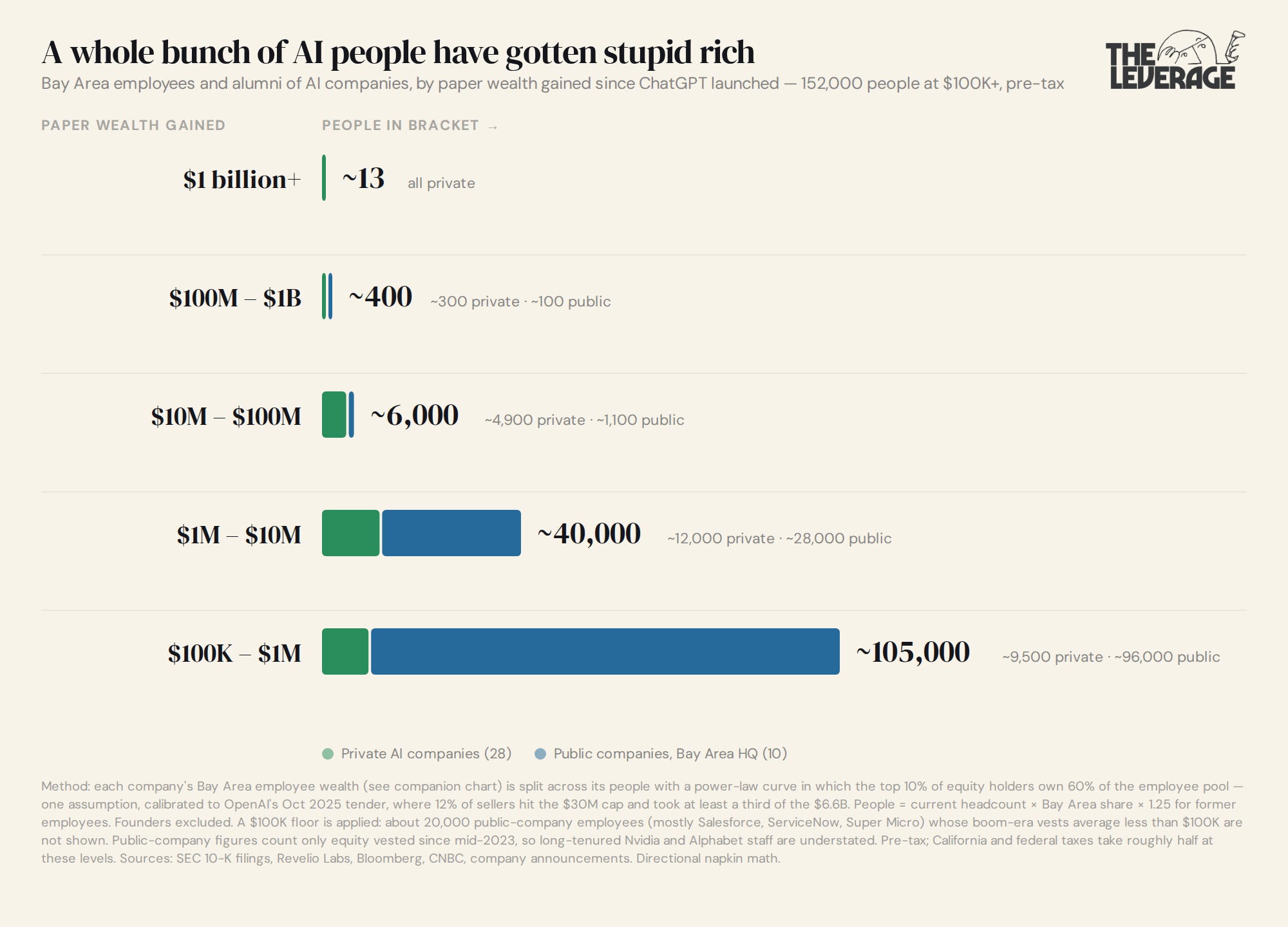
By my estimation, over 46,000 Bay Area residents have made a million dollars in AI equity. 6,400 of them have made over $10M. I do recognize this is handwavy math. But it is at least directionally accurate and allows us to ask an important question:
How many rows up on this chart do you have to go before the people are happy?
The loveless marriage underclass
Through some strange twist of fate, I, the proud descendant of a dental hygienist and HR manager, have spent an abnormal amount of time around billionaires. Typically kids from a rural farming town in Minnesota don’t meet the “I own a couple of islands” class, but by virtue of my career, I have.
Perhaps the most surprising thing I’ve learned from my time with the mega rich is how profoundly broken some aspect of their life typically is. 2 years ago I tried to find one of them who had it all. I asked Twitter for a billionaire who was:
Still married to their first spouse
Widely regarded as morally upstanding
Had kids who turned out relatively well
Had kids who were on good terms with them
The tweet got 1.5 million impressions and hundreds of nominations. People had, uh, opinions. But after talking with dozens of sources, I found exactly one guy the world could agree on: Chuck Feeney. He gave away $8 billion, flew coach until he was 75, and died in a 1-bedroom rental. But even he was divorced! Behind him were 84 more who came close, but whether they made the list depended on your politics, how you define moral virtue, or how well the family kept their troubles out of the press. I’m sure there are more; it was an imprecise research process. But that it was so damn hard to find an obvious paragon is indicative of the problems that come with riches. Money is power, and power is always fraught.
The research on money’s impact shows that there is a logarithmic relationship between money and happiness. Money does make us happier, but each increment requires 3x the money of the last. Moving from $60,000 to $180,000 buys about as much happiness as moving from $180,000 to $540,000, which buys about as much as moving from $10 million to $30 million. The first jump is a promotion. The last one is 10 years at a frontier lab, or a second company, or the years your kids are small. Past the point where your needs are met, the money starts costing more happiness than it buys.
The AI boom is producing a new employee cohort that sits among them, 13 billionaires and 400 people worth over $100 million. To their credit, some are already giving it away. Anthropic matched early employees’ donations 3 to 1 on up to half their equity, its cofounders have pledged 80% of their wealth, and the OpenAI Foundation holds a 26% stake worth over $200 billion. Good on them! More importantly, many of the researchers I talk to find a profound sense of destiny in their work, and view the advancement of AI as a moral and just pursuit. (It always helps when a moral pursuit comes with a bonus Porsche.)
All you want to be is Whole Foods rich
This morning, I woke up early and continued my reading of Infinite Jest. As I sat there sipping on my beverage, I found myself distracted every 15 minutes. 5:15—no movement. 5:30—perhaps a twitch? 5:45—we have an unscrunch and a yawn. 6:00—we have a chattering war cry, “Dada, dada, dada.” What kept pulling me out of my reading flow was the thought, “I can’t wait for her to get up.”
Becoming a dad has been a profound revolution in how I see the world. It feels like with every bounce of her curly hair, my child excavates some new part of my soul. There are hidden veins of happiness and meaning that her mere presence has summoned into existence. Now, as we sit about 2 weeks out from our newest child joining us, I can’t help but be giddy about the new depth of feeling this second child will bring.
In case my profession as a newsletter writer didn’t telegraph this, I do not make the kind of money that most of this piece is about. I worry about daycare bills, about retirement, about what would happen to my family if I can’t make The Leverage work. But still, I am rich beyond measure. That does sound like a cliché, scribbled onto the wall decor for sale in a Walmart clearance aisle, but still, it is how I feel.
When I contemplate whether being one of these AI-rich people would make me happier, I ultimately feel like it wouldn’t be that different. Would a million dollars help me be more attuned to my wife’s needs? Would it magically give me a sharper mind? Could I suddenly learn to enjoy Moana on our 432nd rewatch? (No, no, and no.)
I want to be careful here, because I am not arguing against ambition. Nor am I arguing that those who don’t have children can’t feel the happiness that I have.
What I am saying is that after you hit the point where your basic needs are comfortably met, the highest ROI activity for your happiness is the pursuit of sacrifice. It is meaning-making, in devoting yourself to invisible causes of goodness.
The way I joke about it with my wife is that all we want to be is Whole Foods rich. If we can shop at Bezos’s overpriced grocery store, eating food that kings of yesteryear would marvel at, then we have made it, and any additional money is pointless.
There is a tweet I think about a lot from writer McKay Coppins,
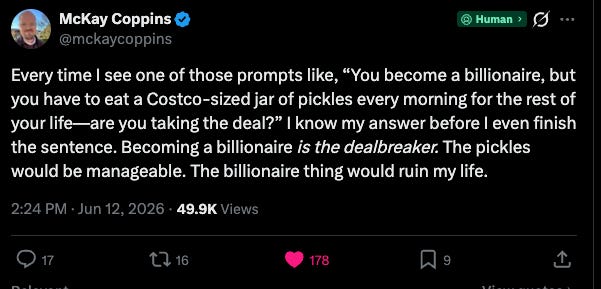
Becoming a billionaire is the trap. It is too overwhelming for anyone to handle. Pretty soon, regular people become “npcs.” Family time becomes ever more “expensive.”
My definition of rich is the ability to see individuals as fully wonderful human beings who are worthy of sacrifice. That feeling can manifest itself as being an AI researcher or a stay-at-home parent. But it is a deliberate choice. When our new baby girl arrives, it is a choice I can’t wait to make again.
I love this. As a kid of a single mom who was a working-class nurse, I definitely didn’t see myself in tech or doing anywhere near as well as I did.
For a number of years, it wasn’t clear that there was an “enough.”
I got smarter as I got older and got off the merry-go-round. An amazing spouse and great kids, who over time opened my eyes, were instrumental.
I’ve watched friends who could comfortably retire, or do something better for humanity with their time, strive for the second and third brass ring. Usually at the expense of relationships.
It’s not about “enough.”
Too often it’s about the comparison to others, which has gotten worse in Silicon Valley and in particular S.F. in my ~30 years here. The peers who did better than you after they left Google/Meta, the AI startup that makes your last startup’s amazing $20b exit look paltry. The private jet.
The fact that I sometimes refer to my current phase as “semi-retirement” is a running joke with my wife. I’m working (almost) as hard as ever, but I’ve been lucky enough along the way that I can aim the drive and energy I’ve got at causes I care about and do it with good people.
If you’re fortunate and have “Whole Foods” enough (or, better still in S.F. BiRite or Gus’s enough), find what gives you enough purpose. Enough friendship. Enough meaning. Enough joy.
tl;dr Envy thy neighbor at thy own peril.
Being in the SF & now AI bubble warps everything. ‘What I am saying is that after you hit the point where “your basic needs are comfortably met” ‘ - the problem with this statement is that it is highly variable, and once you hit Whole Foods level of comfort you’re already well past the 1% of privileged on this planet. A status most people cannot even dream of.
It’s being able to have ambitions, goals, dreams yet being equally present and embracing where you are, whatever you have and being able to show up and contribute in community to something larger than yourself, to (as you say) sacrifice. And not succumbing to the disease of comparisons you’re making.
I think many people in much more humble contexts are able to reach this conclusion much better than we can despite not having much bc we’re surrounded by and warped by the various narratives of our physical and digital surroundings. (although even that’s diminishing bc the digital surroundings means everyone is getting bombarded by the wealthy, mega wealthy, ultra wealthy and wealthy wannabes)