


Author’s note: This is the latest in my “What’s the Bet” series. AI has the potential to change everything, and founders have to make company-defining choices in response. That is not easy. In this series, companies pay me to analyze their bet and explain it to you. I retain complete editorial independence. Today’s bet is brought to you by SpaceXAI. If you have any feedback, just reply to this email.

SpaceXAI’s bet is that agents don’t need to be smarter. They need a computer, and they need to be a team.
Almost every AI agent is just short of useful. It can mostly get the right context, run Orwellian-style surveillance on your meeting transcripts, give you smart-sounding answers, whatever. However, it always seems to fall justtt short of making users exclaim, “Oh shit, that ruled.” There is a gap in capability, some chasm between every AI product’s marketing and its day-to-day reality. SpaceXAI believes the way to bridge that gap is not solely “make model mega smarter.” What truly matters is the harness surrounding the intelligence and the tools you give to said intelligence.
Grok Bot is the expression of that belief. When you sign up, your account gets a computer in the cloud. Your Bots (capital B—they are very particular about this) share it. Once you log them into your apps, the Bots have access to your accounts, and they can keep working in the cloud, essentially forever.
To the skeptic, this sounds like a feature, not a company-defining bet. But be ye not deceived: there is hidden strategic depth here. To see why this idea is so important and so powerful, we need to talk about all the times AI products have failed.
The personal assistant graveyard
The personal AI assistant is maybe the most obvious product in technology. Despite that, no one had even gotten close until about 12 months ago. Siri (remember her?) has been promising a personal assistant since 2011. Apple finally gave up on its own models this June and rebuilt “Siri AI” on a Gemini base. While it is still in beta, it looks mostly like a thing that fires off actions inside apps on your phone. To which our collective reaction should be: “Boring.”
Alexa+ went through the same arc with a decade’s head start, but its device was an ugly speaker everyone got for Christmas. In 2025, Amazon promised a web-browsing agent that still hasn’t shipped, so now Alexa+ just kinda books dinner through OpenTable’s API and not much else. Woof.
For every virtual assistant product, the failure looks similar: yes, it can look up information for you, but it can’t actually use the web or accomplish tasks. Most importantly, it never has full access to the data or apps you use every day.
The labs have all aligned on a similar-ish vision to resolve this historical problem. ChatGPT Work gives its agent a browser on a separate computer in the cloud, and as of July it can sign into websites without ChatGPT ever seeing your password. Claude Cowork keeps it local by putting its browser inside the desktop app on your computer, meaning your computer has to be on and the app has to be open to give your agents browser access. (I imagine this will change in under 12 months.) Google’s Gemini can auto-browse inside your own Chrome, with logins from Google Password Manager. The whole feature is still US-only, with 20 tasks a day on the $20 plan.
Then there are the startups, most of which are chasing the personal assistant. Instinct, an invite-only variation, is the one Silicon Valley is currently buzzing about. You just text it. It, too, has its own cloud computer and password vault, so it can execute annoying personal tasks like getting you a restaurant reservation.
Grok Bot is architected differently. While it can be a personal assistant, it truly shines as a work assistant. A personal assistant needs to know one person deeply and handle a hundred small, unrelated things for that individual. A work assistant needs to know a handful of jobs deeply and run each one the same way every week, inside the software where the data already lives. Put plainly: by giving the Bots their own computer and passwords, you can delegate work rather than tasks. You can spin up a variety of specialized agents, each with a complex job, and trust them to use their computer to get it done. I visualize it like this:
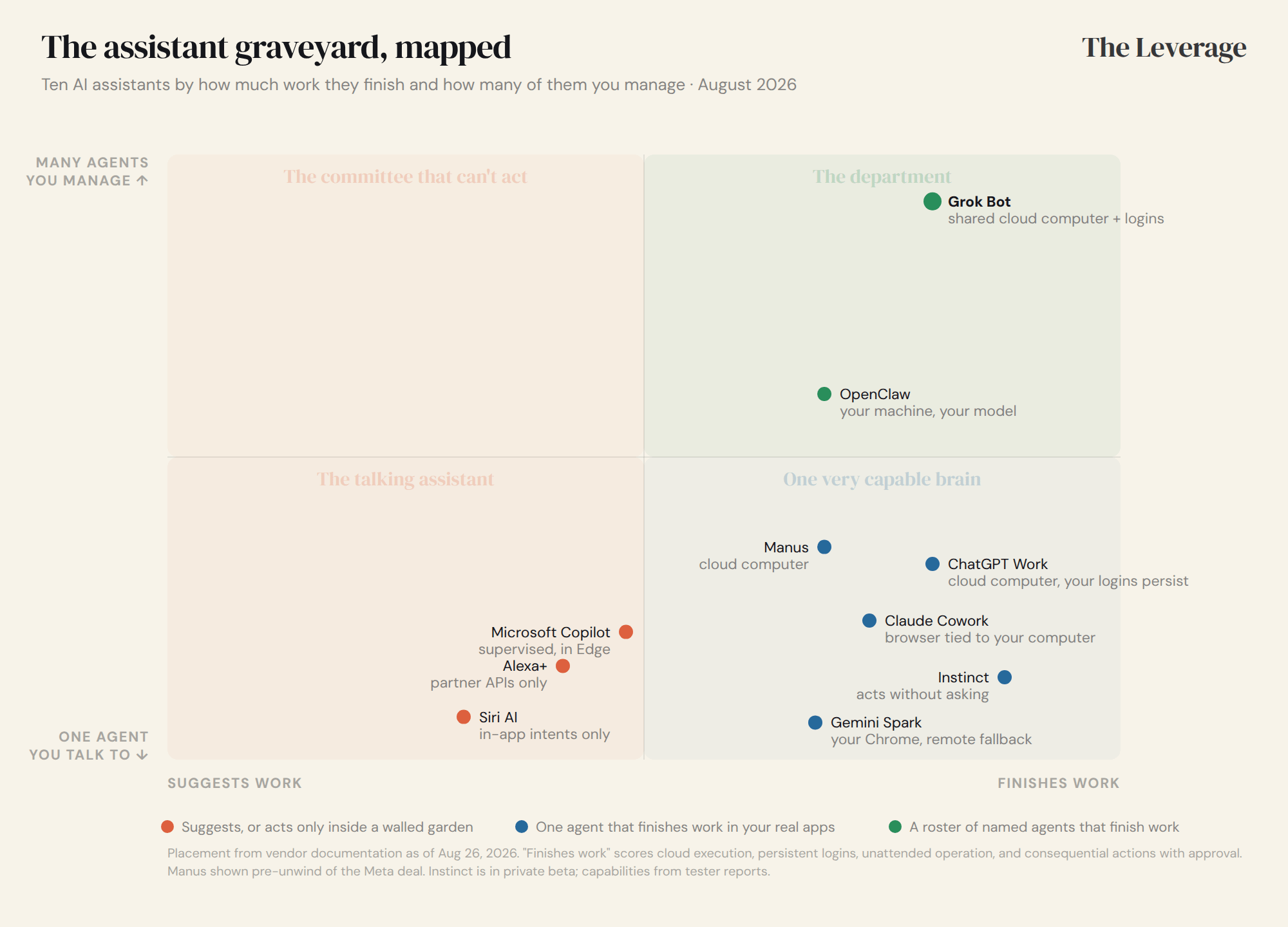
The bottom-left is the dark corner where assistants go to whimper and die. The bottom-right is the current “best practice,” meaning it gets more crowded every month. Grok Bot is nearly alone in its corner: many narrow Bots, sharing one computer with your real logins on it, finishing work. Clearly contrarian, but is the positioning also right?
To figure it out, I’ve been going deep on the product.
Meet my Bots
I’ve built three Grok Bots that I would consider hot stuff.
Marketplace Manager: Facebook Marketplace is a truly miserable service. People are flaky, the messages are relentless. I hate it. That said, I use it all the time because I refuse to pay full price for stuff my kid is going to need for three months. Now, though, MM handles it all for me. I recently listed a daybed that exactly 103 people messaged me about. I saw none of them. MM messaged each of them about availability and pricing, then selected the best buyer for me. I just got a message with the time and place of pickup. I am now looking around my house, eager to start selling off all the junk I need to get rid of.
Bill Nye, the Churn Reducer Guy: One of the hardest parts of a media business is that you’ll lose roughly half your subscribers within 12 months of them subscribing. If I could nudge that number down, it would materially improve my business. My latest attempt is the Churn Reducer. Every week he downloads the list of new subscribers, uses their emails to make an educated guess about who they are, and tells me who I should reach out to directly. The hope is that over time, by giving people the personal touch, I’ll be able to decrease my churn rate. This type of workflow was theoretically possible before Grok Bot, but I was too overwhelmed to make the time. Now it is mostly done for me. Try it here.
Good Idea: I am loudly and proudly an idea guy. Each day I come up with a bunch of ideas for new software I want to exist, services I want to buy, etc. Increasingly, I am convinced that, despite having little technical skill, I can make anything I want. Good Idea ‘s job is to help me think through which things I could build that would make sense to live within The Leverage. I tell it the idea, and Good Idea translates my ramblings into a product review document and a market landscape. It has been enormously useful because I gave it access to my Substack account on its cloud computer, so it knows which types of essays I write perform best, and it can translate those into software services for me to offer.
Building all three took me under 30 minutes. Which brings me to the number I think actually decides this company.
The minutes-to-magic ratio
When you are building for prosumer markets, you have to assume your average user has the attention span of a goldfish. This is where Grok Bot’s larger ambitions, beyond SpaceXAI’s legacy developer audience, shine. Starting a new Bot is quick and easy. As long as you know what you want, getting it working takes minimal mental effort. Here, though, the team will have challenges. Delegating work to a team of AI agents means you have to think like someone who manages people: resource allocation, who owns which workstreams, etc. And the simplicity cuts both ways: if you want to become a power user, delegating much of your life to the machines, you eventually start running into limitations.
And make no mistake: with Grok Bot, the team is firmly targeting prosumers with their $20 a month pricing. At launch, Grok Bot was gated behind $200 and $300 tiers. On August 26 it dropped into SpaceXAI’s $20 Pro plan, and with that, the entire market converged toward similar ranges.
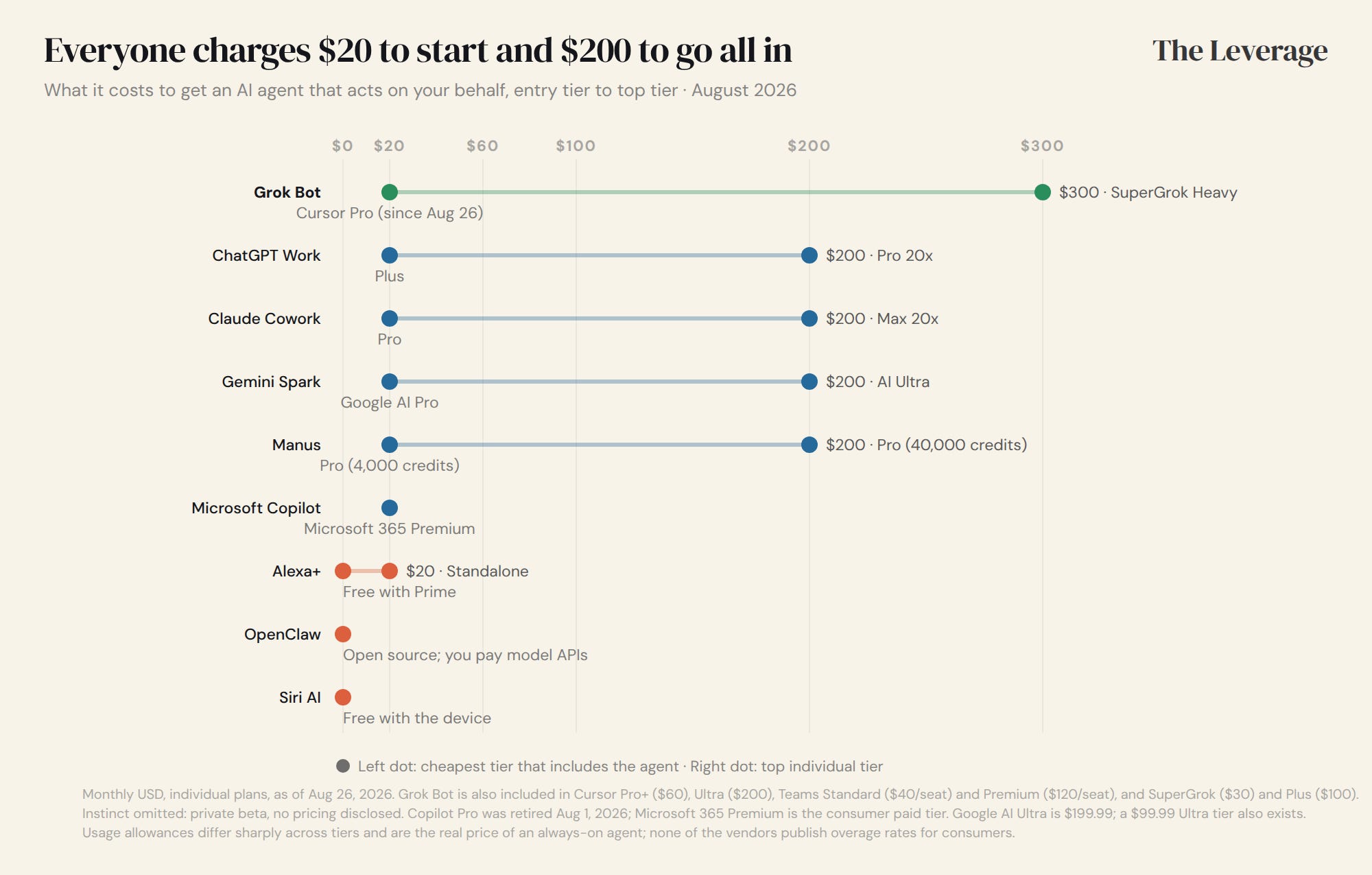
This means no one is going to win on sticker price. The key thing about an AI-native product is that it’s priced against labor replacement, not SaaS. If everyone is charging similar prices, the question becomes the cost of goods sold per token offered. And this is where SpaceXAI has something nobody else on the chart has.
The advantage nobody else at the table has
If you believe, as I do, that what matters is the harness + the tools + the model, then you have to believe that competitive differentiation comes from the utility-to-price ratio. SpaceXAI’s biggest problem pre-acquisition was that it was the largest customer of the very labs it competed with. The SpaceX acquisition means Grok Bot is owned by a company that trains its own models and owns the compute they run on.
This matters far more as agents become the dominating force in AI. A regular chat is a few thousand tokens but a Bot clicking arguing with low ballers on Facebook Marketplace for 20 minutes while sending me screenshots is thousands of times that.
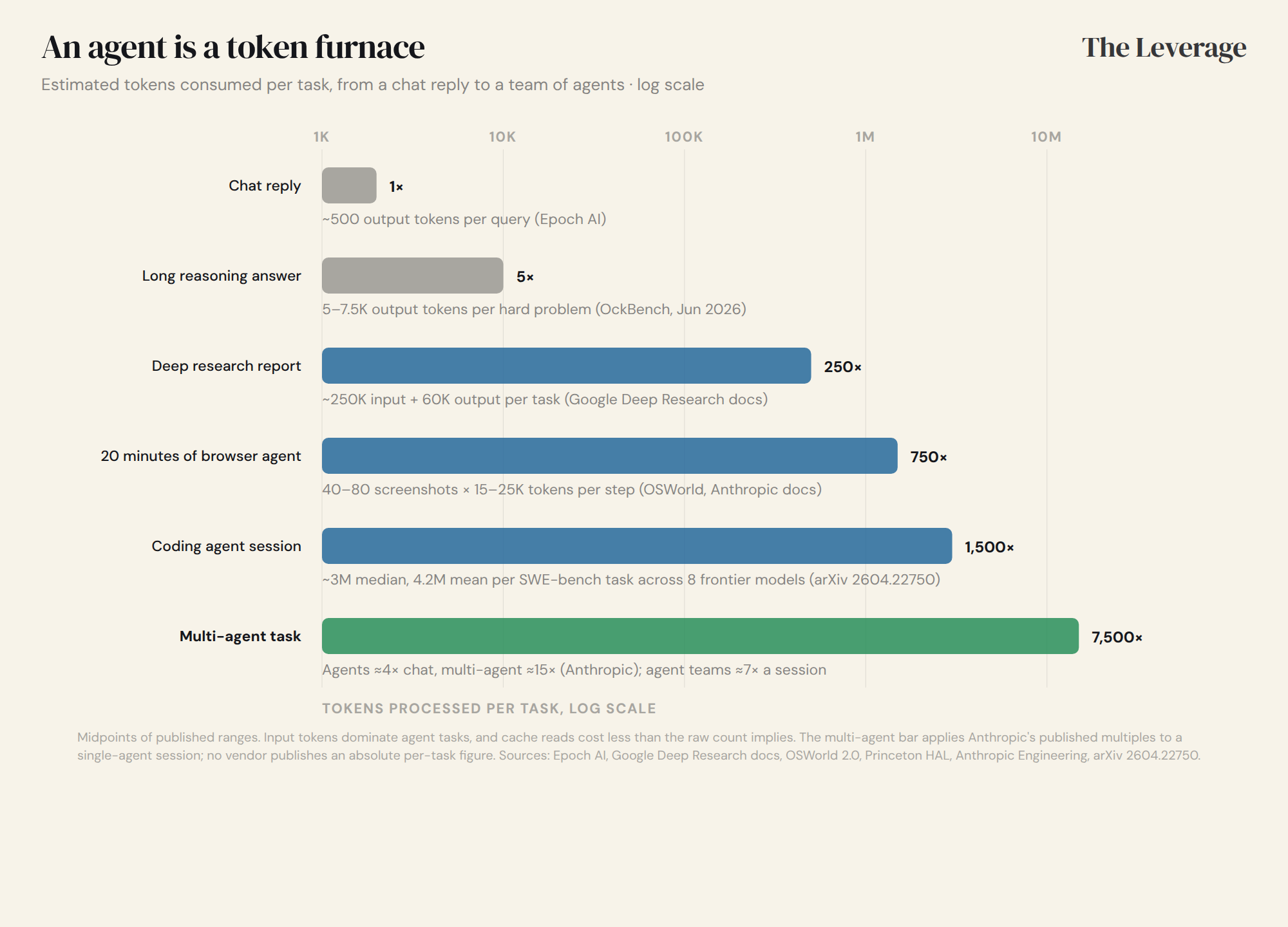
Midpoints of published ranges from Epoch, Google, OSWorld, Princeton’s HAL, and Anthropic’s engineering team. No vendor publishes an absolute figure for a multi-agent task, so that bar applies Anthropic’s disclosed multiples to a single-agent session.
In the long run, Grok Bot will be able to offer a combination of unique models at price points that providers other than OpenAI and Anthropic will struggle to match. (This assumes, of course, that the form factor and the short-term bet on computer use are the right ones.)
So, is the contrarian corner also the correct one? On the computer, yes. Every lab has some version of it, which means that choice alone won’t be enough to win. The bet that decides this company is the product architecture: teams of agents collaborating. SpaceXAI’s developers will understand how to use this product pretty intuitively. Everyone else has to be taught, and teaching is expensive (sponsoring handsome newsletter writers is not cheap!), which is exactly what the owned-model, owned-compute stack is for. It lets the team spend the savings on users rather than margin. For my part, I find myself using the product more and more and more. You can try my marketplace manager and my churn reducer here. Leverage subscribers can get easy access to the product here.