



The defining religion of the AI era has been e/acc. Effective accelerationism preaches that rapid technological progress pushes society forward and will cure the world’s ills. This week delivered miracles for the faithful: Spotify’s earnings call revealed its best developers “have not written a single line of code since December.” OpenAI dropped a new model that writes code 15x faster than existing models. I feel the acceleration.
But e/acc’s detractors got their evidence too. Facial recognition abuse. Naked purchase of political power. AI video models ignoring copyrighted materials wholesale. All of which we’ll cover in a minute. Here too, I feel the acceleration.
In The Leverage, I advocate for a middle way. One where we can be clear-eyed about the enormous benefits of capital markets and technology while also being honest about the downsides. My piece this week struck a nerve, which suggests this middle ground has an audience.
Let’s get to it.
MY RESEARCH

Notes on the SaaSacre. In the last two weeks, over $300 billion in software market value has been yeeted out of the public markets. Everyone thinks AI is killing SaaS, but they’re wrong about why. Instead, AI is shifting where value accrues. Software is splitting into three layers: databases (Salesforce, SAP), point solutions (the stuff humans click on), and a new middle layer I’m calling “the context layer.” Context is the institutional knowledge that tells AI agents what to do, in what order, and whether they’re allowed to do it. Think about what happens when a new employee joins your company. They spend months learning who approves what, which systems talk to each other, what the unwritten rules are. That knowledge — the stuff that lives in people’s heads and Slack threads and outdated wikis — is the context layer. It captures organizational overhead that used to require armies of coordinators and turns it into software margin for the first time. The trillion-dollar question: does this layer get owned by whoever already holds your company’s knowledge (ServiceNow, Notion), or whoever builds the smartest agents (OpenAI, Anthropic)? Either way, context is the new bottleneck. Read more here.
WHAT MATTERED THIS WEEK?

BIG TECH
Welcome to the Silicon Panopticon. Last year, I argued that computer vision was the most important technology to follow LLMs. By pairing cheap smartphone components with near-free AI inference, we will get a new world of automated surveillance. A few days later, I argued that this omni-present virtual intelligence would create a prison of surveillance, one where you were observed, judged, and then disciplined. Frankly, when I published that piece, I wondered if I was being too hyperbolic. Surely my highly principled colleagues in Silicon Valley wouldn’t be shameless enough to build this technology?
Anyway, here are three recent headlines:
Meta Plans to Add Facial Recognition Technology to Its Smart Glasses. The company plans to ship the feature “during a dynamic political environment where many civil society groups that we would expect to attack us would have their resources focused on other concerns.” Originally the company planned on releasing the feature to attendees of a conference for the blind, but decided on this new release schedule instead. I mean, come on man.
US Border Patrol signed a deal with facial recognition company Clearview AI for “tactical targeting.” The contract is, very importantly, not for targeted investigations but instead, for routine day to day surveillance work performed by its agents. This is the same underlying AI technology that was used by ICE in Minnesota, often without warrants or consent. I mean, come on man.
Amazon’s Super Bowl commercial showed how its Ring cameras could form a neighborhood surveillance network — supposedly, only to find lost dogs. After public backlash, the company canceled its partnership with Flock Safety, which lets law enforcement request camera footage without a warrant. Great, except they didn’t cancel a separate contract that allows immigration enforcement to request the exact same Ring footage. So the net result was a press release. Come on man.
I want to name the obvious: all three of these stories touch the current political environment. That’s not the point. The point of The Leverage is always the technology. Facial recognition gives governments a scalable, automated way to track citizens—and the infrastructure being built today will outlast any single administration. Do you want Trump to have this power? Or Kamala Harris? Or *insert your least favorite politician here*? If you don’t believe this will affect you, spend two minutes using the following service to search for your own face. It’ll find you, and it will find information about you in rather uncomfortable ways.
Facial recognition is following the exact same deployment pattern as every other surveillance technology before it. It starts with a sympathetic use case, whether that is finding lost dogs, helping the blind, or catching criminals. Then, it expands.I don’t view (most) of the companies building this stuff as evil. They’re just following the incentives. And right now, the incentives to slow down are laughably weak. Amazon canceled one surveillance partnership after public backlash—and quietly kept a separate contract that does the exact same thing. Grumpy tweets (and newsletters) are not enough to give people privacy rights.
BIG LABS
OpenAI and Anthropic pick their politicians. In one of my videos in January, I argued that politics would play a much greater role in business strategy because AI is such a hot button issue. I have already been proven correct. Greg Brockman, a co-founder and President at OpenAI, has become one of Trump’s largest donors, with the explicit goal of cultivating goodwill and less regulation for AI. Then this week, Anthropic donated $20 million to a Super PAC explicitly designed to counter that effort by backing politicians who support additional safety regulations for AI (which they argue benefits society, and as a fun side benefit, also benefits them). Companies in every industry have used politicians as competitive weapons, but it is unusual to see companies so early into their life engaging so largely and publicly. That tells you something about how high the stakes are and how much both companies believe regulatory outcomes will determine market winners. Very, very different than the previous era of technology!
Anthropic grows revenue 10x every year for three years straight. The company just closed a $30 billion round of funding at a $380 billion valuation. All of this was done on the basis of this chart:
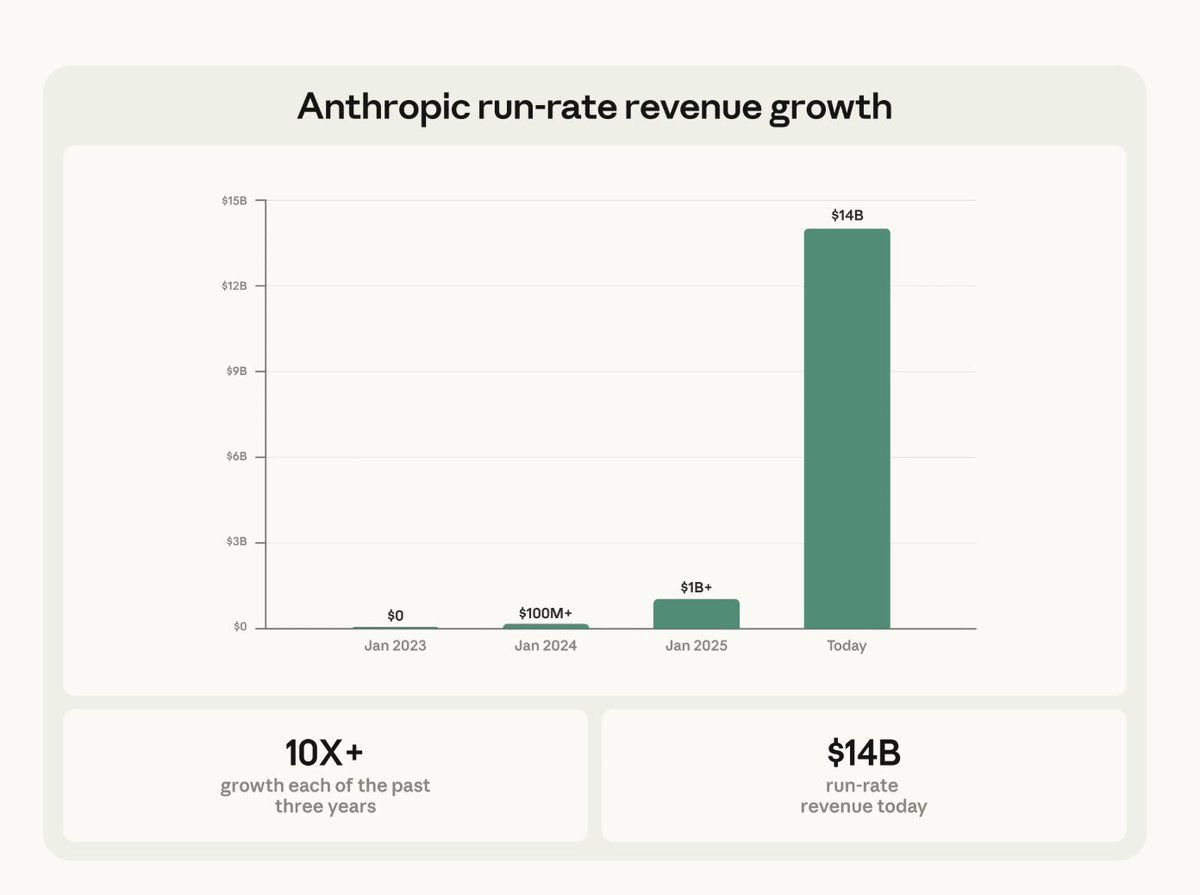
Staggering. There has never been anything like this in human history. I then charted each reported case of revenue from each of the two leading labs.
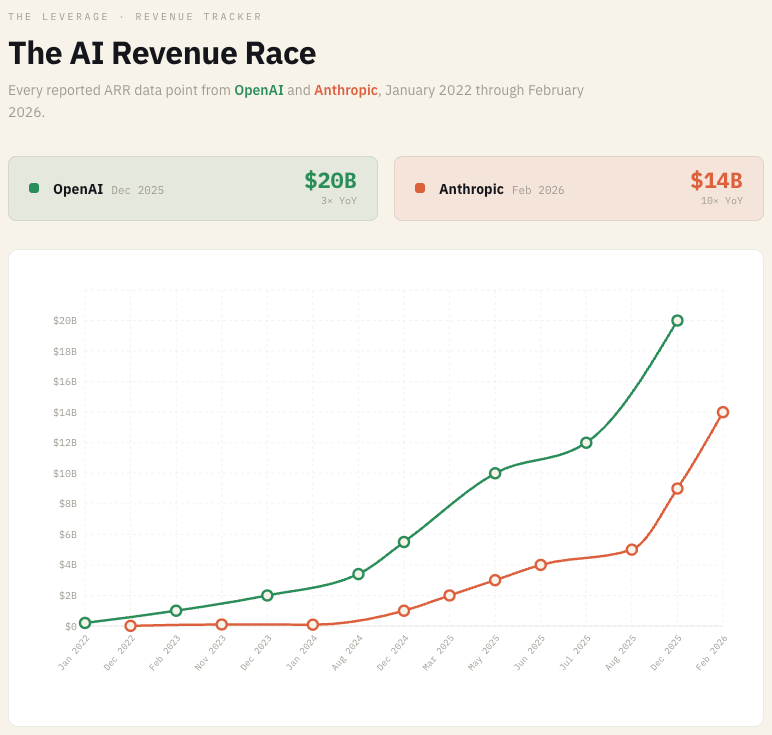
OpenAI seemed to be breaking away until June of last year. Perhaps in this race the tortoise will win? For more on Anthropic’s strategy, you can read my analysis about why their focus on B2B software has paid off so spectacularly.
THE SLOPPENING
The best video model in the world is Chinese, and its maker doesn’t care about American IP law. Bytedance released Seedance 2.0 and the results are freaky good. The model does an impressive job with audio, with physics, with everything really. For the well-prompted videos, it will fool over 80% of viewers. What is truly remarkable is how terrible the uses of it are. Go to X after you finish this newsletter and just put in “seedance” into the search bar to see what I mean. The videos are mostly about abuse of other people’s IP. Want to watch Batman fight John Wick, here ya go. Kung Fu Panda fighting Godzilla and Optimus Prime? Yup. Dragonball Z as a 1970s Kung Fu movie? Of course. This is almost an exact mirror of what happened when I got early access to Sora, the most viral videos were deepfakes of celebrities or stupid Rick and Morty clips.
When anyone can make a professional looking video, and that video is short/has to appeal to the lowest common denominator, the result is slop. There is a good explanation for why the creators of these videos can’t help but make garbage. T.S. Eliot wrote an essay called “Tradition and the Individual Talent“ where he argued that great poets have “the historical sense.” They understand where the art form came from and relate that legacy to their current moment. In theory, AI video tools could empower people with that sense, letting filmmakers with great taste but no budget produce genuinely original work. Instead, the distribution incentives point the other direction entirely. On platforms optimized for engagement, the fastest path to virality is mashing together pre-existing IP that people already recognize. You don’t need a historical sense to put Batman in a cage match with John Wick. You just need a prompt. The tools are Hollywood-quality. The creative ambition is YouTube comment-quality. And that’s pretty much the Sloppening in two sentences.
TASTEMAKER
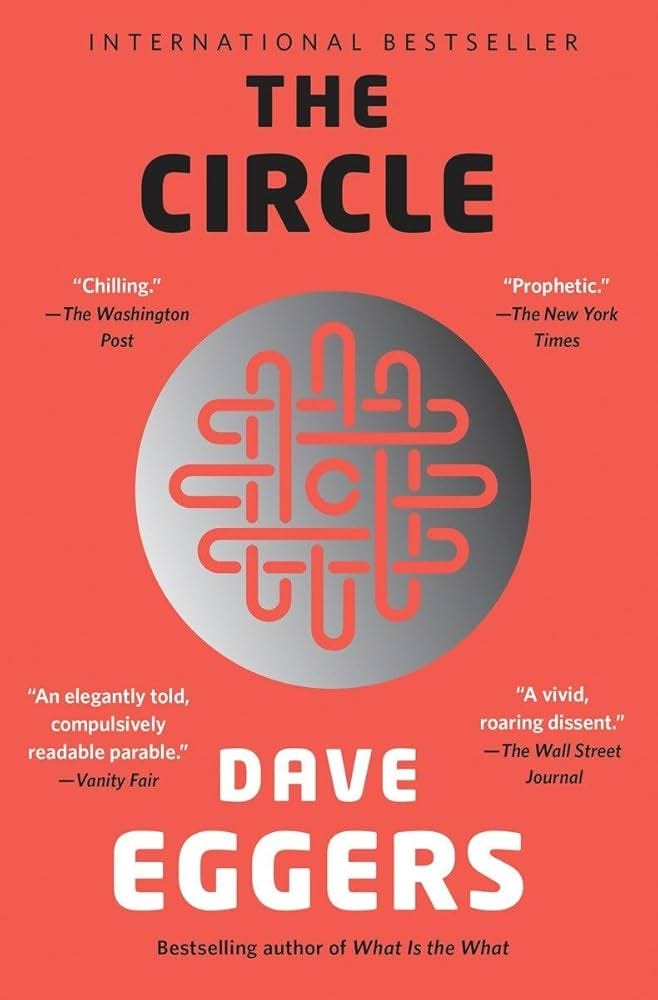
I just spent several paragraphs arguing that facial recognition infrastructure will outlast any single administration. Dave Eggers made the same argument in 2013, except he went further — and at the time, I thought he was ridiculous. When I first tried to read The Circle, I didn’t finish it. I thought it was too ridiculous, that there would be no way that people would so willingly sacrifice their rights to privacy and freedom.
I read it again this week as part of my participation in @Commonplace Philosophy’s bookclub, and it struck closer to home this time. Many of the scenarios that struck me as farcical are now uncomfortably real. This is true even in my own life. I’ve been writing a lot about Operation Dad Bod, where I use a variety of AI tools, pharmaceuticals, and wearables to optimize my health this year. To my discomfort, there is a very similar plotline in The Circle. It is easy to rationalize our way into surrendering our choices to the machine, and I have found myself doing so more and more.
I cannot recommend this book to anyone as a work of serious literature. The characters are shallow, borderline unbelievable. The writing has momentum, but is not masterwork of prose. I can however recommend this book as just-barely fiction. You may realize that the shallow, borderline unbelievable character has a startling resemblance to you.
And one more thing…
In the last 72 hours, Barack Obama went on the record saying that aliens “are real, but I haven’t seen them” and NASA published a study that examined the source of organic compounds on Mars where “the non-biological sources they considered could not fully explain the abundance of organic compounds, it is therefore reasonable to hypothesize that living things could have formed them.”
So, I guess, uh, alien life confirmed? We are not alone in the universe? Feels like maybe I should’ve led the newsletter with that and called it a day.
Go and be kind this week,
Evan
Sponsorships
We are now accepting sponsors for the Q1 ‘26. If you are interested in reaching my audience of 34K+ founders, investors, and senior tech executives, send me an email at team@gettheleverage.com.