



Two years ago, Sam Altman predicted that there would soon be a wave of “one-person billion-dollar companies.” Founders could use AI to replace employees and keep all that payroll expense as profit for themselves.
This idea never made sense to me—foundation models are widely available, and if everyone has the same AI superpowers, distribution gets challenging. So far my rebuttal has held true: while there have been many companies growing quickly, there are no one-person billion-dollar companies.
However, there has been a lucrative wrinkle that I didn’t quite foresee. To understand it, you need to understand my three laws of AI:
AI dramatically decreases creation costs, thus increasing distribution costs.
Knowing what to build is more important than knowing how to build, rewarding people with taste.
Most people do not have taste, and as such, will have their brains turned into slopified goo.
In the context of these laws, the ideal founder is someone who has a unique way to distribute their product, the taste to know what to build, and the trust of their target customers. They can then use that combination of factors to bundle products that would previously have been too expensive to make relative to the labor costs and size of the market.
I call these people “hyper-creators.” A hyper-creator business is one where a bundle of digital goods is invented and distributed by an individual, but are created and maintained by an AI agent. They flood their target customer with software, information products, dropshipped physical goods, and recommendations for everything they don’t produce themselves.
I cringe as I write this, and may God have mercy on my soul for saying it, but think of it as Vertical SaaS for a vibe. (Sorry.) A hyper-creator’s job is to curate a nuanced view of the world, and then pull every monetization lever known to man that is associated with said vibe, tying it all together with their own distribution. That is an exceptionally silly company that could never scale to billions of dollars without adding staff, but it is a delightfully profitable company to build for yourself.
I am starting to see this happening in the wild.
Take my friend Nat Eliason. Nat has spent many years online making stuff ranging from a video game that ran on cryptocurrency, a non-fiction book, a sci-fi book, an SEO agency, to recently spinning up an AI agent that runs an autonomous business that has made *check notes* $78,000 in its first 30 days. The thing tying this dizzying array of activity together is his distribution. He is prolific on X with over 90,000 followers and has a newsletter with 46,000 subscribers. More than that, he has always operated in public, building trust.
Now you, my wonderfully handsome and skeptical reader, may be thinking, “Ah, I too love anecdotal data that confirms my priors.” Well, true. But also! There is plenty of macroeconomic data that shows this trend starting across the economy.
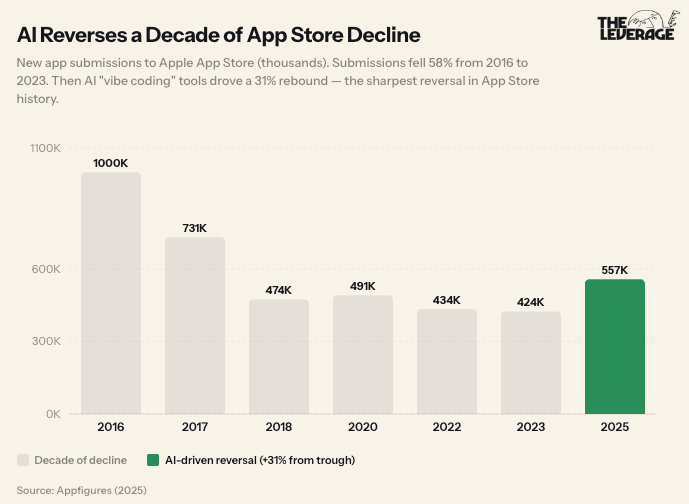
We are starting to see a huge jump in new apps being submitted to the Apple App Store.
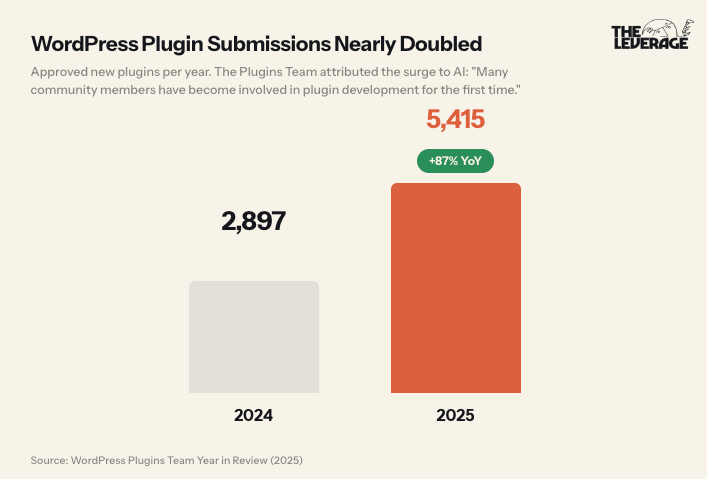
WordPress plugins are up 87% YoY, with the WordPress team pointing to AI as the driving factor.
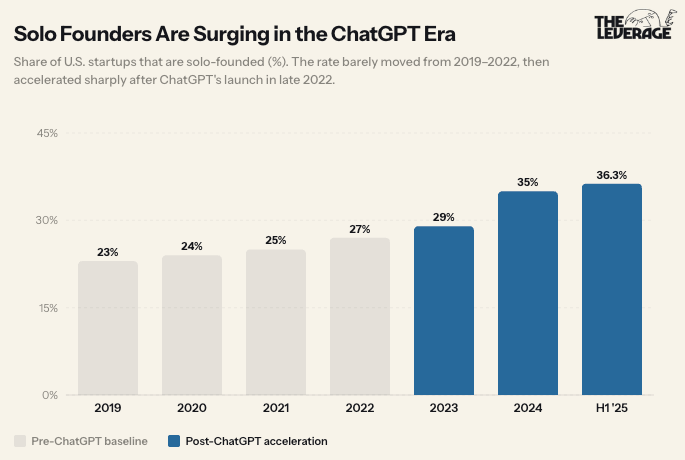
Startups with a solo founder are also spiking. People can use AI to do what they used to rely on cofounders for.
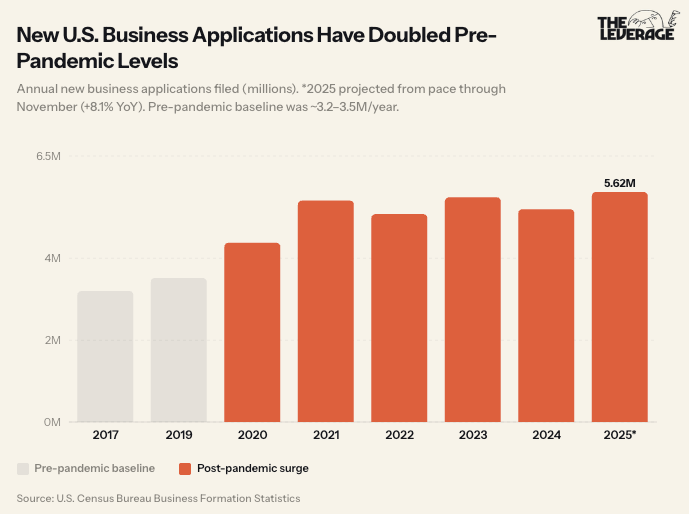
And despite all the economic uncertainty of the last year, people are continuing to start new businesses.
Those businesses are growing remarkably faster too. The recent Stripe annual letter noted that, “This new cohort [of companies started in 2025] is by far the highest performing and fastest moving we’ve ever seen, growing around 50% faster than the 2024 cohort. The number of companies reaching $10 million ARR within 3 months of launch was double the 2024 count.” Don’t forget that AI adoption is growing exponentially too. Anthropic is likely the fastest-growing B2B company of all time, and OpenAI is among the fastest growing consumer businesses.
So we have an environment where new businesses are forming faster, growing faster, and AI adoption keeps growing.
I really started to think about the idea of being a hyper-creator because it has been happening to me. The Leverage has seen a similar acceleration. Last year I would be proud just to publish 2 well written pieces a week. This year, I’ve been publishing multiple times a week, making YouTube videos (my latest just dropped on the SaaSacre!), taken on 3 consulting projects, sold multiple ad packages, am planning The Leverage’s first two live events in May and June, am writing a mini-book on AI and education, on and on.
Hyper-creator has moved from a theoretical idea to my economic reality. The business I am running now would’ve required multiple staff just a few years ago, and now it’s just me, my dog, and a pile of empty Diet Dr Pepper cans making this all work. (Full disclosure, I have a few freelancers whom I use for <5 hours a week of work, but even in that department I have spent about 60% less on freelancers than I did last year.)
I am early, but I think this new way of working will eventually be required of everyone. Dramatically higher expectations of output, and, hopefully, dramatically higher earning potential for those with the unique combination of distribution and taste.
The barbell economy
Long-time readers know that I have a passionate love affair with the economist Ronald Coase. He sought to answer a basic question. Namely, why do companies exist? His answer, which eventually won him a Nobel Prize, was transaction costs. It’s expensive to find people, negotiate with them, and coordinate their work on the open market. Companies form because doing all of that internally is cheaper than contracting it out. A company grows until the cost of managing one more person internally equals the cost of just hiring a freelancer.
AI flips the stable state that Coase’s equation has had for nearly a century. When an agent can do your research, write your emails, design your graphics, build your app, and manage your workflow, the cost of coordinating with yourself collapses to nearly zero. It is cheaper and faster to coordinate with AIs than humans. Your only transaction cost is a $200-a-month Claude Max subscription.
Twenty years ago, Chris Anderson identified this dynamic from the demand side with his Long Tail thesis: when you remove distribution bottlenecks, the market fragments into millions of viable niches.
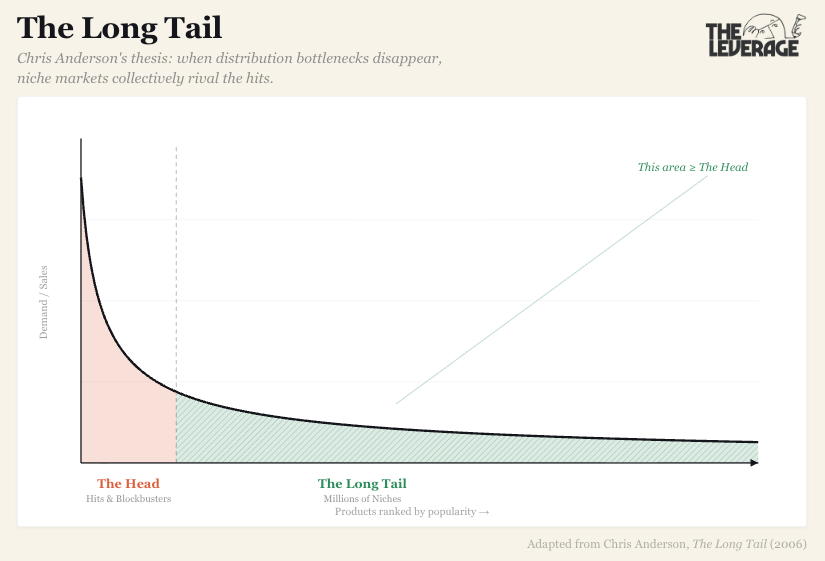
What Anderson didn’t quite get right was the supply side. Sure, the internet enabled demand for niche content and products, but creating for those niches was still expensive. The hyper-creator is what emerges when both sides of the equation unlock simultaneously—infinite niche demand meets near-zero creation cost.
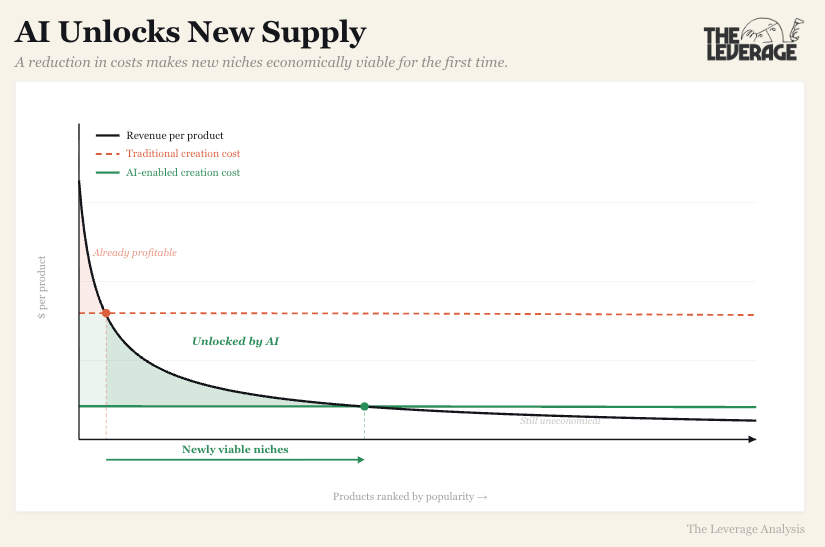
But this future has a dark side, and I’d be a fool to ignore it. The hyper-creator economy produces a barbell. On one end: millions of empowered individuals building profitable businesses around their taste and distribution. On the other: the mega-platforms these creators depend on, capturing the aggregate value. The middle gets hollowed out.
And my first law never stops applying! As creation costs fall to zero, the resulting flood of content makes distribution exponentially harder. Every new hyper-creator makes the game harder for every other one. The niche you’re serving today could be flooded by AI-generated competitors tomorrow, and the platforms you build on could change the rules anytime they want.
In short, this is likely a variation of the “get rich now or join the permanent underclass” meme.
It is deeply unclear to me what the equilibrium will be. Is it a million people each earning ten million dollars? If there are a million people competing fiercely for niches, the winners likely cycle faster than ever. The platforms will even encourage it, because increased creator competition just results in increased revenue for platforms.
Still, until that day of competitive death comes, there is a window of opportunity to build a business that is deeply personal and highly lucrative. These sorts of opportunities are rare, which is why I’m writing this to you.
Which, ultimately, might be the point. As I wrote last year in defense of starting a “bad” business: “I’m not interested in empire or wealth, I’m interested in paying my bills and spending every minute of my time on labor that brings me delight.” The hyper-creator model is about building a life — one where your work is genuinely yours, where the economics are good enough to keep going, and where taste and your fans are the only moat that matters.
For paying subscribers, these are the tools, new media formats, and workflows I'm currently using to transform my life, and by extension, The Leverage into a mode of hyper-creation: