


My friends, I am fired up this week. I always know I have a good edition on my hands when the newsletter is easy to write because my frameworks predicted the news months ago. I guess what I am saying is that there is no better feeling than saying, “I told you so” to tens of thousands of people. (That is like 60% a joke.) What actually gets me excited about editions like this is that it gives me confidence that what you are reading is providing tangible, predictive value for the time you invest in reading. Today, I was right about the future of SaaS, robotics, and what is happening in the book self-publishing industry.
But first, this edition is brought to you by a new sponsor for The Leverage, Span.
Let me say something heretical—you are spending too much time worrying about what model to use. New research from Span suggests bigger returns can happen by changing three specific habits.
Span analyzed agent use across 103 engineering teams and scored every session on 3 variables teams already control: prompt clarity, environment readiness, and quality stewardship. The associations were large. A 1-point gain in prompt clarity correlated with roughly 27% lower token cost per merged AI-authored line. A 1-point gain in environment readiness correlated with roughly 88% more merged code per human turn. A 1-point gain in quality stewardship correlated with roughly 39% fewer review cycles.
When they told me these stats, I didn’t believe them at first. These gains are huge. But it makes intuitive sense. Model selection happens a few times a year while you use those 3 levers for every task. They wrote a report on how to significantly improve your prompts and coding agents. You can read it below. I’ve started saving mountains of tokens since applying its advice!

Make something beautiful. The urge to create is closer to a biological imperative than a hobby, but for 30 years the web crushed it into filters and bios because building anything real took skills almost nobody had. That’s finally over. My belief is that AI has made creation cheap enough that ordinary people can finally build their own corner of the internet. It is on us to make the internet more creative, more independent, and more us. On August 13th I’m gathering 50 writers, designers, and builders in San Francisco to prove it. There will be dinner, unlimited tokens, a guest speaker, and absolutely no pitch decks. It’s completely free. Read and register here.

If you believe in AGI, you can’t also believe in open-source models. On Friday, 25 companies signed a letter titled “Open Weights and American AI Leadership,” asking Washington to avoid “premature restrictions” on open-weight models. The signatories are most of the biggest names in AI including Nvidia, Microsoft, Meta, Palantir, Andreessen Horowitz, Y Combinator, and—curiously—OpenAI. To state the obvious: these people are not altruists. There are trillions of dollars of market cap riding on the current policy regime staying exactly where it is.
The four largest hyperscalers have guided to roughly $700 billion in combined capital expenditure for 2026 alone. That number is only rational if the capability curve keeps bending upward. Meaning, whatever follows Mythos/Fable is just as mind-blowing, and then the one after that, and after that. You get the idea. Nvidia’s entire valuation is this bet. Microsoft’s capex is this bet. Nobody spends $700 billion a year on a technology they expect to plateau.
It’s just really weird to spend like we will add mega-mucho-spooky capabilities for the next five years while also lobbying like those same models are safe to hand out on every streetcorner. Feels like you have to pick one! Either the curve is real, in which case publishing frontier-class weights is indefensible in the long run, or the weights are harmless, in which case this is the largest misallocation of capital in corporate history and the honest letter would read “AI is overhyped, plz ignore us.”
Once the weights are on the internet, anyone can fine-tune them however they see fit, and it is relatively easy to remove model safeguards when you do that. If you believe scaling laws hold, you believe these models will eventually be dangerous in the domains like biology and cybersecurity. That eventually is very, very soon. Like in the next 24-36 months malicious actors will be able to fine tune models to cause serious harm. Open weights mean handing that, unfiltered, to whoever downloads it.
And if you believe we actually reach AGI, then it feels fairly clear that we shouldn’t have that as open weights! A misaligned closed model is a lab’s containment problem. A misaligned open model is everyone’s. You don’t even have to fully buy the Skynet scenario. You just have to notice that the people spending $700 billion a year to build the curve are simultaneously lobbying against any change at all.
And maybe there shouldn’t be any change, it’s just that this entire discourse feels deeply manipulative and shallow. Nuance is not welcomed by our corporate overlords when trillions are on the line.

The context layer got a term sheet. Accel and ICONIQ put $34 million into Paper this week, a design tool built with AI agents in mind. Every element on the canvas is HTML code that agents can read and write directly. Because AI can create infinite designs objects, what matters is building a system to control the output. This is the asset Paper is built to capture. Figma spent a decade winning the file by making it ever better to design things in the browser. Paper is a bet that the file isn’t the long-term prize. In February I wrote Context is King, arguing that as models commoditize, value migrates to whoever holds context in a form AI can actually use. Paper is that thesis applied to design.
Robots are the next big thing but no one knows exactly how it’ll work. Travis Kalanick’s Atoms raised $1.7 billion from a16z to build a holding company where, in his words, the CPU is manufacturing, the storage is real estate, and the network is transportation. Which are perfect founder nonsense words, but whatever. Really, this is a bet that robotics is a market, and conglomerate scale wins it. Humanoid, a 50-person London company with zero revenue, raised $152 million at $1.35 billion, roughly $27 million of valuation per employee, on the bet that the general-purpose humanoid is a general technology. Then there is Gritt, which exited stealth with $34 million to own one vertical, construction, by wedging in through one niche: placing solar panels with sub-millimeter accuracy. The same eight-person crew that installs 800 panels a day by hand does 3,000 to 4,000 with Gritt’s systems, running on rented skidders and off-the-shelf Kawasaki arms, with Gritt selling only the intelligence.
If Kalanick is right, robotics is private equity with better PR and the returns go to whoever owns the most assets. If Humanoid is right, its foundation model economics in atoms, winner takes all, and everything else is a dead end. If Gritt is right, the robot itself commoditizes the way the PC did, hardware margins go to zero, and the profit pools sit in software running on machines anyone can rent. I mapped these exact three paths in November in Who Actually Makes Money When Robots Work?, back when the funding was $12 billion instead of this week’s billion-and-a-half. The framework held up!

Slop doesn’t have to be good. It just has to be infinite. Researchers analyzed the full text of 14,419 self-published genre-fiction ebooks sold on Amazon between January 2023 and March 2026. 20% were substantially AI-written (over 25% of the text detected as machine-generated), but those books captured only 12.1% of sales and 11.3% of revenue. Don’t get too excited though! AI books are selling better than you think.
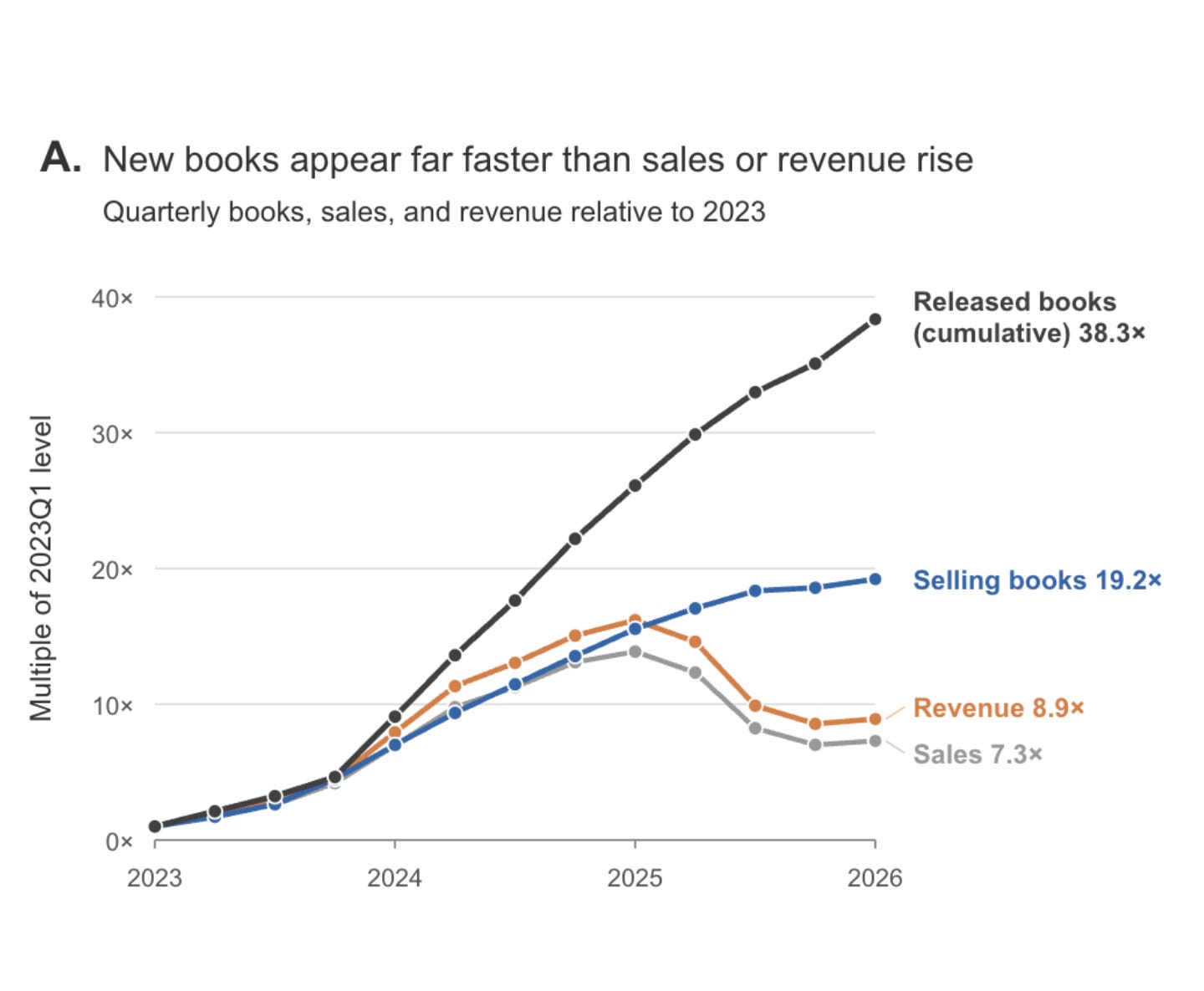
Books recording quarterly sales grew 19.2x over the study period while revenue grew only 8.9x, which means revenue per title fell by more than half in 3 years. Launch revenue for fully human books dropped 17.3%, with the worst damage in the genres AI colonized first.
And at the top: by early 2026, books with detected AI text made up more than a third of all sales and more than a third of the top-25 bestseller positions, up from nearly nothing in 2023. A billion trillion token monkeys will eventually write AI Shakespeare.
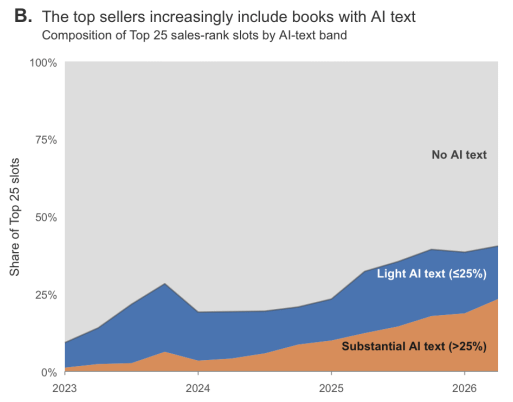
The study is observational, not causal, but the mechanism is exactly what I’ve been describing with the Sloppening. AI is bad on average, but makes up for it on sheer volume. Eventually, human labor gets crowded out. Books are just the first creative market small enough to measure it in. Expect this to happen everywhere.

C.S. Lewis understood grief. Reader Jason Lankow reached out after reading my article about LLM poetry, and how it helped me wrestle with difficult personal circumstances. He recommended that I check out C.S. Lewis’ A Grief Observed. It has been maybe 10 years since I last cracked open one of his books, but oh my, this was achingly beautiful. It is a compilation of journal entries that he wrote after his wife of only a few years died of cancer. It is dangerously vulnerable, and most usefully, not a self-help book. It is his grief, his experience, without the trite advice that modern publishing would insist on. Reading about his pain helped me through my own. You can fly through it in less than 90 minutes—highly recommended. Thanks Jason!
Go and be kind this week,
Evan
Sponsorships
We are now accepting sponsors for the Q3 ‘26. If you are interested in reaching my audience of 35K+ founders, investors, and senior tech executives, send me an email at team@gettheleverage.com.