


On August 13th, 50 writers, designers, developers, and other creative technologists will gather in San Francisco to build beautiful, useful personal websites. We’ll feed you dinner, give you unlimited tokens, and hear from an amazing guest speaker. This is an evening for being wildly ambitious, wonderfully weird, and surrounded by other people pushing AI toward more creative ends. Join us. The event is completely free.
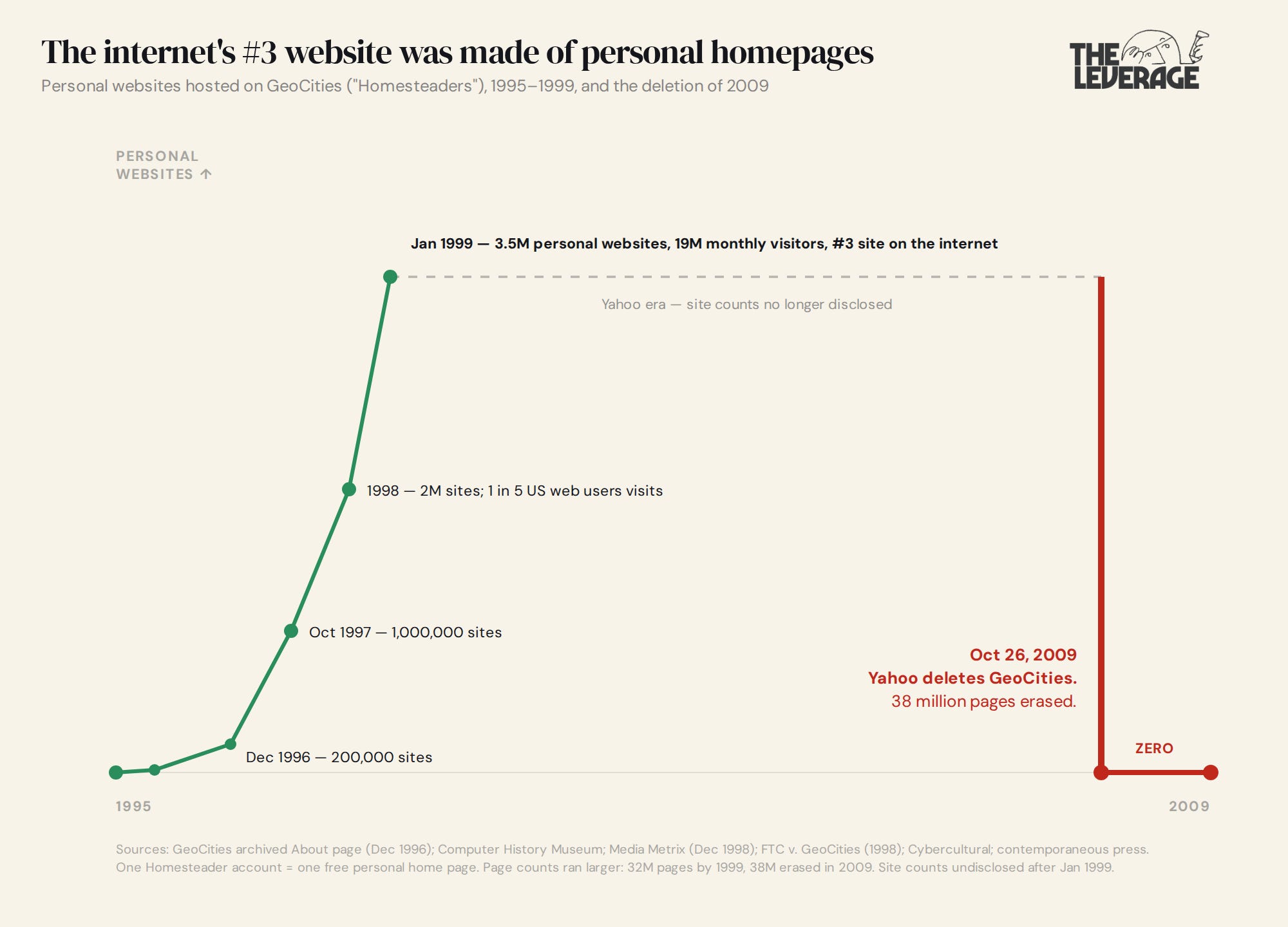
For a brief, wonderful moment in 1999, the center of the internet was ordinary people expressing themselves. GeoCities was the third-most-popular website in the world; a digital playground where people made pages that were beautiful or ugly, useful or useless. At its peak, 19 million monthly visitors wandered through 3.5 million personal sites.
Then Yahoo bought it for $7.2B [inflation adjusted]. Over the next decade, it let the place decay.
Its new corporate overlords never found a durable business model. The attempts at targeted advertising and e-commerce failed. Revenue never meaningfully appeared. Then social networks made posting and browsing content dramatically easier, winning the attention wars. The combination knocked GeoCities out of the fight.
In 2009, Yahoo shut the service down. Thirty-eight million personal web pages disappeared. It was something like a modern-day burning of the Library of Alexandria—one of the great losses in internet history.
Online competition is brutal because attention moves with almost no friction. GeoCities let people create and host whatever they dreamed up, but building a website still required skills most people had no desire to acquire. The platforms that trounced it learned that consumption was easier than creation, then designed themselves around slippery, slick ease.
There was also a threefold rot at the heart of GeoCities:
No ownership. Creators didn’t own the pages they made.
Distorted incentives. Yahoo had to Frankenstein a business model onto this wellspring of creation instead of letting makers choose whether—or how—to monetize.
They didn’t give a damn. Creation is sacred; making is divine. Yahoo saw end products to monetize and eyeballs to harvest.
Those failures feel familiar. From Instagram to LinkedIn, the platforms where we publish and perform, ask us to pour our work and our identities into rented space. They can change the terms whenever they like.
Now, finally, we all have the tools to fight back.
Using AI to Arm the Rebellion
Much of what we hate about the modern internet is an artifact of scarcity. For 30 years, the ability to build on the web belonged to a small priesthood of professional software engineers. Everything else flowed downstream from that fact. When almost nobody can create, platforms optimize for the thing everybody can do: consume. Appetite is universal; technical ability is scarce. A consumption economy was the natural result.
But we are makers by default. I saw it when my daughter first picked up a crayon and immediately drew on everything—my walls, the furniture, Daddy’s face. Among the earliest traces our ancestors left behind are tools and cave paintings. We all want to say, “Hello, world.”
Nobody has to teach us this. The desire to make sits closer to a biological imperative than a lifestyle choice. The bent-necked, thumb-cramped posture we have assumed, our fingers flicking endlessly over glass, is learned behavior. We accepted the training because the alternative demanded skills most people could not acquire.
So our maker impulse was compressed into the little slot machines the platforms sold back to us. Our creative instincts were relegated to filters, bios, and quips. We have been decorating rooms in a building someone else owns, on terms someone else can change.
AI fundamentally changes the unit economics of creation. Custom software is radically cheaper and faster now. A website no longer needs to be a product, a resume, or a scalable business. As Robin Sloan wrote, “an app can be a home-cooked meal.” More importantly, ordinary people can build their own domains, with code they can keep, on terms they choose, all while knowing absolutely nothing about code.
Now, software can carry emotion—a writer can build a robot poet to process his grief. It can be a resume that is a car driving game. What I want from Silicon Valley is more things we would never pitch. I want bad businesses, deeply irrational creations, software useful to twelve people and beloved by all twelve.
On August 13, 50 of us will test that idea in San Francisco. There will be no pitch decks, no capital being raised. Just personal websites, honest expressions of our weird future, built for reasons that matter to the people making them.
If you can be in San Francisco, join us.
Make something beautiful.