



Here is how work used to happen. You would hire a human to do a task. Hiring more humans meant more tasks getting done. When the costs of communicating between those humans got too high, you would hire a manager to centralize that coordination. Technology’s job was to reduce coordination costs and increase task throughput. Easy peasy, monopoly man squeezy.
I’ve been asking myself how, or if, AI changes that.
For example, my friend Nat has an “autonomous business” run by an AI agent that’s made $102K in the last 30 days. That is a crazy sentence to type! But Nat is still running the business by giving the AI agent direction on what to build and help with distribution through Nat’s social media. I can’t help but wonder if this is truly materially different than how business has always been done.
Not to be glib—but this ultimately comes down to The Leverage™ Nat can get out of his time. (Like the name of this publication! Almost like I planned for this sort of thing to happen when I named it!). AI enables Nat to do more, be more ambitious, be more daring with his work. Therefore, the call for technology companies is to redesign their products to raise the ceilings of possibility, not merely automate the way labor used to work.
This week was full of evidence of how painful—and lucrative—that transition is going to be.
But first, this edition is brought to you by one of the tools that gives me the most leverage, Granola.
I’ve been using Granola as my meeting note-taker for months, but their new MCP integration is what turned it from a nice-to-have tool into genuine infrastructure.
Here’s my workflow: I take about 10 calls a week with founders, investors, and operators to help me write quality research. Often, the best insights from those conversations used to just...evaporate. I’d have some half-formed thesis sitting in a transcript I’d never reopen and would promptly forget about. Now, when I’m writing, I can pull directly from my Granola notes through Claude via MCP. It connects the dots between what a robotics founder told me three weeks ago and the earnings data I’m analyzing today.
This is the actual promise of AI note-taking that most tools miss. It’s not about summarizing your meetings (commodity feature, everyone does this). It’s about making your conversations compounding assets—searchable, connectable context that feeds into your real work. It doesn’t just work for writers, everyone from founders to scientists love using Granola.
If you’re doing any kind of research or analysis work, Granola is worth trying. Readers of The Leverage can get their first month free using the link below. Highly recommended!
MY RESEARCH

The rise of hyper-creators. In a world where people like Nat can produce significantly more products than they used to, what happens? There will be new bundles offered by individuals that are centered around a vibe, a perspective, a way of examining the world. For the next few years, there is a chance to build a multi-million dollar empire for yourself. Read how here.
SaaS is breaking…what comes next? I have some thoughts on what happens when applications become essentially free. Watch here.
WHAT MATTERED THIS WEEK?

BIG LABS
OpenAI’s engineers aren’t writing code anymore. The Department of War’s golden AI supplier published a blog post last February that has filled me with melancholy all month. The post titled “Harness engineering: leveraging Codex in an agent-first world” talked about how the company had a team of engineers build a product with “0 lines of manually-written code.” This resulted in a wild increase in efficiency. The firm estimated that they built the product in “about 1/10th the time it would have taken to write the code by hand.”
It wasn’t like they just said “Codex, go make me a product.” Instead, the engineers graduated to thinking about systems versus code. “Humans always remain in the loop, but work at a different layer of abstraction than we used to. We prioritize work, translate user feedback into acceptance criteria, and validate outcomes.”
Building something in 1/10th the amount of time is such a profound acceleration that there is little doubt in my mind that this will be the future of software engineering. How could it not?
Still, that sense of melancholy has persisted. This week, I put my finger on why I was so disconcerted—by moving to a “different layer of abstraction” engineers were moving away from the deep pleasure that comes from knowing how a thing works.
Maintenance is a spiritual pursuit. Every action that takes us further from understanding how the world works, no matter the economic rationale for doing so, is one where we lose a sense of who we are. For more on this feeling, please read my review of Stewart Brand’s Maintenance.
BIG CODE
Is Cursor doomed? It is hard to worry about a business that has hit two billion in annualized revenue, but still, the vibes around AI darling Cursor are distinctly off. The Cursor team strategically leaked that their annualized revenue had doubled in the last 3 months to help calm some of the comments on X, but revenue today is not strategic power tomorrow.
I’ll allow the Cursor CEO and cofounder to explain what has shifted,
“When we started building Cursor a few years ago, most code was written one keystroke at a time. Tab autocomplete changed that and opened the first era of AI-assisted coding.
Then agents arrived, and developers shifted to directing agents through synchronous prompt-and-response loops. That was the second era. Now a third era is arriving. It is defined by agents that can tackle larger tasks independently, over longer timescales, with less human direction.
As a result, Cursor is no longer primarily about writing code. It is about helping developers build the factory that creates their software.”
TL;DR is that the product strategy that got them to that two billi in ARR is essentially kaput. They now need to pivot to helping engineers (and everyone else) manage a fleet of agents that are building software for them.
Unfortunately, this is the exact vision that both OpenAI and Anthropic have. When you have key suppliers trying to move downstream into your market, you have to vertically integrate. To do so, the Cursor team has staffed up with AI researchers who are fine-tuning open-source models from China for coding.
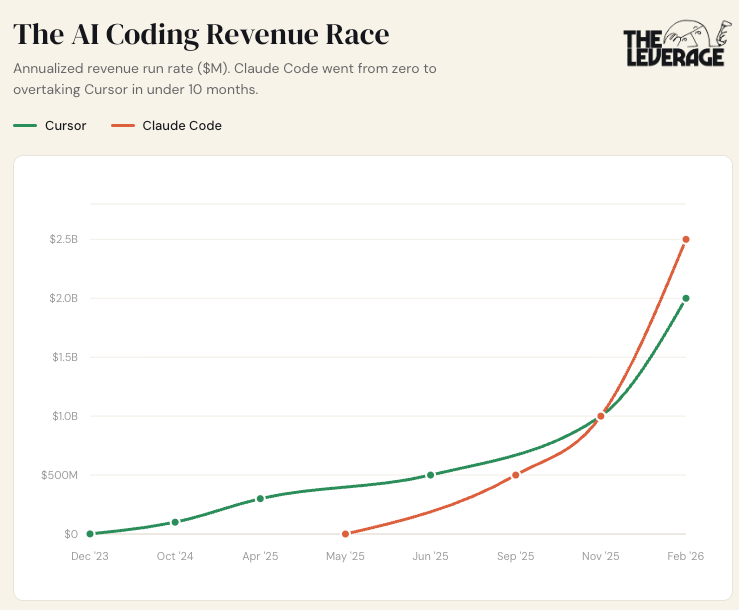
I am one of the few, the proud, people who still believe Cursor can win. Selling a software factory comes with much higher costs. My friends who are fully Claude Code-pilled are easily spending $100K+ in tokens. So if Cursor can come to enterprise CTOs and say “we give you the security and controls of OpenAI at 1/10th the cost,” they’ll continue to build a huge business. Now all they have to do is pull this off.
THE LABOR
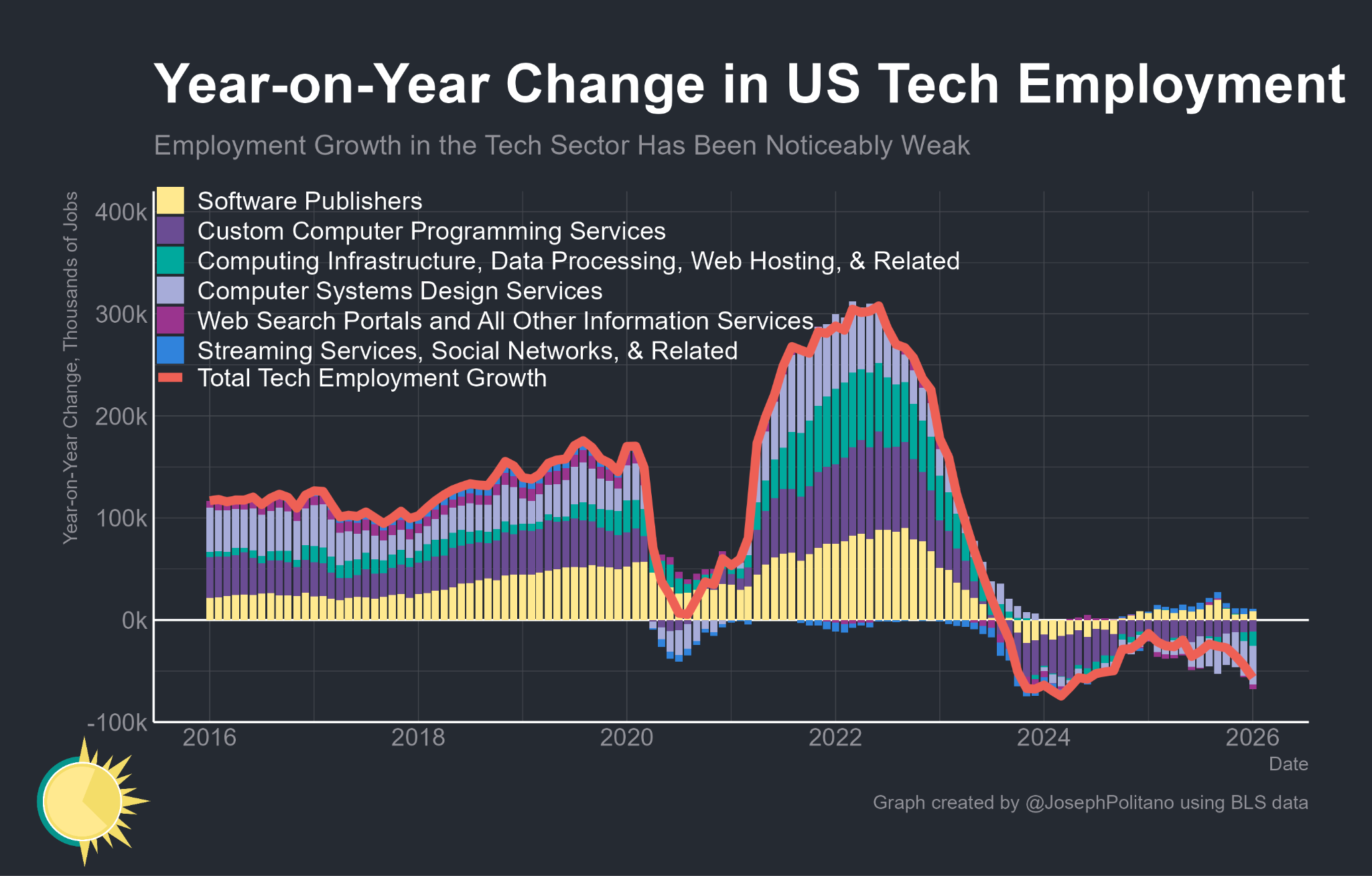
Two things are simultaneously true about tech hiring:
We are in a period of wild job loss as companies shed excess staff from Covid and use AI as an excuse to do so.
AI’s increased leverage does mean you should staff your company profoundly differently. Appropriately structured firms can’t hire fast enough.
The disconnect is that there are very few companies that fall into the latter category. As such, we are in a period of job loss in the tech industry.
TASTEMAKER

Three recommendations this week:
An album to put some hair on your chest. As part of Operation Dad Bod, I’ve been hitting the gym a lot more this year, and accordingly, have been back into rock in a big way. My favorite record recently has been “Something to Consume” by Die Spitz. Highly recommended if you are seeking an otherworldly pump. Listen here.
A live rendition of one of my favorite songs. Rosalía’s Lux was my favorite album last year. Beautiful, aching, artistic: it pushed the boundaries of what a popular album could be. She just performed at The Brits in an iconic set that included guest artist Björk. Watch it here (warning, this is super European).
Have a kid. I am going to finish typing this sentence and go get a hug from a little toddler who wants nothing more in this world than to see me. There is literally nothing better.
One last ask—I’m trying to get to know all of you better. Would you mind spending two minutes filling out this survey? It’ll help me make this newsletter more useful for you.
Go and be kind this week,
Evan
Sponsorships
We are now accepting sponsors for the Q2 ‘26. If you are interested in reaching my audience of 34K+ founders, investors, and senior tech executives, send me an email at team@gettheleverage.com.
I know it is a very stupid question but what exactly is the business of your friend Nat. It was not very clear from that link.
I find that all the amazing ai successes right now are companies selling shovels. Would love to see more examples of other categories
I think it's interesting what you said about your friend using social media for distribution. Social capital has always been an advantage but now one person is like a little factory that builds and distributes within the ecosystem of their own life.