


Here’s the problem with New Year’s resolutions: they assume the issue is timing. As if you’ve been waiting all year for the right moment to start, and now—finally!—the calendar clicks over and you can begin.
But the timing was never the problem. The problem is that the person who makes the resolution on January 1st happens to be the same person who will be asked to execute it on January 15th and February 3rd and all the days after that. And that person—you, I mean, and also me—has a lot of practice being who they already are.
You weren’t great at following through in November. You probably won’t be great at it in February either. Not because you lack willpower or discipline or desire. But because you’re still you. The resolution asks you to behave differently while remaining the same person.
This is like asking a Toyota Camry to win the Indy 500. The Camry is a fine car. Reliable. Good mileage. But it’s not going to win the Indy 500. Not because it isn’t trying hard enough, but because it is a Camry.
And then I found the answer to this “I suck no matter what month” problem, of all places, in a linguistics study.
The second self
There’s a Czech proverb that can be poetically translated into, “Learn a new language and get a new soul.” I always assumed this was decorative-pillow wisdom—the kind of thing that sounds profound but collapses under any scrutiny. Then I read about an experiment that made me reconsider.
In 2012, psychologists at the University of Chicago took native English speakers who’d learned Spanish and presented them with betting scenarios. Half saw the scenarios in English, half in Spanish. When thinking in Spanish, participants were 71% likely to take favorable bets. In English? 54%.
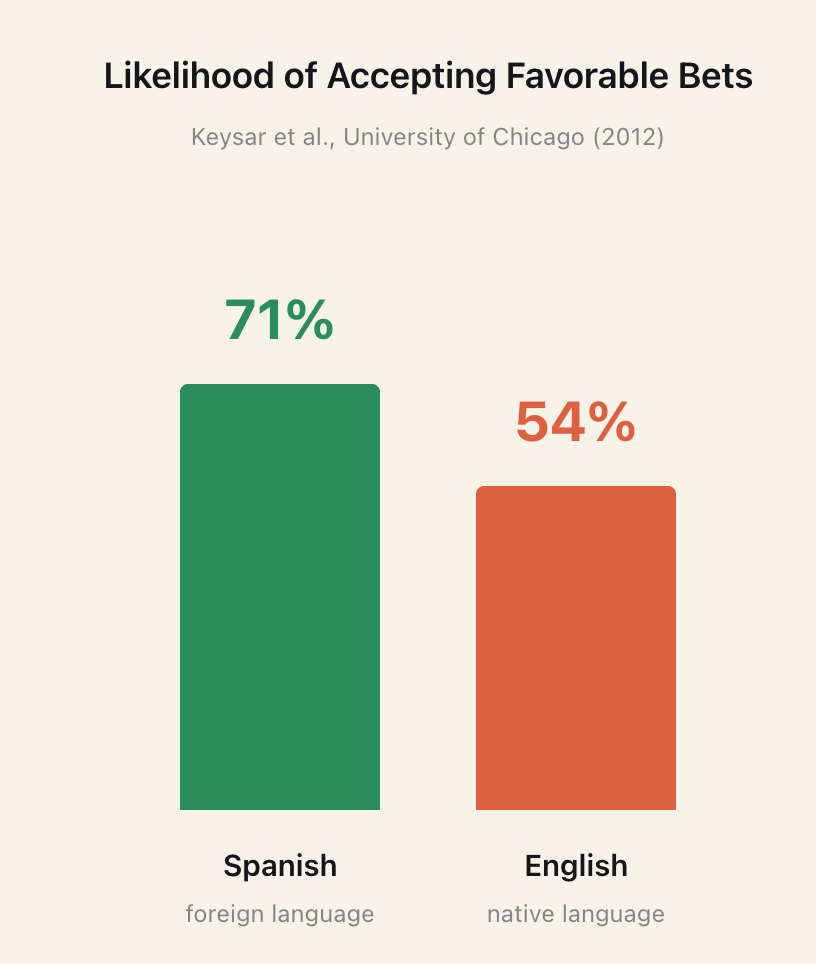
Speaking in another language created what the researchers called a “psychological distance” from your emotions. You didn’t process your childhood fears in Spanish, or your zitty teenage heartbreaks, or any of the ten thousand lost Draftkings bets that taught your nervous system to be cautious. Spanish is a room in your mind that your trauma hasn’t found yet.
“A foreign language provides a distancing mechanism,” lead researcher Boaz Keysar explained, “that moves people from the immediate intuitive system to a more deliberate mode of thinking.” Their conclusions were validated in a meta-analysis of 47 different experiments.
This is what the Czech proverb actually means. That Spanish gives you a new you, unburdened by the emotional baggage of the original. As a person whose Spanish consists entirely of “¿dónde está el baño?,” I wondered if you could get that effect without spending years becoming fluent. Is there a way to create that psychological distance—to access a version of yourself that isn’t trapped in the same loops, making the same mistakes, flinching at the same fears?
As it so happens, French post-modern philosophy may have the solution.
The technologies of self
The French philosopher Michel Foucault spent the last years of his life studying what he called “technologies of the self”—practices that “permit individuals to effect...a certain number of operations on their own bodies and souls, thoughts, conduct, and way of being, so as to transform themselves.”
That’s a mouthful. But what Foucault pointed out was relatively simple. Humans have always built tools to reshape who we are.
The Stoics had their evening self-examination—every night, reviewing the day’s actions, asking where they’d fallen short, planning corrections. The Pythagoreans had dietary rules and sleep schedules and prohibitions on certain behaviors. The monastics had their hours of prayer, their fasts, their vows of silence. These weren’t just religious rituals or lifestyle quirks. They were engineering practices for the soul—external structures designed to produce internal transformation.
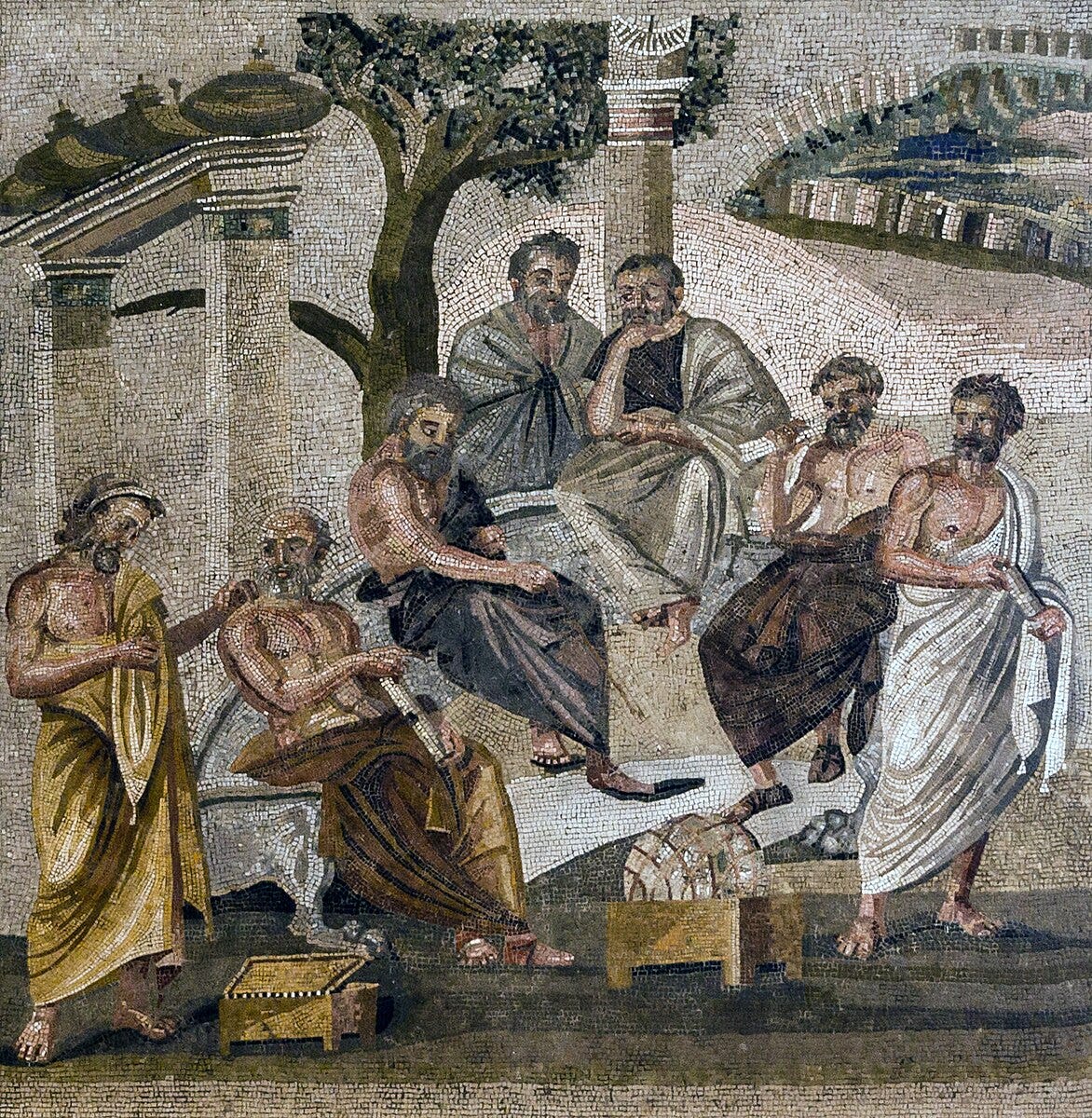
“From the idea that the self is not given to us,” Foucault wrote, “I think there is only one practical consequence: we have to create ourselves as a work of art.”
And yet despite the best efforts of the Greeks, every religion ever, and the might of Xerox PARC, we have yet to build a technology that universally causes the betterment of the inner man. So I wondered if the obvious thing—could AI be the technology that finally results in lasting change? We have some directional evidence that this could be the case. Multiple studies this year have shown that if you can get someone to sit down with a chatbot for 10 minutes, you can seriously alter their political views. Could we somehow invite a similar change to someone’s interiority?
I believe yes.
The personal strategy system
My theory is that the reason resolutions fail isn’t lack of motivation. It’s that the system for keeping resolutions requires you to remember to work the system.
The Stoics tried to solve this with external structure—the evening examination, the philosophical community. But most of us don’t have a philosophical community. We have a Notes app full of abandoned lists and our evenings are filled with screaming children who will only eat mac and cheese. Who has time for a philosophy community? What I wanted was something that combined the persuasive nature of chatbots with the measurement of a traditional business planning process.
I was surprised that nothing like this really existed. There are therapy chatbots, but the applications hold all your data hostage, and they require subscriptions. There are journaling apps that have some AI features built in, but they lack the conversational back and forth I wanted, and they couldn’t do the long-term goal management.
So, I decided to build it for myself. I’m calling it a Personal Strategy System, and it’s to help you build the “second self” that is key to the foreign language effect. When you talk to an AI about your goals, something strange happens. You have to articulate things you’ve never said out loud. You have to explain your rationalizations to something that doesn’t automatically accept them. The AI doesn’t know that you “always” fail at this and doesn’t share your assumption that you’re bad at follow-through. It just asks: what do you want, and what’s stopping you? Doing this feels distinct to my previous conversations with career coaches or therapists, it’s a co-built second identity, one of a person who actually does their new years resolutions.
The system has three layers:
Quarterly planning conversations. Every three months, you sit down with Claude and have a 30-45 minute conversation about who you’re becoming and what you want to accomplish. The AI pushes back on your rationalizations. It helps you identify what you’ll say no to—which is the actual hard part. Then it forces you to commit to 2-3 things.
Weekly check-ins. Five minutes. What happened, what’s blocked, how you’re feeling. This is the part that usually falls apart—nobody maintains a journaling practice. But the AI is waiting for you. It remembers what you said last week. It noticed you haven’t mentioned that goal in three weeks. It’s harder to lie to something that has perfect memory and no stake in believing you.
Pattern recognition. This is what makes it different from every productivity system you’ve abandoned. After enough check-ins, the AI starts seeing what you can’t—that your energy craters every third week, that you keep avoiding the same goal with different excuses, that there’s a blocker you’ve mentioned six times without ever addressing. It gives you the outside view on your inside life. The view your friends are too polite to offer and your therapist only sees for fifty minutes a week.
I think AI changes that. I think it’s the first technology that can give ordinary people access to their second self—the one who isn’t flinching at the same old fears, who can see their patterns from the outside, who can finally answer honestly because they’re not performing for anyone.
If you want to build a second self: I’m releasing the Personal Strategy System for $10. No subscriptions, just a flat fee. The system works by pairing several Notion databases together with an integration into the LLM of your choice. It takes maybe 3 minutes to set up and then you are on your way. If you want to try it out, you can get access via the button below.
Love it! Operating off of a similar theory of why change doesn't happen (but without the great context of the study and philosophy you cite!) I have been building my own version of this as a local Mac app. See I think there is still a fatal flaw in your system, if I understand its workings correctly: it's still you exercising the reminders and self-discipline to go ask the AI about stuff. It's still the ancient practices, now your "philosopher community" is just AI.
What I'm building is the helpful friend who pokes their head into your office or texts or knocks on your door to ask: "Hey, how's it going? Did you do that thing you said you wanted to do? Ah OK, what got in the way? Yeah, I understand. Do you still want to try to do it? What do you think would make it easier?", who will be the one checking-in with *you* at the end of the week, asking you if you want to do your Quarterly planning, etc. And remembering everything along the way as your system does. It's the *active* aspect of it that I think is critical though, and the fact that it lives in my constant work environment: my local computer (and eventually on my phone; already prototyped another Android app so I'm confident with mobile dev now).
I'll be trying to share more about the tool I'm building in the near future, and will be keen to hear how yours is working for you over time! If yours had the more active check-in aspect to it I'd already have bought it to see how it compares, but I do consider that key to at least what I think *I* need. If I've assumed too much about your system's workings let me know!
What a sublime idea ;)
Would be keen to at least give it a go.
Keep writing Dear Evan.
Wishing you a beautiful 2026!