


Request for startup: I am on the hunt for companies who actively elevate their users’ taste. Is there any product in your life that you feel makes you smarter? More emotionally aware? More tasteful? If so, please reply, I’m working on something.
This week is a good one:
My rant against the short king of Hollywood
We finally know what the new American tariff regime will look like
A 4½-hour movie that is very much worth your time
Let’s get it.
MY RESEARCH

Robots make society weird. Much of our world is designed around the flexibility that two hands and a general intelligence enables. You can give baristas dozens of little knobs to twist, and with a few hours of training, they can easily walk from station to station, pouring pumpkin spice lattes for us all. However, that model comes with important constraints. Trite stuff like respect, breaks, bathrooms, etc. Robots allow us to place businesses where they previously weren’t possible, reshaping how the world functions. And perhaps most surprisingly, we can look to the history of aircraft manufacturing as an answer for whether this weird society is going to happen.
THE SLOPPENING. The Netflix deal is economically rational and culturally barren. It represents the natural end state of the competitive nature of the internet, one where those who are willing to appeal to the lowest common denominator, and look at their customers as users, not viewers as the winners. I have some, uh, pretty strong thoughts on this deal.
Loud isn’t enough. I wrote an essay for early stage founders on how stunt marketing is not an effective growth strategy. Instead, you need to strike a differentiated position for your product, which viral marketing can then contribute to. The best person who’s ever done this is the grandpappy of SaaS, Marc Benioff of Salesforce. You can read it in the Speedrun newsletter.
WHAT MATTERED THIS WEEK?

AI LABS
Aight, AI getting people to change their politics is very real and very scary. Two very well done papers published in Nature and Science have firmly proven that AI is the most persuasive technology we have ever invented.
The first study, in Science, ran 76,977 UK adults through 91,000+ conversations with 19 different LLMs about 707 political issues, randomizing whether people see a static 200-word GPT-style message or have a ~10-minute back-and-forth chat. From there, they measured how many percentage points people move toward the position the bot is arguing for. The companion Nature paper does the same thing in live elections: thousands of voters in the 2024 US presidential, 2025 Canadian federal, and 2025 Polish presidential races, plus a Massachusetts psychedelics ballot measure, chat with a bot advocating for a candidate or side. The results are eye opening when put in comparison with some other papers I pulled:
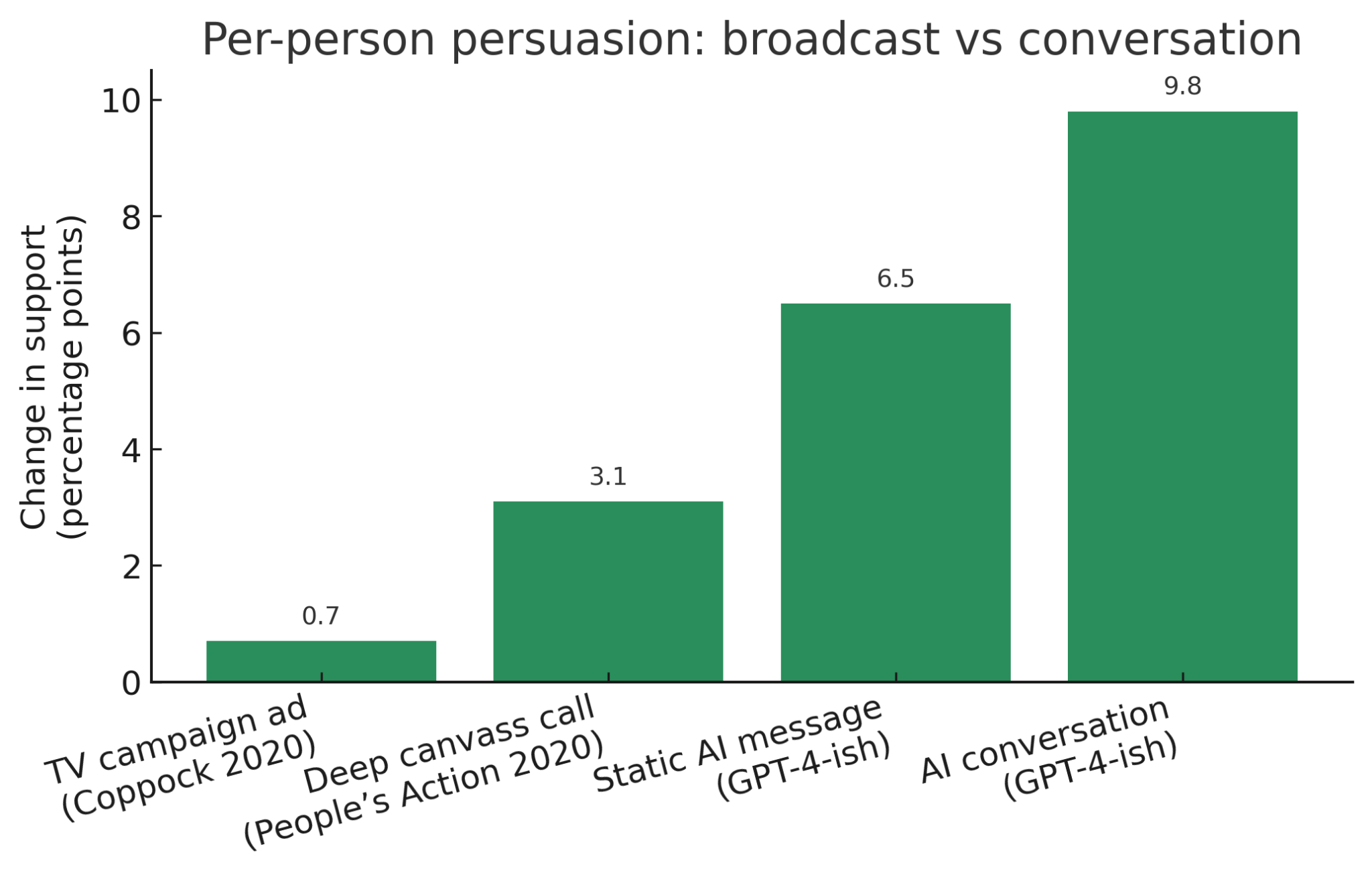
Now, of course, a ten-minute one-on-one conversation about politics is more persuasive than a TV ad barking at you while you fold laundry. Humans have known that since the door-knocking era. What makes this different is the distribution. The beauty of broadcast ads is that they ride along with content people already want to watch, so you get millions of half-attentive impressions for your dollars. Conversational bots flip that: they’re far more persuasive per person, but only if you can somehow get voters to willingly engage in a 10-minute political chat. The new world of influence will be won by finding ways to incentivize people to have these conversations with chatbots. As always in AI, when creation becomes cheap, distribution becomes expensive.
There was also a fascinating wrinkle to the studies around scaling laws. The Science paper also plotted persuasion against model size. They found a modest scaling law—about +1.6 percentage points of persuasion for every 10× more pre-training compute—but the bigger gains come from fine-tuning and prompting. By adding a persuasion-specific reward model and optimized prompts they boosted effects by up to 50%, mainly by pushing the bot to stuff in more seemingly relevant facts.
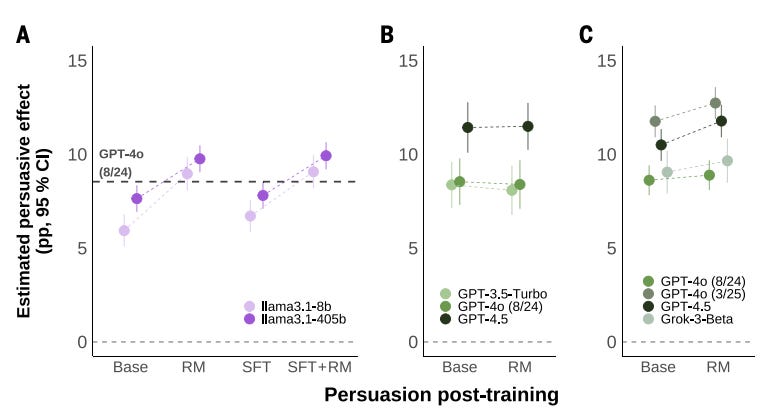
The real winners in this world aren’t just whoever owns the fattest transformer. It’s whoever owns the reward functions and datasets that tell the model what “persuasive” looks like and can train armies of bespoke political agents on top of that. However, even those may not be that much of an advantage for long (more on this in a second).
POLICY TIME
The Korean tariffs are going to hurt badly. Remember “Liberation Day?” Well those deals are finally being consummated and the U.S. and South Korea finished hammering out their version. In conjunction with the Japan deal, we now have a precedent for what the U.S. tariff regime is going to be for the countries they like. They cut their “Liberation Day” tariffs on most Korean goods from 25% down to 15%, retroactive to November 1 for autos and November 14 for most other products, in exchange for a $350 billion Korean investment pledge and a bundle of regulatory concessions. Having followed these for a while, this is what each of these deals are looking like:
A flat ~15% tax on Korean-origin imports (autos, furniture, a ton of industrial goods).
A huge headline capex number into U.S. “strategic sectors” like shipbuilding, semis, energy, and critical minerals—$350 billion in Korea’s case, with $150 billion for shipbuilding and $200 billion in staged cash investments. These strategic sectors seem to be selected on the whims of the President.
A promise to open or expand plants on U.S. soil and to treat U.S. digital platforms more gently on things like data flows and app-store rules.
The administration’s story is that these deals just make the invisible visible. For years, the U.S. had “0%” tariffs on allies while eating hidden costs: non-tariff barriers, industrial policy, IP slippage, regulatory games in cars, and digital markets. The Trump folks say the old trade agreements mispriced all that, and the 15% rate simply monetizes the phantom friction that was already there. That argument isn’t crazy! There really were a lot of quiet ways America was getting nicked. I don’t know if it amounts to 15%, and I will leave that debate to the macro-economists.
But here’s the problem for the operators and investors who read this publication. Those hidden costs move slowly; the 15% shows up on your P&L immediately. Fixing regulatory asymmetries and subtle discrimination takes years of negotiation and institution-building. By contrast, the moment this deal goes live, every Korean-origin shipment that doesn’t fit into a narrow exemption suddenly costs 15% more at the U.S. border.
This has MAJOR implications for the tech sector because Korea is a key manufacturer of the memory that data centers require. South Korea controls roughly 60% of the global memory and has a 90%+ duopoly hold over high-bandwidth memory, which is a key component in AI data centers. A 15% border toll on Korean-origin hardware is effectively a tax on the global supply chain in what is already a shortage.

Approximate distribution of where memory chips are assembled, based on vendor shares and packaging-plant geography.
So the reason to care isn’t just “trade nerds did a thing.” It’s that the price of GPUs, the geography of fabs, and the regulatory environment for your apps are now being set in the same deal—and that deal has a very simple headline number: 15%.
DEAL VIBES
Can you simulate a market’s populace? Aaru has raised $50 million at a blended valuation slightly below a billion, betting that they can. The company sells to politicians, marketing firms, or anyone else who doesn’t want to spend money on expensive surveys. Their service is having AI agents act as certain segments and then fill out those surveys instead. I am very interested in whether this idea works. There are a bunch of startups exploring the idea—I know of at least 7. The short-term value is fairly easy to see.
What’s more interesting is in what ways these simulations can act as simulated learning environments for other AI models to rely on. Is it possible that you can train models on being more persuasive to AI agents pretending to be segments of the populace you care about? That is a much bigger deal than just “cheaper surveys.”
TASTEMAKER


“And when I arrive at my destination, I’m gonna Kill Bill.” I’m going to recommend you set aside the time to go see a 4½-hour movie. I recognize that is ludicrous, but I am going to do it anyway. Kill Bill, the Whole Bloody Affair was released this weekend in 70mm as a combined version of parts 1 & 2. It is a SIGNIFICANTLY better film together than apart. When I first saw the separate films I had a good time, but I didn’t have a strong opinion on them as a work of art. However, Uma Thurman’s portrayal of The Bride is a singular work of passion and emotion that was severely stunted by the splitting of the films. One of my favorite experiences at the cinema in years. I highly recommend it!

Have a great week,
Evan
Sponsorships
We are now accepting sponsors for the Q1 ‘26. If you are interested in reaching my audience of 35K+ founders, investors, and senior tech executives, send me an email at team@gettheleverage.com.
Evan, your newsletter often helps me see one step farther. Our devices have microphones built in; whoever can replace one-way ads with an interactive AI conversation unlocking content is going to be fantastically rich. I recently rejoined Amazon Prime (I quit when they added ads to Prime Video) and the integration of things like the "add io cart" button into ads drastically simplifies the funnel. Having a persuasion bot on the front end amplifies this, and basically scales the "get X for free if you come to our timeshare pitch" model.
I'd make an argument for Pulse being an imperfect but very useful product/service. I am getting into building agents and it gives me a great daily brief on developments allowing me to go deeper one step at a time. I also have it summarize one philosophical idea per day. It's frustrating as it gets repetitive and can't remember that it's sending the same info. But having it right there in ChatGPT is useful.