



Good news! This isn’t a gift guide. The last thing you need is another email hawking the latest way to do something you don’t need. Instead, you need more knowledge, more time, more health, more focus, the kind of stuff that gives you The Leverage™ to succeed. And the good news is this email has that for you, for free. This week we’ll cover:
The $1.2 billion, soon-to-be-public company that is trying to sell you steroids.
A robotics company automating construction sites in a novel (and smart!) way
The perfect Thanksgiving movie
But first, this edition is brought to you by Framer.

A hard truth is that context switching kills momentum. Which is why it’s funny that most design tools make you choose between exploration and execution. One tool for designing, then exporting to another one, losing fidelity along the way. Or start in a website builder and constrain your creativity to templates.
Framer’s new Design Pages feature collapses that workflow entirely. You get a real design tool—vector editing, animatable gradients, 3D transforms, the whole kit. But the difference is that your design file is your production site. One click and boom, your creative product, live on the internet. Framer is the design tool that eliminates friction.
The free tier is genuinely full-featured and I’ve had a ton of fun designing personal sites for myself there. For advanced features (including some killer AI products) use code EVAN2025 for a free month of Pro.
MY RESEARCH

You Don’t Need to Own the Pipes If You’re the Water. If you want to understand the real strategic fault line in AI—not the vibes, not the hype, but the actual trillion-dollar divergence shaping the next decade—this essay is your map. In it, I walk through Anthropic’s absurd, historic revenue surge, the shockingly good economics behind Opus 4.5, and the quiet little secret that the company spending a tenth as much as OpenAI is nonetheless winning the only market that truly works today. But the real payoff is the clash of philosophies: OpenAI’s attempt to own every inch of the stack versus Anthropic’s Switzerland strategy, the bet that if you become the intelligence itself, everyone else becomes your distribution. If you care about where AI is actually going—and who’s positioned to own the future—you should read this.
Ads in AI are a good thing. You might not like this idea, but that doesn’t stop me from being right. Sourcegraph CEO Quinn Slack walks through how putting ads inside a coding agent went from “that’ll never work” to $5–10M ARR in a month, with advertisers wiring six-figure contracts at 2 AM because the leads are that good. But the really important idea is the audacious thesis beneath them: that ad-supported agents could become the demand floor for the trillion-dollar data center buildout, that coding agents might fuse Google-level intent with Instagram-level engagement, and that trust—not compute—is the true moat. I was incredibly surprised by the scope of Quinn’s ambition for his ad network, make sure to listen in or at least read the analysis I published with the interview.
9 prompts to use with Nano Banana Pro. I am more and more convinced that Nano Banana is the future. The newest model from Google disrupts existing visual intelligence software because it makes it relatively easy to generate things like slides, storyboards, or product UIs. They aren’t all that great, but for many quick use cases, they are good enough. Over the coming years, more and more of our visual assets will be generated, while those select few that are hand-crafted will have to be significantly better to stand out. For paying subscribers, get exclusive access to 9 prompts that will teach you the nuances of this model.
WHAT MATTERED THIS WEEK?

AI LABS
It’s time for science. The Trump Administration announced “The Genesis Mission” a sweeping, government-wide effort launched by the Department of Energy under direction from the White House to build a unified AI-powered science platform.
The Genesis Mission is basically the Trump administration saying, “What if we built a national AI scientist?” The order tells the Department of Energy to stand up a unified AI platform that knits together national lab supercomputers, cloud compute, and decades of federally funded scientific data into one mega-infrastructure for science. The idea is to train big scientific foundation models and spin up AI agents and robotic labs that can generate hypotheses, run simulations, and automate experiments across things like fusion, semiconductors, biotech, quantum, and advanced manufacturing—framed explicitly as a Manhattan-Project-scale push to win a long AI cold war and turn existing R&D spending into faster, more directed breakthroughs.
Should people take this seriously? Yes—at least as a signal. On its face, this is still just an executive order and a bunch of deadlines; the hard parts (appropriations, procurement, talent, and inter-agency knife fights over data and control) are all to-be-determined. But it’s also the clearest statement yet that the U.S. government intends to treat AI infrastructure for science the way it treated nukes and space in the 20th century: as a central axis of industrial policy and geopolitical power. If even half of what’s outlined here gets real money and competent execution behind it (a very big if) it will reshape where cutting-edge models get trained, who gets access to the best scientific data, and which companies end up sitting inside the choke points of this new scientific paradigm.
PUBLIC MARKETS
Attention (and steroids) are all you need. Because tech giants are so damn good at selling ads, it means that most other companies that compete in the attention economy have to dramatically lower production costs (creators), have a scarce good that fans can’t get enough of (sports), or slowly die a painful, gory death (newspapers). A fourth option is having a form of vertical integration related to your content. You sell goods related to the attention you are generating.
The Enhanced Games is a media company in the fourth category. Backed by Peter Thiel, Donald Trump Jr, and a Saudi Prince named Khaled bin Alwaleed, the company is hosting an athletic competition in 2026 that allows for the participants to be juiced to the gills on enough testosterone and growth hormones to let even your Grandma bench 225. The Enhanced Games is planning to go public via a merger that values the company at about $1.2 billion.
In addition to hosting a drug-permissive athletic competition, the company intends to generate revenue through direct-to-consumer performance-enhancement products and telehealth services, brand partnerships and sponsorships, and media/broadcasting rights tied to the Games. Basically if you watch this and feel sad about your testosterone levels, the company will then have a place where you can buy drugs to get similarly juiced.
I am not pointing this out as any form of social commentary, and take no public position on the validity of its competition. I just want to point out that its existence is directly related to the economics of online attention. Fascinating company to watch, if the IPO generates further interest I’ll have more analysis here.
DEAL VIBES
Robots for construction are finally working. A robotics startup is four things:
Body: What the robot is made of
Senses: How the robot perceives the world
Brain: What kind of software is allowed to make decisions
Ops: What happens when the robot breaks
Each company will focus on some unique combination of these four layers, with the goal of maximizing the user’s return, while simultaneously decreasing the liability that the robotics startup owns.
Most companies in Silicon Valley are focused on becoming elite at either the body or the brain. However, most people with long experience in the field will tell you what actually determines profit margins is a combination of ops, brain, and senses. Gravis Robotics, which raised $23 million this week, gets this. The company has a suite of sensors and a brain that it attaches to excavators owned by their customers.
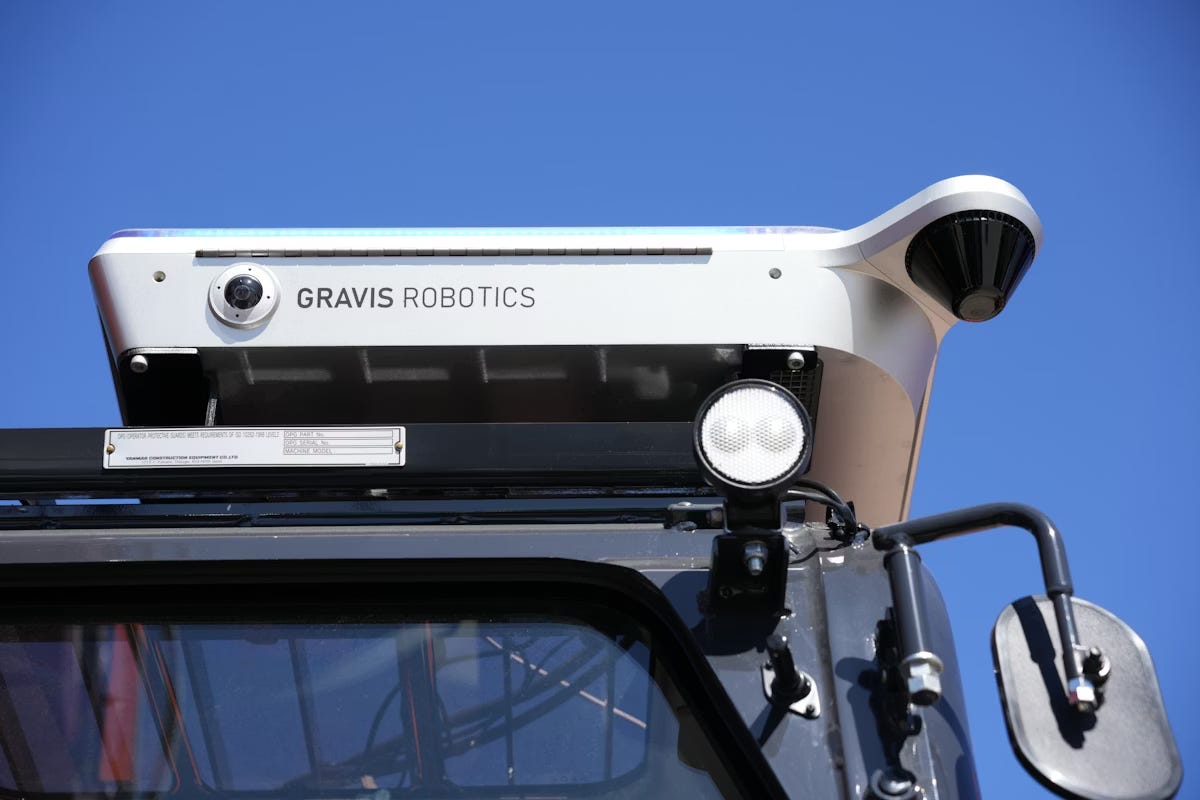
This detail is crucial. It allows their construction-company customers to increase equipment utilization while decreasing labor costs. Any time the brain or sensor breaks, you can just have a staff member take over the machine manually, meaning that the ops are mostly taken care of. Meanwhile, one person can manage dozens of excavators all from the comfort of a tablet.

This is a theme we will return to over and over again over the next twelve months. Many of these robotics startups we are covering will live or die on the basis of capital efficiency and ease of operations, not the validity of their technology. Very cool stuff!
TASTEMAKER

One film you should watch in theaters this week.

The best Knives Out yet wrestles with faith. The first two films were dominated by the impeccably drawled and dressed Benoit Blanc played by Daniel Craig. The detective’s preternatural abilities of deduction were entertaining to watch.This new film is more ambitious, gaining depth by sidelining what made the first two so popular. Instead, the story relegates Benoit to more of a supporting role alongside a priest played by Josh O’Connor. The film ends up being a loving, caring meditation on the complicated nature of faith, legacy, and on the need to turn the other cheek. Adding more of this human element allows for far more tender and sincere moments then the previous two films. This movie will receive no nominations at the Oscars but who cares—it is the perfect holiday film. I saw it with a sold out crowd this weekend and it was delightful. I could watch one of these every Thanksgiving for the rest of my life. Knives Out forever!
Have a great week,
Evan
Sponsorships
We are now accepting sponsors for the Q1 ‘26. If you are interested in reaching my audience of 35K+ founders, investors, and senior tech executives, send me an email at team@gettheleverage.com.