



I think software has changed more in the last 24 months than in the last two decades. How you construct a team, what strategies are defensible—shoot, if you even need employees at all, all operating norms need to be reconsidered.
Just this week I met a pair of founders who had built a really novel consumer application. It had beautiful design, gamification, payments, a fully-featured creator backend. This thing fizzed and popped. Five years ago, I would’ve assumed it would take a couple of great engineers 6 plus months to make it.
These guys had made it in four weeks. Four weeks! Even crazier, they don’t know how to code. All they had was a dream, a Claude Code account, and a dangerously high caffeine intake.
It is an incredibly exciting time to be making things. The hard part is knowing what to actually do—thankfully this newsletter has the signals for what is happening next.
But first, this newsletter is brought to you by Box.
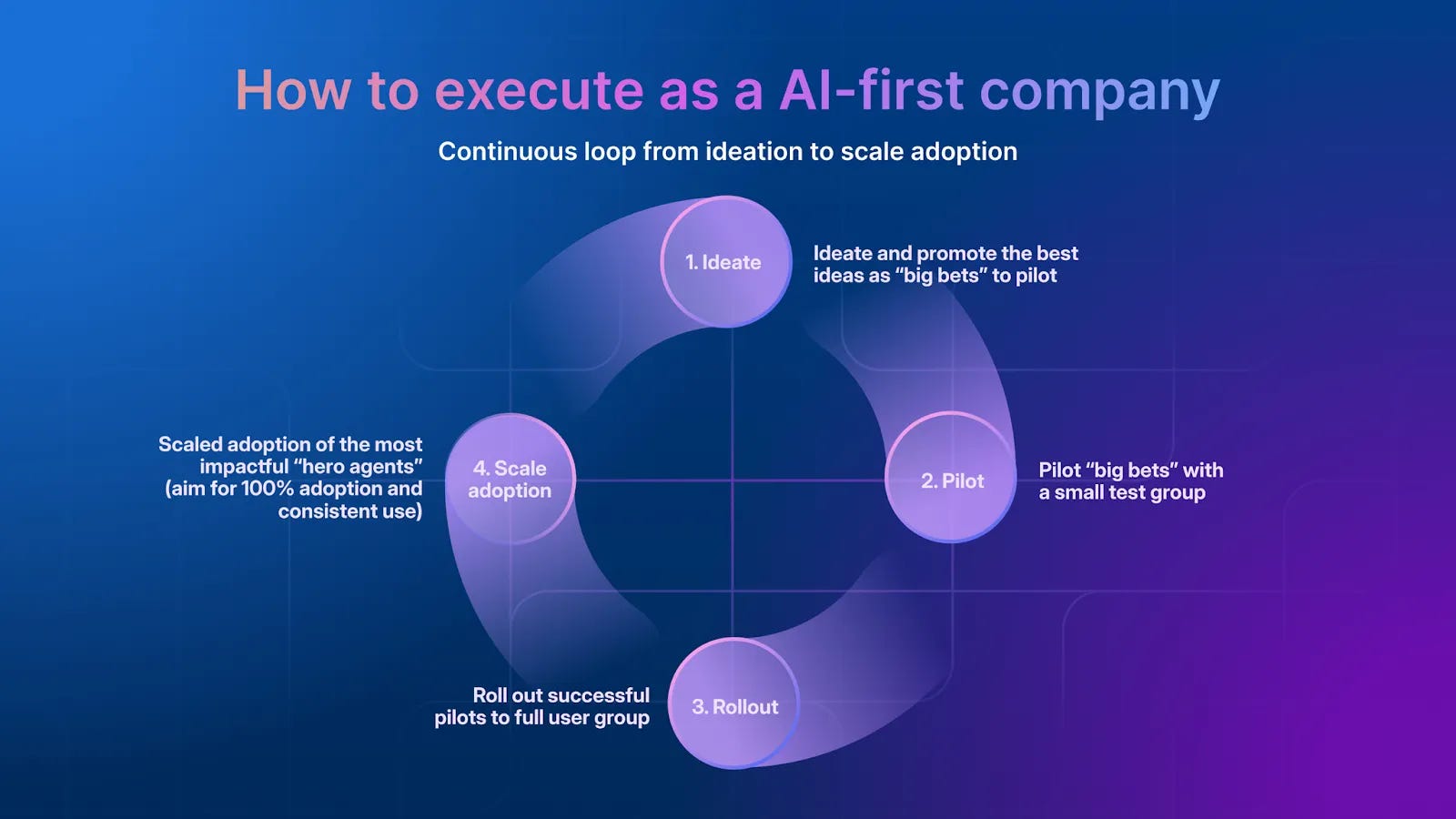
Box, the leading Intelligent Content Management company, is breaking down how it structures experiments, frameworks for AI principles, and more in its Executing AI-First series.
In it, you’ll discover how to turn a raw idea into a strategic AI powerhouse, and get a step-by-step playbook for empowering teams to thrive in the era of AI.
In this series, you’ll learn:
How Box approached becoming AI-first through its value realization strategy
How to deploy agents with an Ideate>Pilot>Rollout>Scale plan
How to identify and empower AI managers
How to measure what matters by tracking AI agent impact
Dive into Box’s Executing AI-First series and follow along for actionable insights and downloadable templates.
MY RESEARCH

GLPs plus AI are witchcraft. Good technology increases our agency while bad technology makes our choices for us. In my physical health I have found that a combination of GLPs and the use of tools like Claude to be the most empowering, useful tools for physical health I’ve ever encountered. Night and day difference. For subscribers I describe the routine, apps, and AI tricks I’m using to lose weight.
Companies who elevate taste can make billions. [Video Essay]. Rather merely bemoan the current state of media and tech, I wanted to understand how startups could elevate people’s aesthetic judgement. This work has turned out to be enormously popular, and this video essay dives deeper into the arguments for a new type of startup that could help fight back. Watch here.
WHAT MATTERED THIS WEEK?

BIG TECH
Apple is making Siri into a ChatGPT competitor. Bloomberg reported that Apple has decided to get into the Chatbot game. The new Siri will far exceed what it can do today—searching the web, creating content, generating images, analyzing files you upload—and it’ll be woven directly into Apple’s core apps. This is late, but necessary. They don’t have the AI talent that the rest of big tech does, which helps explain their recent partnership with Google’s Gemini models.
What’s more interesting is what they could launch in the years to come. As I hypothesized in my essay this week, Apple is the one company with centralized subscriptions, payments, and usage data on its customers, which means they can make a chatbot no other company can on mobile. I don’t want Siri to be controlling just Apple’s apps, I want it to be controlling every app on my phone. I never want to click again. It feels inevitable; you can just see the marketing campaigns right? “Think Different” hits when the phone does all the boring thinking for you.
This step is the next on a journey to a complete reinvention of how we use computers. It can’t come soon enough!
The TikTok deal is done (and is also a weird, slimy, gross mess). American entities now control 80.1% of a new joint venture called TikTok USDS, with ByteDance retaining just 19.9% to comply with the congressional ban that required Chinese ownership below 20%. The ownership structure features three managing investors—Oracle, private equity firm Silver Lake, and UAE-based investment firm MGX—each holding 15% stakes, while another 35% is distributed among eight other investors including Dell CEO Michael Dell’s investment office and trading firm Susquehanna International Group. Under the arrangement, U.S. operators will “retrain, test, and update” TikTok’s content recommendation algorithm using American user data.
I predicted this outcome back in September 2025, and the weirdness has only intensified since then. While I don’t want to judge the investors without knowing the specifics of how this came together, the whole situation feels deeply strange—the political flip-flopping, the particular roster of investors allowed to participate, the timing of everything. Even setting aside concerns about political corruption (which admittedly rest on circumstantial evidence), the most bizarre aspect is that the two things giving TikTok its actual business power—the algorithm and commercial operations—remain functionally controlled by ByteDance. Despite the elaborate ownership restructuring that satisfies the divestiture law, this arrangement changes relatively little in practice, raising questions about whether it genuinely addresses the national security concerns that justified the ban in the first place, or if this all became some sort of political horse trading.
THE SLOPPENING
People can’t distinguish AI from reality anymore. Video model startup Runway released its 4.5 model. The results are genuinely indistinguishable from reality. The startup “recruited a random sampling of 1,043 participants” for a study to prove this. “Each participant viewed 20 videos (10 real, 10 generated) in randomized order and judged whether each was real or AI-generated.”
The results were…shocking.
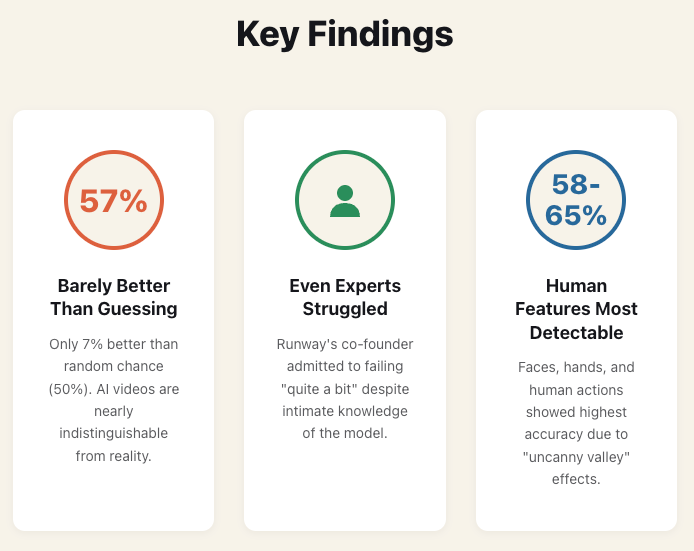
Keep in mind these are random generations. With careful prompting, creators can make it even harder to tell. I am no Pixel Puritan. Whether a ten second clip of a shark is real or not isn’t a major issue. However, that we can all be so easily fooled is a big one. I took the test and got 60% right. Think you can beat my score? Try it here.
Youtube is against slop (but only of the AI variety). In his 2026 letter, YouTube CEO Neal Mehta said that one of his big focuses for 2026 is “managing AI slop.” He is committed to stopping the platform from being flooded with “low quality, repetitive content.” This is a worthy goal, and godspeed brother.
Still, I think the issue isn’t AI-specific slop, but that AI reduces the cost of all slop. What I mean is that it is hard for me to look at the most recent videos from the platform’s most popular creator and not think, “huh, this is slop.”
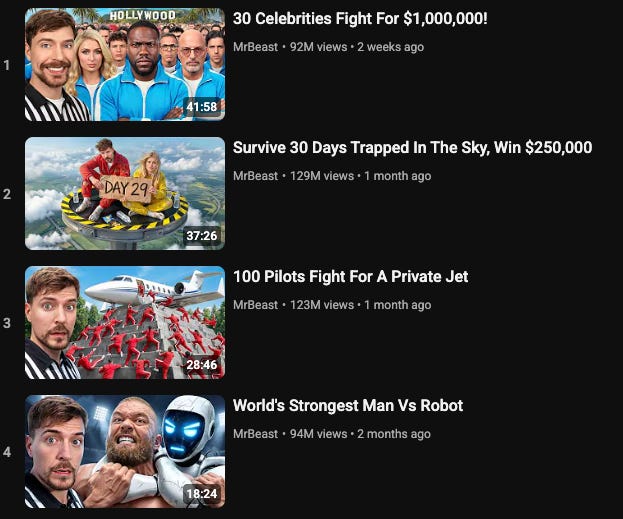
No big tech platform has an answer for how to combat the second-order effects of AI. There is a giant race to the cognitive bottom for viewers going on and startups are the best hope to stop it. I applaud YouTube’s efforts to combat AI slop, but there are many, many more types of slop out there that we should also stop.
AI RESEARCH
Claude has a Date Me doc. Anthropic released a “constitution” document that they use to train their chatbots and shape their behavior. It is one of the most fascinating documents I’ve ever seen from a corporation. The fundamental problem with LLMs is that the things we are growing are being asked to make decisions in ethical gray areas. Since you can’t write out rules for every edge case, you instead have to give the model a good sense of ethical judgement. To accomplish that, Anthropic trains it on about 20,000 words’ worth of guidelines. I have many, many thoughts here, and will likely dive in deeper in the weeks to come, but it is worth reading as a technological/ethical artifact. Summary is here and the full document is here.
STARTUP STRATEGY
How much longer will coding survive? Back to my story at the top of this edition. These types of conversations have been happening more and more for me. Founders just keep shipping more products. For some outliers, that increased product velocity has increased their revenue. However, for many others, the revenue growth hasn’t kept up. With that in mind, I saw this tweet from Martin Casado at a16z.
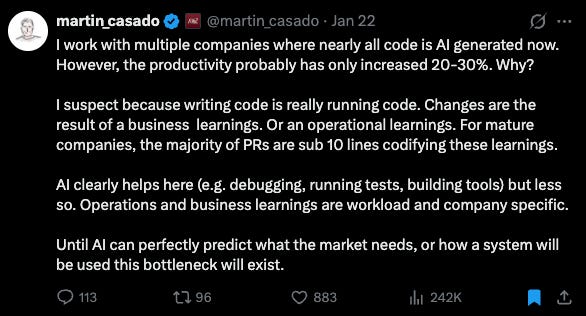
Ultimately, startups are about learning secrets. Novel technologies, how to sell in novel ways. It is about moving faster and grinding harder than a large company could ever hope to match, not for the sake of speed itself, but for the sake of gaining knowledge. Then the code comes. Ultimately code is a reflection of the knowledge you have about your customers’ workflows. LLMs just mean you can translate those insights faster, but it does not materially change the real bottleneck which is secrets. The founders I mentioned could make the product so quickly because they knew what the market needed.
TASTEMAKER

So now I am older
Than my mother and father
When they had their daughter
Now what does that say about me?
Oh, how could I dream of
Such a selfless and true love
Could I wash my hands of
Just looking out for me
Oh man, what I used to be
Oh man, oh my, oh me
I’ve been thinking a lot about the song Montezuma by Fleet Foxes this week. Released in 2011, the album carried me through my 20s. It’s shaped by the soaring harmonies that make Fleet Foxes great, but the lyrics are significantly better than their other two albums. I pulled these verses specifically, because in the context of the world’s cruelty, I yearned for something empathetic and caring. This album hugged me and gave me that. You can listen to a great live version of this song here.
In dearth or in excess
Both the slave and the empress
Will return to the dirt, I guess
Naked as when they came
I wonder if I’ll see
Any faces above me
Or just cracks in the ceiling
Nobody else to blame
Go and be kind this week,
Evan
Sponsorships
We are now accepting sponsors for the Q1 ‘26. If you are interested in reaching my audience of 34K+ founders, investors, and senior tech executives, send me an email at team@gettheleverage.com.
I think the bigger issue is exactly what you pointed out: AI doesn’t create slop by itself, it just makes low-quality content dramatically cheaper to produce. The more interesting use of AI is helping creators improve real work, like speeding up tedious editing tasks. I’ve been experimenting with tools such as an <a href="https://videoobjectremover.com/" rel="dofollow">AI video cleanup tool</a> to remove distracting objects from footage, and that feels like a much healthier direction for AI in creative workflows.
On the Runway app test: I got 65% (hehe ... ). I wished the videos could be continuously playing since that would have made it easier to spot the differences. I think I could have had higher if I knew you can't click on the videos to make them loop again.
The "cheat" was you warning us that it is hard to tell the difference. So I made my decision mostly on logical elements rather than if it "feels" real or fake. The simplest was the last (for me) with a highway with a double yellow line AND a white interrupted line as well. One was with a lady putting a leash on a dog. Normally she would not turn to the camera every few seconds.
Definitely not easy.