


Author’s note: This is the latest in my “What’s the Bet” series. AI has the potential to change everything, and founders have to make company-defining choices in response. That is not easy. In this series, companies pay me to analyze their bet and explain it to you. I retain complete editorial independence. Today’s bet is brought to you by Town, an AI personal assistant. If you have any feedback, just reply to this email.
Town’s bet is that the personal assistant requires a deeply friendly context layer.
Despite tens of billions of dollars and hundreds of startups, nobody has nailed the personal AI assistant. The idea was always obvious: use LLMs to make work admin not suck. But as someone who has tried nearly all of them and then promptly churned off each and every one, I can confidently say that nobody had built one a non-early adopter would tolerate. Until now. Town is the personal AI assistant I have wanted for years, finally made manifest.
The fastest way to explain Town, at least in SF group chats, is that it is OpenClaw without the management overhead. You get a Townie (a named, customizable assistant), give it permission to read your inbox, Slack, and other data sources, and it goes to work. Mine is a fat, magic gerbil who loves to read. His name is Luther. Lately I have been texting him more than my wife.
Out of the box, 3 workflows will provide some wow factor for users:
Morning briefing. Every day at 5am, precisely timed to my daughter’s current wake window (please, someone help me), Luther emails me my schedule, the items that need addressing, and the news I care about. I listen at 2x speed while my dog does her best to kill my neighbor’s bush via potty break.
Auto-inbox. This is where it felt like Town had a real breakthrough. Luther labels, sorts, and drafts roughly 45 emails a day. The drafts are close to send-ready and adjusted for who is on the other end. A buddy catching up gets one casual line. A PR person pitching me something stupid gets ignored. Hard to describe how magical this is.
Meeting briefing. Before a call, it preps a note on who is in the room and why they matter relative to my work. For sourcing calls it tells me which piece the call is for and what I should be asking.
From there you can build automations specific to your own circumstances. (More on mine in a second.) As I mentioned in my disclosure, Town paid me to analyze their bet, but sponsors get no say in my analysis or verdict. So when what follows reads like worshipful praise, it’s because Town is genuinely that good. Many assistants offer products similar to what I’ve listed, but only Town’s were simultaneously easy to use and delightful. It’s worth understanding what bets they made to make that possible.
The expensive bet Town makes
Jean-Denis Greze spent 7 years as CTO of Plaid and before that led engineering at Dropbox. He founded Town with Tony Vincent, who led product and AI at Google. On June 3 they came out of beta with a $55M Series A led by Alex Rampell at a16z, with Forerunner, First Round, Alt Capital, and Conviction participating. Counting the seed, that is roughly $73M raised in about 15 months. When I asked Jean-Denis how they are using that capital to make the product feel so good, he gave me three answers.
1. Pre-processing as a capital moat. When you sign up, Town builds a personal wiki about you with sections on your communication style, your key contacts, your active projects, and how you like to work. From there it progressively constructs a mini CRM of your top relationships, building profiles for up to 100 people. This is expensive to do per user. Fully built out, Jean-Denis told me it runs about $100 a user. But by doing the research up front, the model receives pre-synthesized context instead of burning tokens on agentic search. To translate the technobabel, this upfront spend meaningfully improves output quality. It also creates brutal switching costs. Every week of use makes your Townie smarter about you and makes leaving harder. This is the type of bet you make when you have either 1) extreme confidence in your long-term retention or 2) $55M from a16z. My guess is it is a little of both.
2. Network effects in a category that has none. A personal AI assistant is inherently single-player software. Jean-Denis is betting he can bolt network effects onto it through 2 features. The first is a team layer, where Townies can benefit from routines, skills, and integrations built by other teammates’ personal assistants. If John and his Townie build a killer routine for drafting follow-up emails after sales conversations, Emma and her Townie can use (and contribute to) that same skill without starting from scratch.
It’s similar to a GitHub repo, where teammates can collaborate on resources and constantly bake in improvements and best practices. The biggest difference is that it’s easily self-servable for users of any level of technical proficiency and Townies create skills and routines proactively.
The second is what the team calls agent-to-agent. “My agent can work with your agent on things. I could ask your agent, how’s the partnership doing with Evan? Your agent looks in your Gmail and your Google Drive and figures out the answer, but it crucially doesn’t automatically reply to me. It asks you: ‘can I reply to Jean-Denis with the answer?’ You look at the answer, remove a part if you want, and then your agent replies to my agent.” No data leaves without your approval, and you do none of the work. This means your agent can dramatically cut down on annoying slack pings.
Jean-Denis uses it with his wife for personal tasks too. She will ask her agent whether he booked the kids’ dentist appointment, and when he has not, the reminder lands in his morning briefing. Adoption sits at roughly 10% of users today because the feature is new. But if it works, it means Town gets multiplayer lock-in on a single-player experience. As someone who gets too many emails about doctor appointments and school events, I am currently trying to convince my wife to get a Townie so we can coordinate better.
3. Feel as the differentiator. By my assessment there is relatively little net-new technical science happening here. These are variations and improvements on existing ideas about personal assistants. The uncomfortable reality of the category is that everyone has access to the same models, so the building blocks are commonplace. Memory, connectors, tool use, and scheduled agents are offered by every serious lab and startup. When the supply chain is commodity, firms compete on user experience and brand. The UX half is the pre-processing and personal CRM described above. The other half is a whimsical brand. Their website is chock-full of fun little guys that make the product feel friendly.
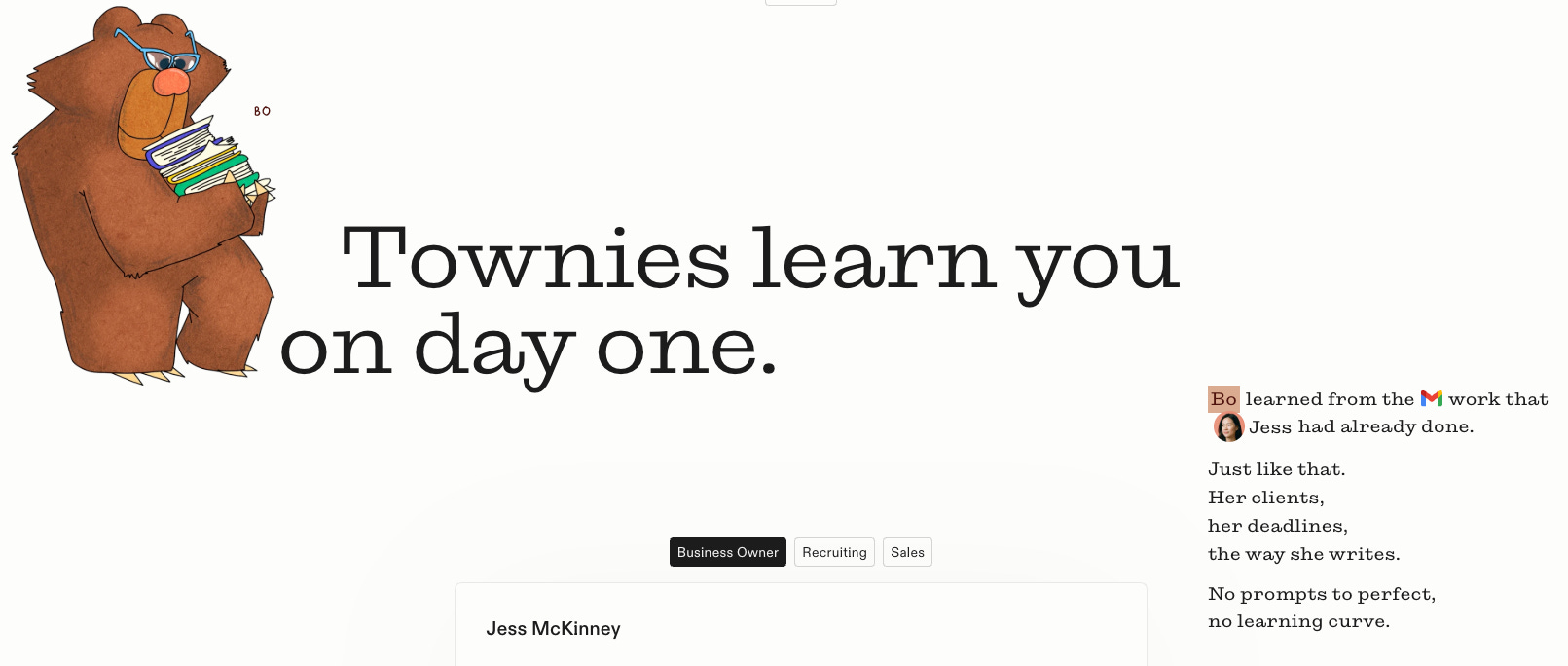
This sounds like fluff if you are a mega AI nerd, but it is the kind of bet that decides mainstream adoption. As much of an AI guy as I am, I still find it deeply funny that an obese gerbil is tasked with updating my CRM.
Still, none of that alone would have me this excited about the product. Town is the first AI assistant to clear a benchmark of mine.
What actually happened when I used it
My white whale has been a to-do list that maintains itself. This sounds like an easy idea! Just have an agent scan your emails, meeting notes, and work deliverables, then update a database a few times a day. However, there are two tricky gotchas that every previous version of this I’ve built has failed. First, the agent could not prioritize, because it had no context on my relationships, meaning that the to-do list couldn’t get what to-do actually mattered right. Town’s CRM and pre-processing solve this. Alternatively, a connection would fail within a few days, and fixing it would go on the to-do list that no longer worked, which meant it never happened. Town manages my connections so this problem is solved too.
Now I have a Notion database that sweeps my email, Slack, calendar, texts, and meeting transcripts 3 times a day and sorts tasks into my actual work buckets. Since I started, the back catalogue of small tasks has chipped down to near zero. It means I no longer worry about dropped balls, Town just tells me what needs to be done. My job is now managing the most difficult employee of all (myself) to make sure I just do what Luther says.
Town also watches how you work and proposes automations. In my case it suggested a centralized travel doc routine for some upcoming trips. Over time, this will build an army of custom routines that make my work higher quality and my personal life less stressful, and many of them were Luther’s idea rather than mine.
Jean-Denis told me these auto-recommendations already drive roughly 10 to 15% of in-app interactions. So more than a tenth of usage is self-generated, which is a meaningful number for a product with usage-based pricing. It also solves the blank-page problem, which is what kills most AI tools for normal people.
Where I think this could break
Despite my effervescence for Luther and the automations he has enabled, Town is competing in one of the most cutthroat markets in tech right now.
The first type of danger is the host of startups with similar pitches to Town. There are literally hundreds of funded startups chasing similar positioning. Shoot, just Y Combinator has backed 142 “AI Assistant” startups. Many of these are focused on verticals or product wedges different than Town, but that makes the category even nosier. The second is open source projects like OpenClaw. Every month it gets better, raising the floor on what a free alternative can do. It is possible that Town’s whole “we make OpenClaw accessible for normies” becomes increasingly unnecessary. The third bucket of threats is Native SaaS bundling. Every existing productivity app is adding agents and trying to become what Town is offering, and they already have your data. There are only so many times that people will ignore the CoPilot popup on Outlook before they give it a try. The fourth is the labs. Anthropic and OpenAI are the silverback gorillas that keep vaguely gesturing at this personal assistant idea, and they train the models everyone else rents, so in theory they can offer pricing and capability nobody can match. For now the two of them are chasing ASI and coding automation rather than the personal-assistant focus of startups like Town.
Luther’s best chance of still being alive in 12 months is the bundle of bets described above. By the time the labs get serious about consumer delight and per-user pre-processing, Town intends to hold years of accumulated personal context and team-level lock-in that no model release replicates. That is their bet. So far, it is the first one in this category I have been willing to keep paying for.
If you want to try it out, readers of The Leverage get their first two weeks completely free, and as a special bonus, you’ll immediately receive an additional 2500 credits applied to your account for an extended trial. I can’t recommend it more strongly. Simply click here to try this breakthrough out.
How would you compare to Every’s Cora? The email digest has been huge but I’m missing to dos. Also does it grab your iMessages?
Who owns your personal wiki and mini-crm data? You? (portably) Or the company?