



When you ask little boys and girls what they want to be when they grow up, they all answer the same way, “I want to spend my one wild and precious life increasing shareholder value.” The hallways of our schools are replete with posters of Warren Buffet offering inspirational quotes about proper hedging strategies to produce alpha. And who can forget the motivational series from Peter Thiel wearing a mustache made of money, the copy demanding, “Got Monopoly?”

Obviously this is fiction. While I was one of the few children who innately loved inefficient markets—my elementary school banned me from trading Pokemon cards because I hustled too hard and made the other kids cry about getting ripped off—most people are not broken in the specific way that capitalism rewards, and just want to be an athlete or an astronaut or really anything that doesn’t involve understanding what a “software workflow” is.
This phenomena, namely the innate desire of humanity to do anything besides office work, is perhaps why so many of my friends are captivated by the idea of the “zero human company.” This is where you use AI agents to autonomously run a company for you. A zero human company makes the product and then distributes it to customers. It has all the hallmarks for an idea to go viral: Effort required? Minimal. The shareholders gaining value? Only you. Yacht’s acquired? Quite a few. All you have to do is go to the AI of your choice and say, “Create a billion dollar business, make no mistakes.”
The tiny issue is that, of course, this idea is a complete farce. No AI model today can accomplish this task. And even in the world where the models are smart enough to do so, everyone will have access to them, thus increasing competition, which will increase distribution costs, and eventually erode margins to zilch. If digital powers are as abundant as a ChatGPT subscription, then competition switches to other bottlenecks (customer attention, access to capital, etc). I have been banging on this drum since 2022.
Over the last few weeks, I have worried that I am a moron and wrong. The cause for my concern is the startup Polsia. The way the company markets itself is pretty remarkable, so I’m going to quote it in full,
“Polsia thinks, builds, and markets your projects autonomously. It plans, codes, and promotes your ideas continuously — operating 24/7, adapting to data, and improving itself without human intervention.”
Yes, the company is doing what I’ve spent years saying isn’t possible. It builds autonomous companies that should, supposedly, make money without you being involved. The company has seen stellar results over the last month or so, and hit a $4 million annualized revenue run rate since launching in December.
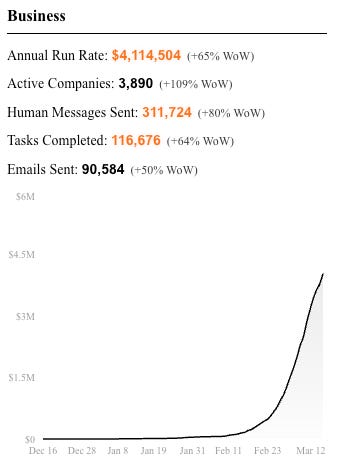
What is happening here? That this startup has 3,890 companies being managed by its AI seems like strong evidence that my whole shtick the last few years is dead wrong. Have I doomed myself, and by extension, all of you my beautiful readers, to the permanent underclass with my errors?
Let’s investigate.
Employees? Where we’re going, we don’t need employees.
The clue to what this thing is comes from the description of how it “plans, codes, and promotes your ideas continuously.” [Emphasis added.]
This means it generates a business idea, writes code to create that idea, and then markets that idea to the target customers.
Plan
To begin it starts by asking if you want to build a new business or add to an existing one. I already have had enough of my hair turning grey running The Leverage so I told it I wanted to sell something using my existing company.
Polsia’s first idea was The LeverageOS, a vertical SaaS and AI agent product that would help newsletter operators run their business. This is truly, godawful idea for a variety of reasons. Just to point out the most obvious one, newsletter writers are overly-opinionated, technoilliterate assholes who will spend the least money possible on software (ask me how I know.)
I could try refining this idea for 30 minutes with the agent, but instead, I had it start again to find something to sell to my audience “founders, investors, and senior tech operators.” The next six suggestions it had, well, uh, sucked. They were pond water ideas—pitches that looked sorta ok, but were ultimately shallow.
As Paul Graham wrote in his classic essay Do Things That Don’t Scale, “The feedback you get from engaging directly with your earliest users will be the best you ever get. When you’re so big you have to resort to focus groups, you’ll wish you could go over to your users’ homes and offices and watch them use your stuff like you did when there were only a handful of them.” Polsia doesn’t have that. It has never read the replies to my posts, never sat in my DMs listening to what you’re frustrated about. It’s doing smart pattern-matching on market categories. That is not how a quality startup is built! Theoretically I could give it all that data, but that seems like a lot of work and the interface is not designed for that.
Eventually, I gave up, and handed it the idea for an app I’ve been working on already.
Codes
Here is where Polsia did the best. The AI built a detailed plan, asked multiple clarifying questions on what I envisioned for my product, and then got to work coding it. The product I am vibe-coding is fairly complex—it requires API calls to prediction markets, user authorization, and robust security that users would trust their personal information to it. Not easy to build. Still, Polsia got it roughly working, and did it in the time it took me to go to the bathroom and get a snack.
Still, it was only 80% of the way there and I felt frustrated at my lack of control over the code and design. Sure, I could go back and forth for three hours with Polsia to guide it via a chat interface, but I just knew that it wouldn’t be an efficient use of my time. Coding agents require more specialized interfaces than a mere chat window.
Keep in mind my original thesis here. If AI dramatically reduces creation costs, that means the minimal baseline of acceptable software products are infinitely higher. Each page, each interaction of the application has to blow the customer’s socks off. I have high standards and so do you.
So, I did what any self-respecting founder would do: I took Polsia’s output, thanked it for its service, and moved the project over to Replit. The difference was immediate. With Polsia, I was describing what I wanted and hoping the agent interpreted me correctly. With Replit, I was looking at the actual design, code architecture, and making decisions myself. The AI was still doing the vast majority of the work—I am not writing CSS by hand like some kind of animal—but I was the one deciding what got built and how it felt to use.
This is the part that the “zero-employee company” evangelists gloss over. The last 20% of polish for any product is the only part that matters. That stuff can’t be autonomously generated because it requires a point of view. It requires someone who has opinions, and the tools to act on them quickly. AI agents will likely one day be able to use those tools as good as you, but that day is not yet here.
We are only 2/3rds of the way into the Polsia process, but you can likely guess my point already. “Zero human companies” are manifestations of the shifting vectors of competition for startups. AI simultaneously raises the quality floor for what a differentiated company has to offer, while raising the possibilities of how large a company can become. A SaaS app is not the afternoon project of someone—it is no longer a venture backable startup. And a billion dollar outcome is no longer enough to shoot for. It needs to be $100 billion.
I’m getting ahead of myself. The last thing Polsia does is get people to pay attention.
Promotes
I am not here to be a hater. AI-automated marketing actually works. There are people out there right now using AI to spin up hundreds of programmatic SEO pages, blast cold email at scale, and generate dozens of ad creative variants per day. They’re making money. The workflows are real.
Polsia does variations of this: Meta ads with AI-generated video, cold email outreach, Twitter posts, SEO content, you get the idea. And look, if you’re selling a generic B2B SaaS tool into a nice enough market that is currently lacking in competition, this is probably fine. You can brute-force your way to some amount of revenue with volume.
But, once again, there are more specialized tools out there to do each of these tasks. For each of these channels, there are already specialized tools that do each job better than a generalist agent ever will. And, every single one of these tools is shipping their own AI features as fast as they can. The autonomy offered by companies selling you zero-human companies is a feature that the rest of the industry is copying by the quarter.
Theoretically a general agent will have access to enough data scattered across your company that they could theoretically be smarter then the silod agents offered by software companies could be. I’ve sold a company, and helped multiple startups scale through their first ten million in revenue, and with the benefit of that experience, let me tell you an uncomfortable truth. Most of the early shareholder value is created via the fine art of winging it. Great founders are data-driven, but for most of the decisions you are making in the starting years, the data is sparse, and often contradictory. You have to build a bone-deep intuition for what your customers want. I fundamentally just don’t think AI currently has the ability to do so.
In a gold-rush, you could sell shovels or you could sell shovel parts
So what is a zero-employee business?
Let’s start with what Polsia actually is, because I think it’s more interesting than the hype suggests. They’re at roughly $4 million in annualized revenue, charging $49 a month. That’s around 6,800 paying customers. They’re also running inference on every one of those companies. My guess is that their margins are razor thin, maybe even negative on heavy users.
But that is why I find this company so compelling and why I want it to succeed—their aligned business model. Polsia takes 20% of revenue from the businesses it builds. Polsia is betting that some of these companies will actually work, otherwise this is just an experiment that might break even. And some of these companies will likely be profitable! If you’re building a simple tool into a big enough market and letting AI brute-force the distribution, you’ll find some customers. The question is whether you’ll find enough to build something durable, or whether you’ve just created a temporary arbitrage that closes as soon as everyone else spins up the same thing.
Here is what I think is actually true, and it’s not as bearish as you might expect.
First, we are watching the abstraction layer of business shift in real time. Ivan Zhao, the CEO of Notion, put it simply this week: “The future of knowledge work is code.” I wrote on Sunday about OpenAI building an entire product with “zero lines of manually written code”. Their engineers “work at a different layer of abstraction” by building systems to guide the AI. This is the long, repeating cycle of computing. Just as C++ replaced writing in binary, AI agents are replacing writing code entirely. It’s helpful to understand how the lower layers work. It is no longer necessary. Polsia is an early, messy attempt at pushing that abstraction layer even higher—to the point where you don’t even need to prompt the AI yourself. They’re not there yet. But the direction is right.
Second, the bottleneck has moved, and it’s moved to the places AI is worst at. It used to be that building software was hard and expensive, so the companies that could ship fastest won. AI demolished that. Now the bottleneck is three things: taste, distribution, and attention. Taste is knowing your customer well enough to make the thousand small decisions that separate something people tolerate from something people love. Distribution is having a channel that you own and that can’t be replicated by someone else spinning up a Polsia instance. And attention is the scarcest resource of all. When everyone can build everything, the competition is over who can get anyone to care.
I wrote two years ago that if everyone has access to the same AI tools, Syndrome Syndrome kicks in: if everyone’s super, nobody is. Polsia’s own dashboard is the best evidence I’ve seen that this is playing out. There are 3,853 AI-generated companies on the platform. They are all competing for the same finite pool of customers using the same set of tools. The winners will be the ones who already have the audience and taste to know what to build before the agent did. Those advantages don’t come from a $49 subscription. They come from years of compounding work that no agent can shortcut.
So no, I haven’t doomed us to the permanent underclass. But I haven’t been proven wrong, either. The zero-employee company is the creation side of the equation finishing its collapse. And when creation is free, demand is all that’s left to fight over.
the Polsia dashboard with 3,853 competing companies is the best real-world proof of the Syndrome Syndrome argument.
Sam Walton saw the same shift in retail. by 1989 his distribution cost was 1.7% of sales vs Kmart's roughly double — not better stores, just infrastructure built a decade before anyone understood why it mattered. his principle: build the warehouse before you build the stores. capability built ahead of need becomes a moat. capability built in response to crisis becomes a cost.
Bezos kept Made in America on his desk for years. he visited Walmart before founding Amazon and applied the exact same logic to the internet. by the time competitors noticed, it was already uncrossable.
everyone has the same shovel now. the person who owned the land before the gold rush wins.
The whole point on 80/20 is key.
Generic/General AI tooling can get you to 80% but 80% is table stakes, nobody pays for table stakes.
You only get punished for not having table stakes.
The Winners get the last 20% right.
This applies the same be it one AI workflow, one AI agent or whole products.