Wall Street Does Not Care About Your Math Proof
The Weekend Leverage, Nov 22

On Friday morning, Anthropic mathematician Levent Alpöge announced that he had used Claude to solve the Riemann Hypothesis. This was perhaps the most notorious and challenging open problem in mathematics. Seeing this announcement appear in my push notifications gave me chills. Admittedly, more in a “what hath God wrought?” sorta way (or perhaps more accurately, in a “what God hath we wrought” sorta way) because of the amount of potential these models are showing. You would think that showing the power of AI like this would result in a jamboree of shareholder value being created. Instead, Anthropic stock responded by puking down another 8.5%.
That seems…strange. How could using Claude to discover the secrets of the universe somehow decrease the present value of future cash flows? Why would this make the stock price go down?
I’ll tell you, but first, this newsletter is brought to you by Grok Bot.

This week I looked down at the scale and saw a number I hadn’t seen since before Covid. Naturally, I’ve let this modest success go to my head. I now want one glorious ab. (Six feels greedy.)
The problem is that eating in a caloric deficit requires so much clerical work. Meal planning. Logging everything in MyFitnessPal. On and on it goes. I just wanted to lose weight and somehow became my stomach’s chief of staff.
So I built Operation Dad Bod, a Grok Bot.
It uses its cloud computer to pull recipes from my family’s recipe database, plan dinners, prepare an Instacart cart, and help log meals.
The magic of a good AI agent is that it lets you accomplish what you want while avoiding the work you hate. You can get a similar ab-creating setup below.

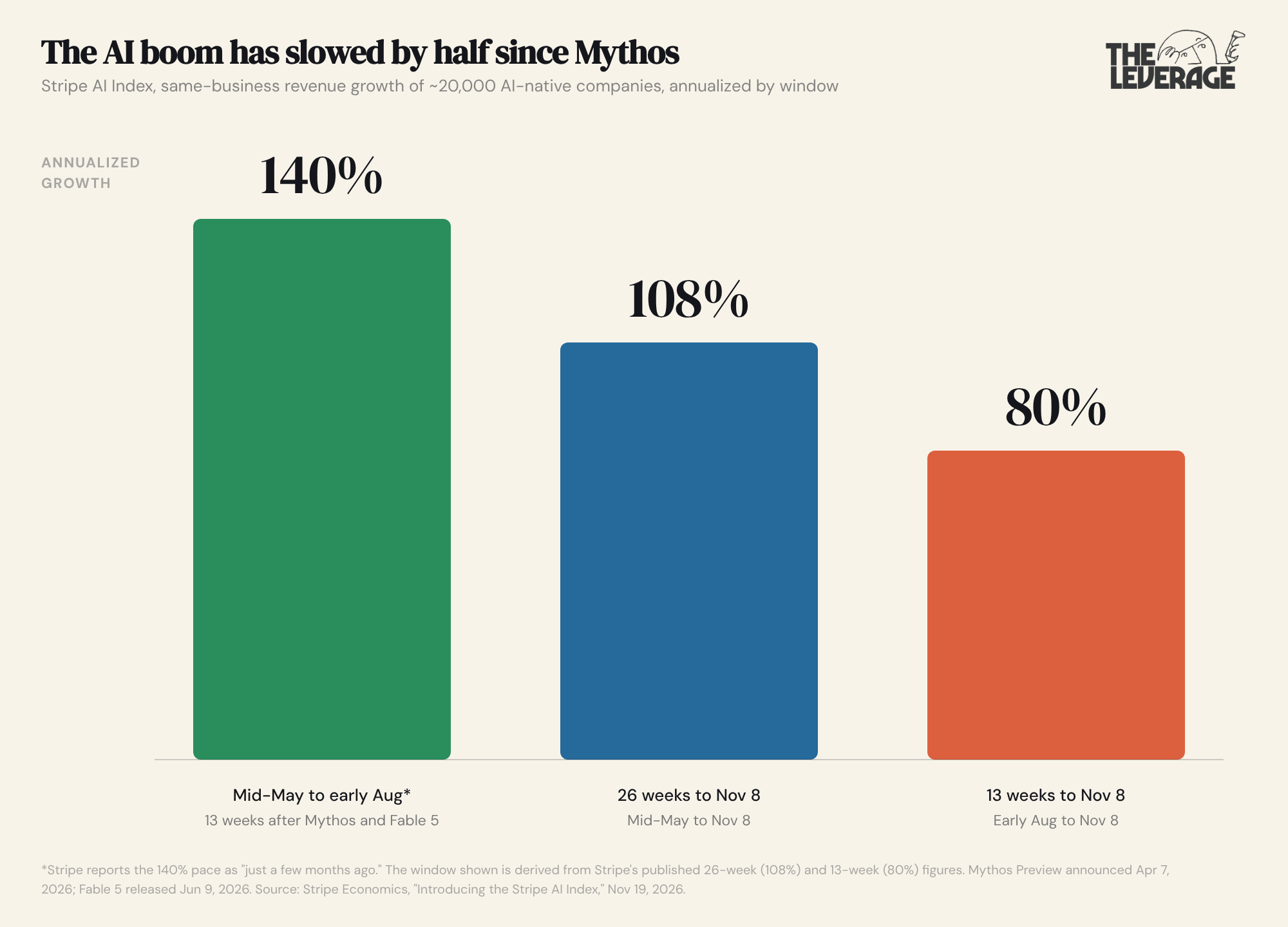
Math breakthroughs do not make you money. Stripe just published the Stripe AI Index to track the revenue for the roughly 20,000 companies whose core product is AI on their platform. The smack-ya-mama-this-number-is-so-silly data point is that AI-native revenue grew 103% over the past year while Stripe’s index of normal SaaS companies grew 33%. Incredible, yet also partially deceptive.
Over the most recent 13 weeks, annualized growth was actually only 80% while it was hitting 140% “just a few months ago.” That period of insane growth neatly lines up with the diffusion periods of Fable 5 and GPT Astra. Both of these model classes unlocked a slew of headlines/capabilities that have been sprinkling through the economy ever since. There are some important caveats with this dataset—both Anthropic and OpenAI will be represented in these numbers; however, their big enterprise contracts, the things materially growing their businesses, will not be paid for via Stripe. Still, two other datasets help explain why growth is slowing (I promise I’ll get to the math breakthrough after this):
First, price competition is brutal right now. Ramp’s AI Index tracks what 85,000 American businesses actually pay for AI through cards, invoices and ACH, which means it catches the direct bills to Anthropic and OpenAI that Stripe’s data misses. In the month to October 23, token volume among the businesses it tracks rose 37.1% while token spending rose 8.9%. The blended price of a million tokens fell from $0.76 to $0.56 in that single month, with OpenAI cutting 42% and Anthropic 16%. To translate: customers loooooove AI, but unless you have the truly frontier, make-ya-fingers-tingle type intelligence, they don’t really want to pay up and will happily substitute to another model provider. So Anthropic saw fewer price cuts because its model is better and more understood in the enterprise setting, while OpenAI needed to gain market share via price subsidy with their slightly inferior Astra. It’s like every AI company in Stripe’s index is running up a down escalator where they have to grow volume faster than they cut prices or their revenue stands still. The way they have done this thus far is to make ever better models. However, that may be hitting a wall.
Second, and more important than nerdy spend numbers, is that most firms simply can’t handle the horsepower of a Fable- or Astra-level model. Ye olde middle-market firms using Astra for their workflows is like trying to use a Ferrari to pull a wake surfing boat. Yeah, the engine can do it, but it probably isn’t meant to work that way and you’re gonna crash. The firms structurally capable of using frontier capability are rare. A new NBER survey finds 78% of firms use AI, but spending is concentrated in 2% of them. Anthropic’s S-1 says more than half the Fortune 500 pays Anthropic and yet the average one spends less than 0.1% of its expenses doing so. Essentially, most companies are still figuring out what to do with the model from two generations ago when chatbots got good (Opus 4.5) while those of us on the frontier are deploying agent swarms to tackle the hardest problems (Claude solving math).
Anthropic really started breaking through with the launch of Claude Code. By making the intelligence it was wielding legible to enterprise buyers, it allowed for its intelligence engine to be used properly. So at least part of the reason that Anthropic is down is that, first, to prove this hypothesis you needed a certified genius mathematician in partnership with the thing, and second, frontier scientific discoveries don’t generate excess profits. Science is a bad business! That’s why we make tenure track professors do it. We greedy capitalists exist to harvest the inventions of the academics who don’t realize they are sitting on gold.
My word of advice to Anthropic next time they make a discovery that shakes the foundations of human understanding is to simply communicate how I can use this math to make a better SaaS product. Anything else is simply illegible to public market investors.

Media is a terrible business and software won’t fix it. GTA VI came out this week, a billion-dollar project that is, at its core, just another app. Tech has decided that software should be a media product. I think that gets the dangerous word wrong. The top 1% of app publishers take 93% of revenue, and cheaper code does nothing to flatten that curve. My argument is that there is exactly one thing software-as-media is good for, and it is the thing MSCHF figured out years ago. Read here.
How Can Software Be a Creative Medium? I went live with Celine Nguyen, a former product designer who just went full time writing her newsletter, to talk about what AI is doing to those of us who make things for a living. We got into why GPT-2 wrote more beautiful sentences than any model since, the semicolon habit I’m fairly sure I picked up from Claude, and my nagging fear that these tools are quietly making me a worse analyst. One question we debate: Writing has been basically free for 50 years and books didn’t get better, so why would cheap software be any different? Watch here.

Grand Theft Auto is sparking some wondrous writing. While the game is ostensibly about murdering fools and slinging crystal meth, it is really about America, and how wonderfully absurd this country really is. Even if you have no interest in video games, read this piece. It reminded me why I love this craft.
My favorite scent right now is from a Bay Area perfumer. Warning: you’ll feel powerful wearing it. Lately I’ve taken to putting it on before important Zoom meetings, which is, like, nonsensical, but also deeply effective? Human brains are weird.
A song to cry to. There have been a lot of “best indie albums” ranking lists floating around the internet lately. (Namely, Pitchfork’s.) As a millennial with a gold hoop earring, I obviously have strong opinions on the genre. Too many of them are leaving off Carrie and Lowell, the heartbreakingly tender album from Sufjan Stevens. In 100 years, when my children’s children study the ancient texts, this album will stand apart in its depiction of grief. Worth a listen.
Discussion about this post