Media Is a Terrible Business and Software Won’t Fix It.
Cheaper code doesn’t solve the same power laws

As you read this sentence, tens of millions of husbands are abandoning their children. Lawns go unmowed. Slack is muted and emails abandoned. Today is the release of Grand Theft Auto VI, a videogame that will likely become the highest-earning entertainment product of all time. It is a staggeringly large project that is estimated to cost over a billion dollars to create. While calling it “just another app” is a little trite, it is, at its core, just another app.
I am not playing it. Other applications have earned my attention. I don’t say this to indicate some holier-than-thou attitude. I physically cannot. When my wife and I had our first child, money was tight and we couldn’t afford new maternity clothes for her. So, I sold my PS5, Gift of the Magi-style, so she could get something she would feel beautiful in, and haven’t really thought about it since. Instead of GTA VI, applications like Google Docs and Stripe, the digital cogs that keep The Leverage turning, are the videogames I play now.
I bring this up because an idea in vogue in tech is that “software should be a media product.” This sounds snazzy and smart. But what the hell does that actually mean?
When we consider the utility a consumer derives from an application, it can likely be divided into “entertainment” and “does non-entertaining things for me better than I did before.” From there you can likely divide apps along a spectrum of ephemerality. On one side are permanent apps that users use in utility loops that reward repeat behavior. Substack would be that for me. I post on here a couple times a week and (theoretically) I am rewarded with enough money to buy groceries. On the other side would be quick dopamine hits that you briefly discover, enjoy, and then never pick up again, something like a BuzzFeed quiz from back in 2014.
Ha, tricked ya. Yup, it’s a 2x2:
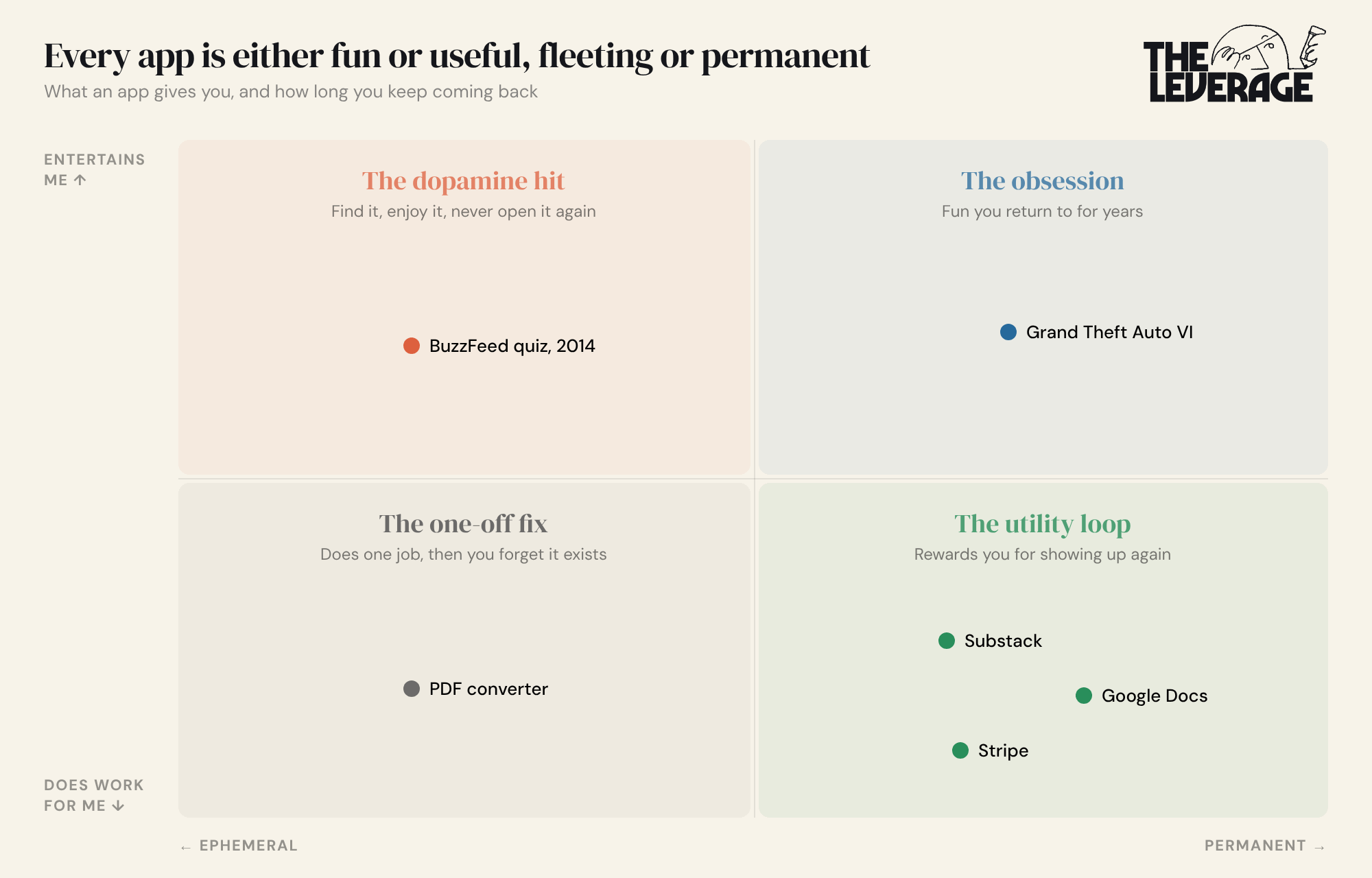
This framing should cast significant doubt on the “software is the future of media” thesis. The important word in “software as media” is the second one. Media is one of the absolute worst, most rotten, horrible, terrible, no good markets known to man. It has infinite competition, low margins, and is something I would only wish upon my worst enemy (which is apparently myself). If software is media, then LLMs’ impact on this product category is that they decrease barriers to entry. Software is only the future of media if it allows for either improved monetization or distribution. If you want to obtain higher LTV from software, then you, once again, are stuck creating permanent apps with core utility loops—aka God’s country of sloputainment, videogames, and B2B SaaS. My claim is that permanent software is where you monetize while ephemeral software is how you get people to show up. Media companies will use the second to feed the first.
Distribution is the area where I find this market most compelling. Because relatively few people are actually good at using coding agents, and most of them are smart enough to not work in media, only a few firms are using apps as a way to gain outsized attention. In this, the correct firm to study is MSCHF. The art collective spent multiple years dropping everything from anime waifu tax software to the Big Red Boots to cologne that smelled like WD-40.
The common thing between all these objects was that 1) they went viral and 2) they usually sold out immediately. I profiled them two years ago and after spending time with their team, the CEO Gabe Whaley said something to me that applies here:
“Everyone bifurcates the world into content and distribution…From the beginning, we viewed those as the same thing. Each object gets better with more participation, and so does MSCHF. Scale is not the goal. Scale is a tool to make the concepts better and more powerful.”
The mistake is to think of software’s infinitely scalable nature as a business strategy advantage that allows you to outcompete other forms of media. Instead, consider it an object-level advantage. When software as media is at its best, there are same-side network effects where each additional user adds more inherent value to the other users. Wordle is the easy example here. It was a simple guessing game with relatively little code. Everyone gets the same word on the same day, so each additional player made your own grid of green and yellow squares mean more when you dropped it in the group chat. It went from 90 players to millions in about three months without a single ad.
This is fortunate because software generally requires a user’s interaction, which means that its full nature can’t be shared on the attention-aggregating platforms. Instead, software media companies are stuck doing stunts, optimizing their product for screenshots, or making videos: the exact same marketing playbook that all media products compete with. Software as media is most meaningful as a new, powerful form of lead generation. In the newsletter world, the playbook to get new users was “I wrote a 50 page guide, give me your email to unlock it.” Now it’ll be, “I coded for 50 hours to make this app that solves your problem, give me your email to get it for free.”
The fundamental error that I’m calling out here is that if we treat software merely as another standalone media product to add into a media company’s mix, then we are subjected to the same problems inherent to all attention products: namely that they monetize poorly, have low switching costs, and are subject to extreme power laws. As I argued in August,
“In apps, the top 1% of publishers took 93% of revenue. In music, 88% of the 253 million tracks on streaming services got fewer than 1,000 plays last year while 80 artists each cleared $10M on Spotify. In video, the top 3% of channels take roughly 85% of views. Cheaper production simply doesn’t flatten the curve. It just makes the long tail longer, which means the head gets relatively richer, and whoever sits between the tail and the audience gets richest of all.”
What I think is much more promising is treating software as a form of creative expression.
Which is what I’m talking through tomorrow with Celine Nguyen, one of my favorite writers on Substack. We’re doing a live discussion on Friday at 1 p.m. ET about software as a creative medium: how much “software literacy” people need to make their own small, personal programs, whether “software as creative expression” is just a fancy way of saying videogames, and what kind of intellectual future we want our kids to inherit. Come hang on the Substack app!
Discussion about this post