


On a sweaty August night in 1973, Cindy Campbell’s back-to-school party birthed a movement. The event ran from 9pm to 4am, with her mom serving snacks and her dad bringing the beers. But it was her brother, DJ Kool Herc, who was about to make history. For months, he had been developing a new technique in which he combined turntables and a mixer to frantically loop a section of a song. With this, he could create a repeating beat, over which his friend Coke La Rock would perform spoken-word poetry. That poetry eventually became known as hip-hop. Herc turned production technology into an instrument and, in doing so, transformed the world.
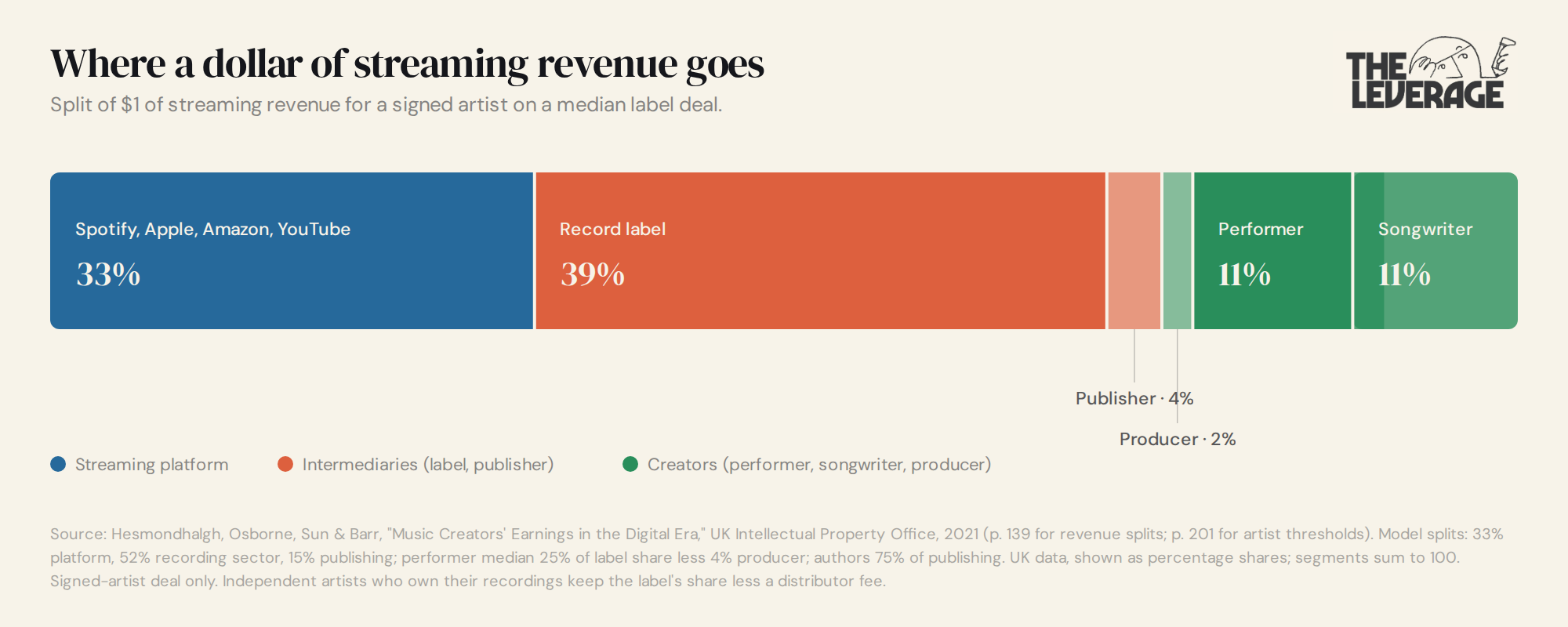
What’s strange about this story is that the people who invented this medium didn’t own it, or even get all that wealthy from it. DJ Kool Herc isn’t a star; Coke La Rock never had a hit song. This story would play out over and over again in hip-hop. Each decade, a new technology arrived that cut the cost of distribution (boomboxes and cassettes let people hear the music outside of parties) or the cost of production (tools like the Roland TR-808, which inspired everyone from Marvin Gaye to Kanye West). But regardless of the era, the average rapper didn’t get rich. The platforms did. And you know the management teams at the labels did! It was very rarely the artists and inventors themselves.
I mention this story because it seems obvious to me that consumer apps are undergoing a similar revolution. Coding agents were built to make engineers faster, the same way turntables were just built to play records. But instead, regular people are using them to make apps as a form of personal expression. They can be jokes or personal sites, meditations on grief, or tools for five friends. Hip-hop was an art form created at the intersection of radical new technology and culture. I think the same thing is about to happen with apps.
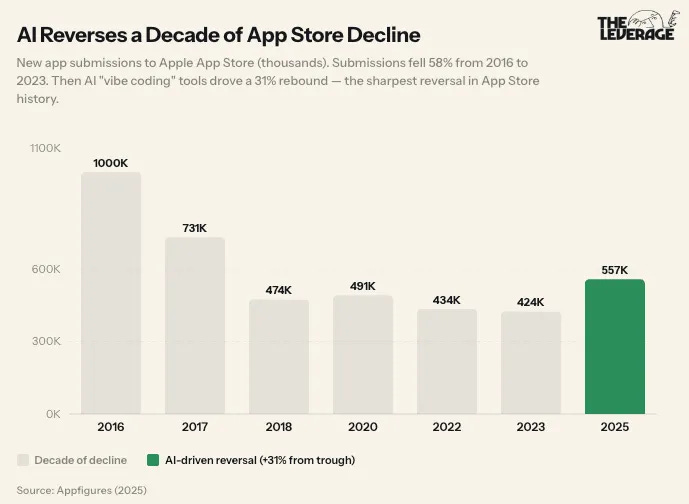
We do have some evidence that there are at least more apps. Lovable alone reported 50 million projects created in total and 1 million new projects a week. Considering the App Store only has about 2M active apps, that is a remarkable jump; Lovable users are creating more projects in 3 weeks than exist on the App store in total. And even the App Store is seeing a jump in submissions.
If apps become the next great form of media as this analogy would suggest, someone will build a label, a select few creators will become as big as N.W.A, and the whole playbook will happen again.
I guess what I’m saying is that in about 50 years maybe there will be someone making apps for the Super Bowl halftime show. That sounds nuts, but so is Kendrick calling Drake a pedophile in front of 133 million people, but that happened just last year, so some nerd hacking on stage doesn’t seem like that much of a stretch.
This is, admittedly, a selfish line of questioning. My newsletter is already nine media evolutions behind what is currently popular, and I find myself coding more and more and more. Am I, as my friends Marc and Los would put it, on the verge of being an “appstar” instead of a writer? Will there be an app label that screws me? Which platform will aggregate consumer demand and suck up my profits? If so, should I just build that platform instead?
For essentially the entirety of internet history, coding was expensive and esoteric. That is no longer the case. So, what happens next?
The Lord of the Apps
As the good folks of Harvard Business School will tell you, value in any supply chain accrues to what is scarce. What is handy about the app revolution is that it is being distributed along existing channels. That means the default path is for value to keep flowing to the same places it has gone in other digital media like music, video, and text. Namely, to people like the Lizard King and the Swedish Slasher (as Mark Zuckerberg and Spotify’s Daniel Ek are affectionately known in my household).
The beauty of technology is that in a few very special circumstances, a startup can grow large enough to change the global default. For the app market, there are five ways the value will likely be distributed:
Social mini-apps: Building a new age YouTube or Instagram for apps, with coding and social sharing baked into the platform.
Studio system: App creators will have their own network of agencies and ad partners.
General-purpose building: Tools will charge cheap subscriptions for code and try to monetize the services surrounding the apps.
Vertical integration: Meta, Google, or XAI will embed apps native into their existing attention platforms, monetizing the same way they always have.
Token monsters: Coding agents like Claude or Codex monetize on the volume of code generated.
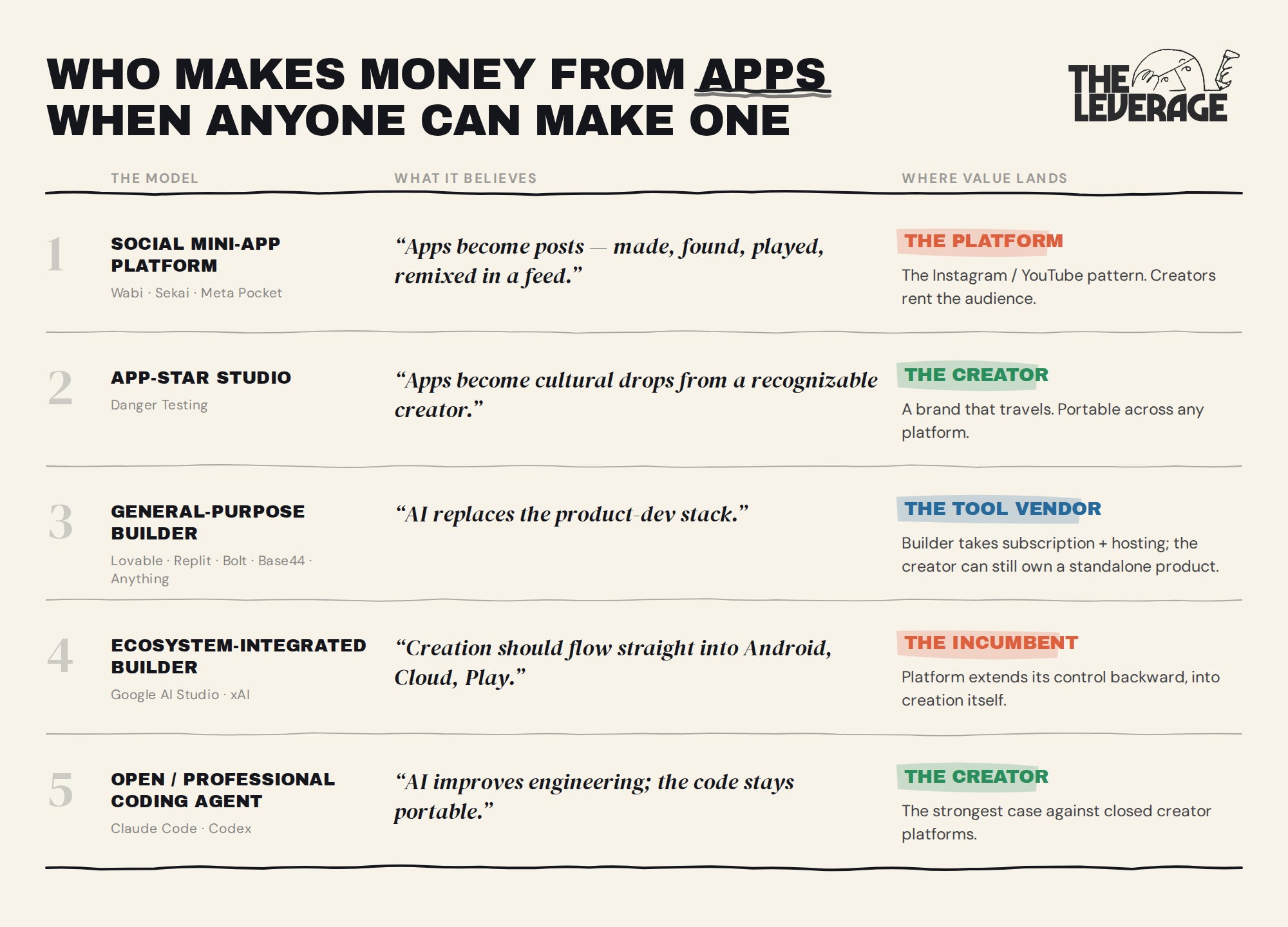
It is the first two categories that are the most nascent and least understood. For category 1, Wabi raised a $20M round to build a “YouTube of apps” where anyone can prompt a mini-app into existence and publish it to a feed. This means Wabi can monetize discovery as well as creation. For category 2, Danger Testing is the other end of the chart. Marc Müller and Los Toure ship a new app every week the way a band drops singles, and their hits are built to go viral, not to retain. Essentially, this is the creator studio model applied to apps. For all of these categories, there are dozens, if not hundreds, of startups attempting variations on the ideas.
Whichever category ends up dominant, tthere will be one universal truth: the power law. It is, and forever will be, the most important law on the internet, and every medium that becomes cheap to produce ends up subject to it.
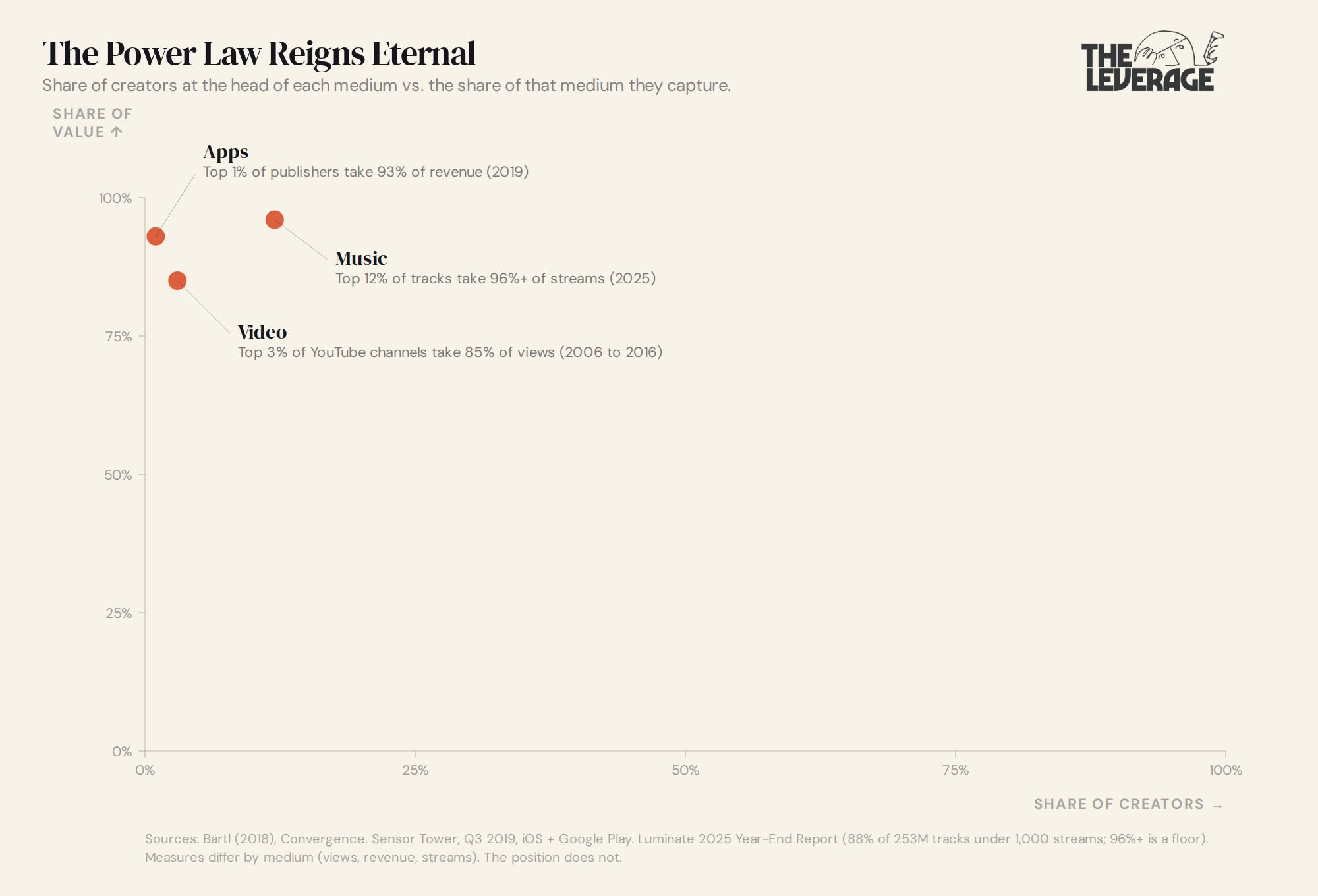
In apps, the top 1% of publishers took 93% of revenue. In music, 88% of the 253 million tracks on streaming services got fewer than 1,000 plays last year while 80 artists each cleared $10M on Spotify. In video, the top 3% of channels take roughly 85% of views. Cheaper production simply doesn’t flatten the curve. It just makes the long tail longer, which means the head gets relatively richer, and whoever sits between the tail and the audience gets richest of all.
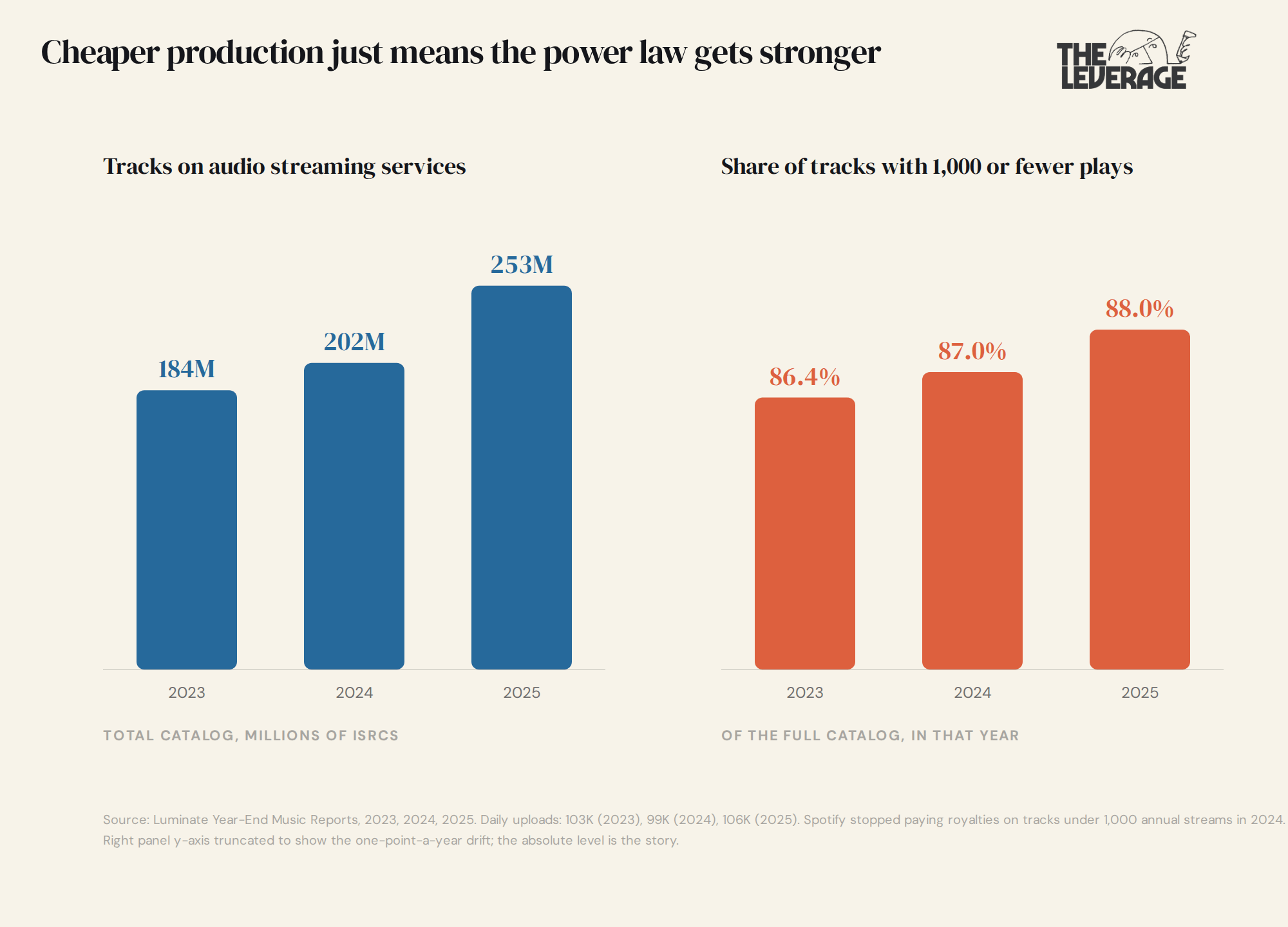
So if you are an app creator, the math would say you are essentially choosing to play the same online lottery that The Leverage does in text. This math is factually accurate, but spiritually wrong. A tiny number of artists in every medium have figured out how to stop playing the lottery entirely. How they do so applies not just to digital artists, but to everyone.
