


This week I got nerdsniped by Uber’s CFO claiming they’ll have the largest autonomous vehicle fleet on Earth by 2029. So I pulled the partnership announcements, the capital deployment schedules, and the SEC filings, and I ran the numbers myself. Spoiler: they won’t. Most of their partners haven’t actually solved autonomous driving yet, which feels like a prerequisite.
Elsewhere, Amazon is building a phone again because apparently the Fire Phone’s spectacular flameout wasn’t enough to learn the lesson the first time, and The Sloppening has officially graduated from “your uncle shares weird AI images on Facebook” to “senior government officials might be making military decisions based on X feeds full of deepfakes.”
We will get into it. But first, the edition is brought to you by HighLevel.

If your business runs on scattered tools, disconnected automations, and half-built funnels, you are not alone.
Most marketers and business owners only scratch the surface of what HighLevel can do. They use a few features, launch a campaign, and never tap into the full power of the platform.
HighLevel was not built to be just another tool in your stack.
It was built to run your entire system.
With HighLevel, you can capture leads, build high-converting funnels, automate follow-up, manage your pipeline, and deliver seamless client experiences all in one platform.
Inside HighLevel you can:
Capture and convert more leads
Build funnels that actually perform
Automate follow-up and nurture at scale
Manage pipelines and close more deals
Deliver seamless client experiences
Create predictable, repeatable revenue
Everything works together in one place so you can spend less time duct-taping tools together and more time growing your business.
Start your 30-day FREE trial of HighLevel and see how powerful your business can be when everything runs on one platform.
MY RESEARCH

What is AI native? Investors and operators are behaving as if “AI native” startups will grow bigger, faster. And really, they are betting all of our careers on this notion! So it seems important to actually understand what that phrase means. I investigated. Read here.
Apple keeps stumbling into piles of money. The Neo is a marvel of supply chain mastery at $600. The Mac Mini is an incredible amount of power at the exact same price. And somehow, no matter which way AI goes, Apple will be the one who ends up capturing a lot of the value it generates. Watch here.
WHAT MATTERED THIS WEEK?

BIG CAR
Uber has finally awoken to the Waymo threat. Uber announced a $1.25 billion deal with Rivian on Wednesday to deploy up to 50,000 autonomous R2 robotaxis by 2031. It was the fifth self-driving partnership Uber announced in eight days and the fifteenth in the last twelve months. The company has finally started putting real capital to work in an attempt to stop Waymo—or theoretically Tesla if they ever figure it out. The goal of all these partnerships is to ensure there is sufficient diversity in autonomous vehicle suppliers on their network that they can compete.
A noble goal! So noble that they should’ve done this, like, three years ago. I think the firm has to be aware it is behind here and is trying to convince investors that isn’t the case. At the Morgan Stanley TMT Conference on March 2, Uber CFO Balaji Krishnamurthy declared that “by 2029, Uber has the largest AV deployment globally, and we’ll be facilitating more trips than anyone else.” This is a bold claim and one that no one at the conference pushed back on.
So, I did the math myself by compiling announcement timelines and capital deployment schedules from Uber, and I think Uber is doing some really funny math here. My forecast is that Uber will have less than half the autonomous vehicle inventory of Waymo by 2029.
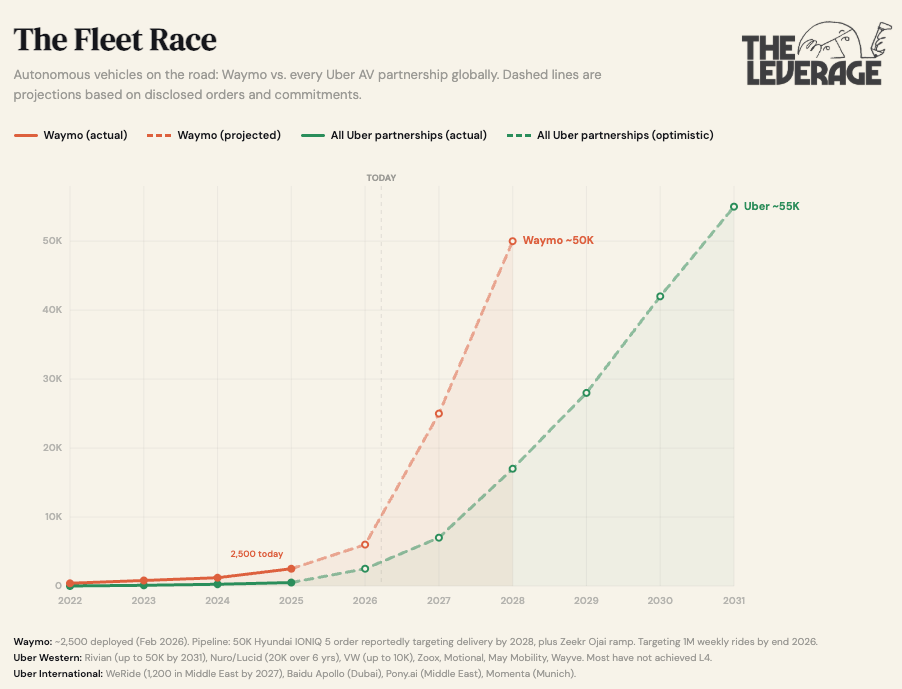
Waymo has 2,500 vehicles on the road today doing 450,000 paid rides per week. It also has a 50,000-unit Hyundai IONIQ 5 order reportedly targeting delivery by 2028, a Chinese-built “Ojai” robotaxi already in autonomous service, $16 billion freshly raised, and a Mesa, Arizona factory designed to produce tens of thousands of vehicles annually. By 2028, Waymo will almost certainly have 50,000 vehicles deployed. Even in the most optimistic scenario where every single Uber partnership delivers on time and on volume, including Chinese partners like WeRide, Baidu, and Pony.ai operating in the Middle East, Uber’s total global AV fleet reaches maybe 28,000 vehicles by 2029. That’s roughly half of where Waymo will already be. The “largest deployment globally” framing only works if you redefine deployment to mean “trips facilitated across everyone else’s cars” rather than vehicles you actually control.
I also can’t help but wonder if the Uber CFO is fudging the numbers by assuming they get some of Waymo’s fleet on the platform.
But even this math, which I would politely call optimistic, is not the thing that makes me most worried about Uber’s strategic position. The bigger problem is that Uber’s 2029 fleet is almost entirely theoretical. The marquee partner, Rivian, the one where they are putting the most cash, doesn’t even have the technical capabilities to do this yet. Rivian’s own SEC filings note the company “intends to develop” Level 4 capability. The same is true for Nuro, Lucid, Volkswagen, Motional, Wayve, and Momenta. Of Uber’s entire Western partnership roster, only Waymo and Zoox have actually achieved Level 4 autonomy. And Waymo, the most important partner on the list, hasn’t expanded its Uber integration to a single new city since June 2025, choosing instead to launch Miami, Dallas, Houston, Orlando, and San Antonio on its own app.
The CFO promising the largest autonomous fleet by 2029 when most of your partners haven’t solved autonomous driving yet is like a 12-year-old promising he’s going to date Sydney Sweeney despite his voice still being a beautiful soprano. I admire the confidence, kid, but you need to hit puberty first.
BIG TECH
Amazon is building a phone again. The younger readers of my newsletter may not be familiar with the lore of the failed Amazon Fire phone, but it was a smartphone that had “3D” features, very limited apps, no access to the Google Play Store, and was cancelled within a year. It was absolutely not bussin.
So it is worth noting that Amazon is trying again. Reports said they were looking at two options at the polar ends of the screen spectrum. The new device will be a smartphone, tightly integrated with Prime memberships and AI, or alternatively, a “dumb phone,” inspired by the Light Phone, which has relatively few apps and is focused on reducing screentime.
If you look at the history of the company’s consumer hardware efforts, the most successful efforts have either been products at significantly lower prices or utilized Amazon’s ecosystem advantages. So, for example, the Fire’s failure came because they tried to do an existing category at premium prices while the Kindle made an existing category radically cheaper (and offered new technology with e-ink).
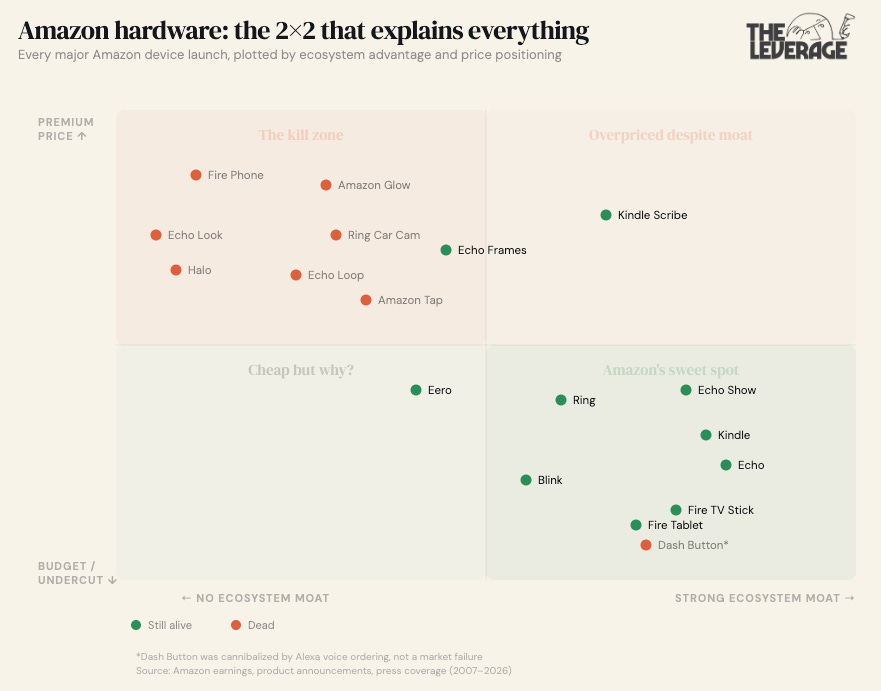
For the phone, the dumb phone movement seems far too small to be meaningful to a company of Amazon’s scale. These devices have, at most, a few million users. And the “make an iPhone but Siri isn’t ass” plan could be cool, but my sense is that every single GPU and chip is going to be needed for other AI use cases. Still, I hope they pull it off! The world needs more quality competition in this market.
THE SLOPPENING
The war in Iran has an AI slop problem. I’ve been writing about The Sloppening for a while now, and I’ve mostly framed it as a consumer problem. Algorithmic content degrades your experience on the internet, your brain turns into pixelated oatmeals, etc. etc. The Iran War has heightened my anxiety about this problem into the “this is existential” category. BBC found that the three most popular AI-generated fake videos from the conflict racked up over 100 million views in the first week. Hundreds of millions more views followed across fabricated satellite imagery, repurposed video game footage, and deepfake war clips. X’s own head of product admitted that 99% of the accounts spreading this stuff were doing it to game the platform’s Creator Revenue Sharing program.
There is this comfort I used to offer myself that “the elites are smart enough to not be tricked.” That view, unfortunately, turned out to be incredibly naive. The Sloppening doesn’t just fool your uncle on Facebook, it is coming for everyone. Remember the Venezuela raid? Photos from the Mar-a-Lago war room showed screens displaying X feeds—senior officials had literally searched “Venezuela” on the platform. These are the same feeds saturated with AI-generated war deep-fakes that are good enough to fool Grok, good enough to fool me, and are probably good enough to fool you too. Unfortunately, the guy holding the nuclear football has already been fooled by AI slop about cars and now that same slop is about missiles. The Sloppening started for me as a theoretical concern about people’s decreasing literacy around the humanities. It has now progressed to a national security problem within the span of about a year.
TASTEMAKER

Project Hail Mary: This is a sci-fi film that copied the Marvel movie formula (complimentary). Ryan Gosling shooting zingers with aliens makes for cute entertainment that hums along at a blistering pace. I saw an early release on 70mm film last weekend and it just opened up to the general public. The cinematography has no business being as beautiful as it is, so it is worth seeing it for that alone. A perfect one to take the whole family to. You should go!
Go and be kind this week,
Evan
Sponsorships
We are now accepting sponsors for the Q2 ‘26. If you are interested in reaching my audience of 34K+ founders, investors, and senior tech executives, send me an email at team@gettheleverage.com.