

AI Native or Death. Choose.
A working definition for the most overused phrase in tech.


Are the startups being funded today ten times better than the cohort five years ago? You better hope to God that the answer to that question is a resounding yes, because otherwise we are all in real trouble.
The reason why this matters is that Silicon Valley is acting like the answer is already decided. Startups are burning more—OpenAI forecasts a $218 billion cash burn between 2026 and 2029. Venture funds keep getting bigger—the top five VC fund closes in Q1 2026 totaled $35 billion, more than half of all US venture capital raised in all of 2025. And the valuations are richer—each week I hear of deals where startups are getting 100-250x revenue multiples.
Top to bottom, everyone is building their strategy around the idea that this current generation of startups are going to be bigger, faster. This gospel has even permeated the public CEO brain as layoffs start to accelerate, with AI being offered up as the excuse. So whether you are in a cushy job at Google, or working in the startup mines, the assumption is that you gotta be “AI-native” or you’re gonna die.
The natural question, and one that I’ve been struggling to answer for myself is, uh, what the hell does that even mean? What is the difference between a normal tech startup and an “AI-native” one? What is the difference between a normal career and one that is fully AI-pilled?
One of my worries is that these strategy choices are incorrect and that these companies/funds are acting too aggressively. That’s capitalism for ya, big risk, big reward, no crying in the casino. But the consequences of getting AI native wrong extend way beyond the people writing the checks.
In either case, answering the question of what is an AI native turns from a theoretical exercise to an urgent, pragmatic question. So today, I’m going to do that in two parts:
What is an AI native financial performance?
What is an AI native product?
By the end, you’ll have a working definition sharp enough to evaluate whether any AI company you’re investing in, working at, or competing against is actually AI native or just wearing the costume. And more importantly, you’ll know what to do about it.
AI Pilled Growth
Even those whose job description says “invest in AI startups” have a surprisingly difficult time defining what they are looking for. I’ve spent weeks asking venture and growth investors variations on “what is an AI startup?” and gotten responses ranging from “grows faster than I thought possible” (good, but also means you could be investing in like, yogurt or something) “uses AI to solve problems for their customers” (sounds academically rigorous, but again, could apply to anything that slaps on a chatbot).
Perhaps the most useful lens is the one where we can be most quantitative. Money! AI Native companies should make more of it and they should make it more quickly.
To figure out if that was happening, I pulled 50 public tech companies on the basis of revenue per employee. As you can see below, SaaS doesn’t look so hot in comparison with the soaring heights of the Magnificent 7.
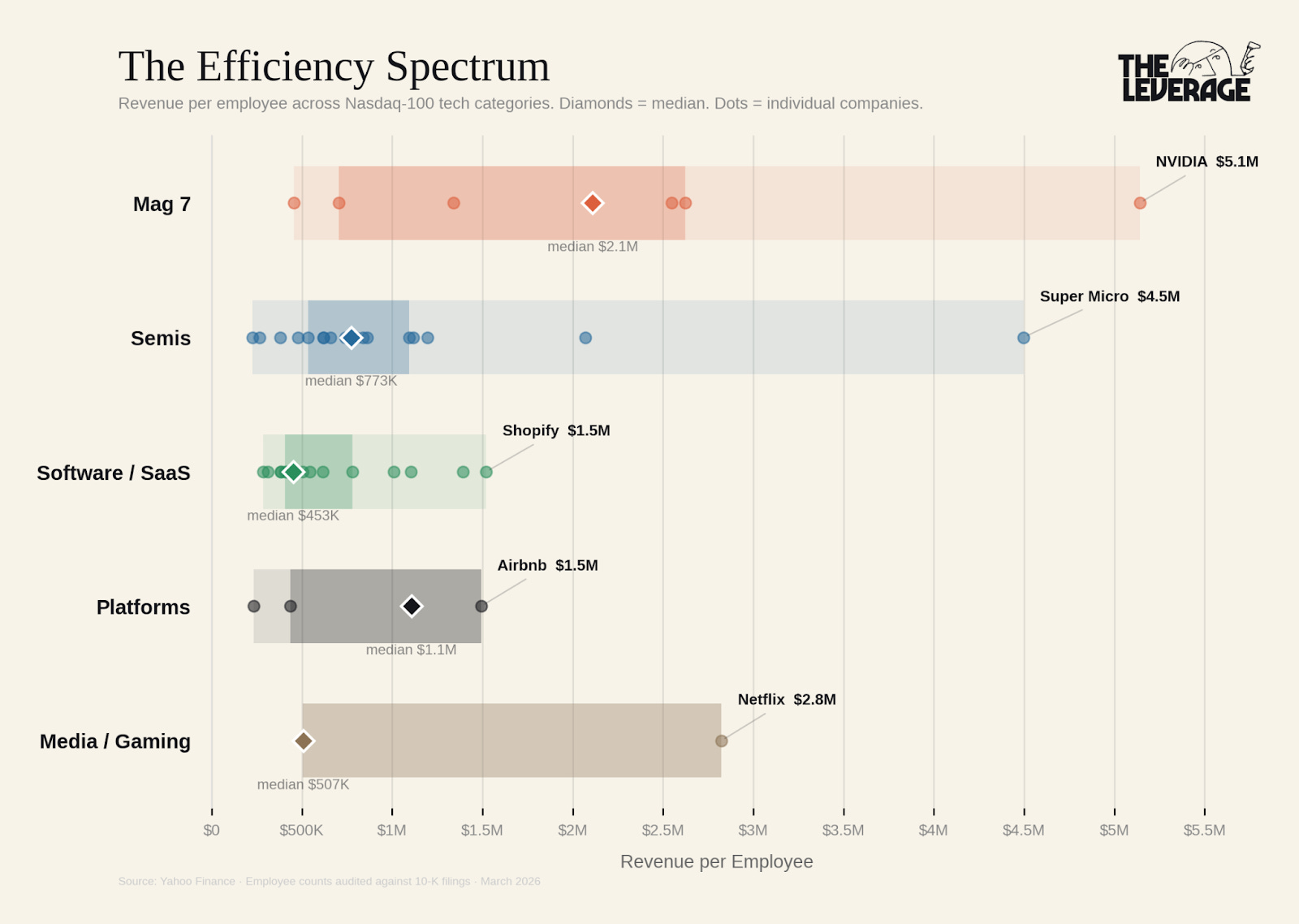
Much of this ratio’s performance is determined by the business model. If you are a SaaS company whose growth is directly bound by the number of sales staff you can hire, you’ll naturally have a worse revenue per employee (RPE), while the companies who have built platforms (Google, Meta) or outsource the labor intensive parts of their process (Nvidia, Apple) look much better.
Next, I scraped an astronomical amount of headlines, LinkedIn posts, and podcast appearances to analyze the startups that you could truly consider to be AI native. I broke them into three categories. Foundation model companies like OpenAI, AI-Native applications like Cursor or Harvey, and AI-accelerated legacy SaaS companies like Notion that have leaned hard into AI. Note: this data is fuzzy, but I am confident all these numbers are in the ballpark and in aggregate, telling.
The chart makes the structural shift visible. Foundation model companies compete with the Mag 7 on per-employee efficiency. AI-native apps spread wide, but even the median ($755K) beats the median public SaaS company by 67%. And legacy SaaS companies that have pivoted hard into AI, like Notion and Intercom, land right in line with their public peers which is impressive seeing how they are in such growth mode.
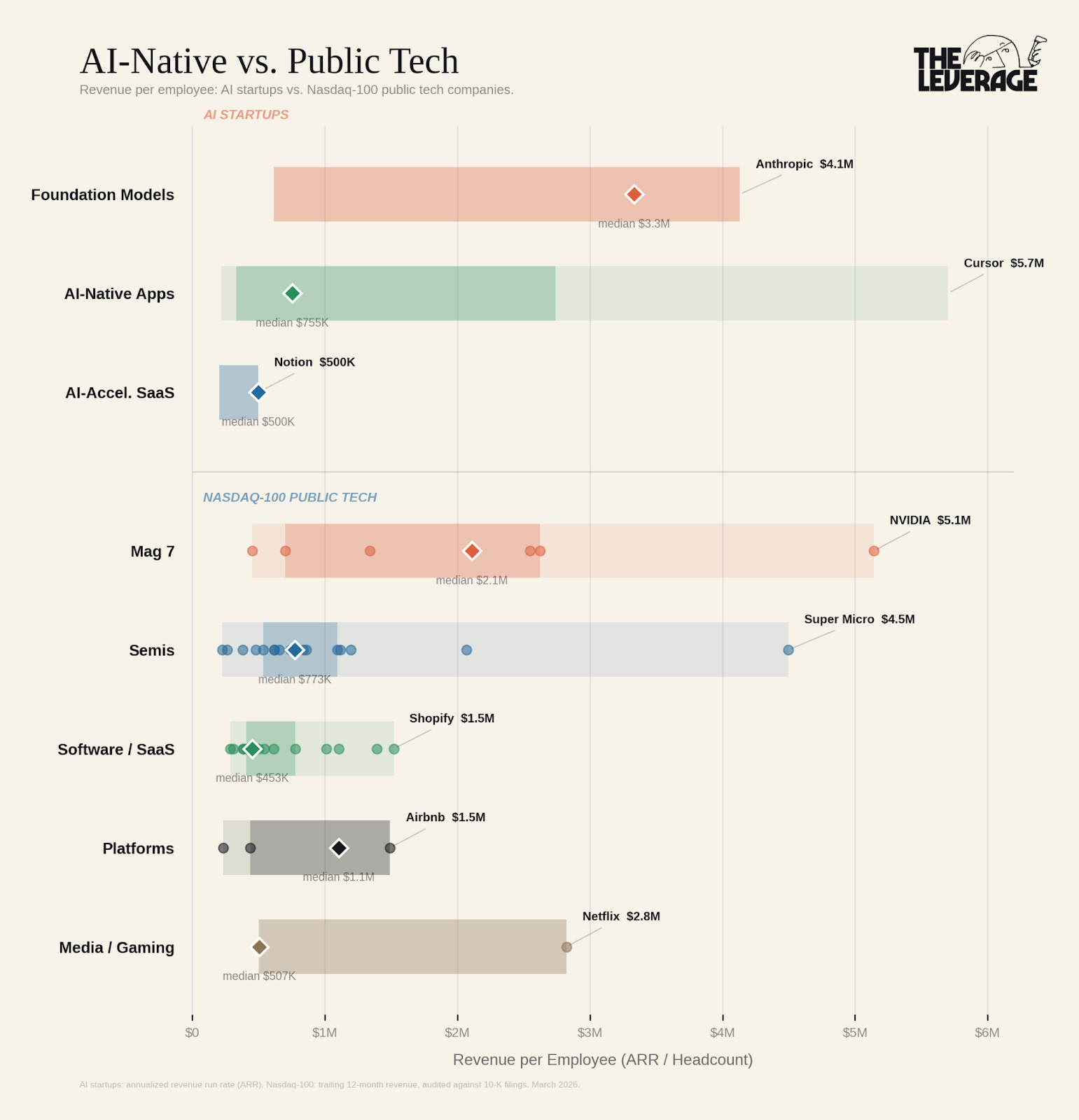
On a revenue per employee basis, the AI native companies are crushing. This is doubly impressive when you consider that every single one of their legacy competitors is frantically adding as many AI features as they can, and it isn’t slowing down the startups.
So the top-line story is clear: AI native companies are more efficient, and they’re winning despite every incumbent scrambling to catch up. But here’s what keeps me up at night, and why I worry more for the readers of this publication than for anyone else in the ecosystem.
If these investors and founders are wrong about AI native, the bubble pops with an unholy level of force, and tech careers take years to recover. If they are right, then betting correctly on the right AI startup, repositioning your investment portfolio, and timing your next career move could make this the most lucrative decade of your life. Either way, the RPE chart above isn’t enough to tell you which scenario you’re in.
Below, I break down what happens when you stress-test RPE against a specific vertical, why the legal tech data reveals a completely different story about AI pricing power, the product framework that separates companies worth betting on from the ones that will get repriced violently, and the cost dynamic that most AI bulls are quietly ignoring.
Keep reading with a 7-day free trial
Subscribe to The Leverage to keep reading this post and get 7 days of free access to the full post archives.