



Whenever the technology paradigm changes—like when we figure out how to make GPUs write code—we have to figure out which rules of building a good business still apply. AI companies are growing at absurd speeds. But how much of that growth will stick? To help separate the hype from the fundamentals, I turned to one of my smartest friends, Kyle Harrison.
Kyle is a General Partner at Contrary where he’s invested in companies like Anduril, Ramp, Base Power, Valar Atomics, and Cursor, and is the Founder of Contrary Research, the firm’s private markets research arm that has grown to 100K+ subscribers. In his free time, he also writes the blog Investing 101 and has a wife, four kids, and (if his kids get their way soon) a dog.
First though, this newsletter is brought to you by Town.

The dirty secret of AI chatbots is that you still do the work. You are still prompting, copying, pasting. Window to window, distraction to distraction. It’s like having a very smart intern who refuses to touch the enter key on their laptop. Town acts instead. I hand my assistant one-off jobs and then it just…does it. By giving it permissioned access to my inbox, Slack, and files, I can automate away the rote drudgery of knowledge work and focus on the labor that brings me joy. I explained the bet making it so good in What's the Bet: Town. Readers get 2 free weeks and 2,500 bonus credits.
And with that, here’s Kyle.
Every tech company, from their pitch deck to their homepage, has a bragging mantle; the trophy wall of super-powered business nerds: first the words “trusted by” followed by the most impressive set of logos they can (legally) muster.
A couple dozen tokens of social proof, assuring the viewer, “don’t worry, grown-ups give us money.” Lately, a “fake it ‘til you make it” version of this wall has been jokingly (or not jokingly) reshaped to say things like “Trusted by users who also trust” so that they can list AWS, Nvidia, Netflix. Not because those companies are users, but because their users happen to be people building technology or, you know, watching TV.
This phenomenon is an attempt by founders to manipulate a potential customer’s psychology. Revenue is based on a simple trueism: price x quantity. And here you have, displayed for your viewing pleasure, the best of the best represented in that quantity. Logically, then, the thinking indicates the more logos, the more social proof. But that’s not quite right.
As an investor, I’ve looked at thousands of companies and I can tell you definitively that startups who go logo hunting are like people who date for looks alone. Beauty on the outside fades. You know where it actually counts? The inside. And beauty on the inside for a startup customer? Annual contract value.
Let’s use Snowflake as an example. Divide its market cap by its customer count and each logo is worth roughly $8.7M. ZoomInfo will share similar logos with Snowflake, and despite that, if you run the same math each logo is worth about $34K. It is the same caliber of customer, somehow yielding a 250x gap in what that logo actually represents.
Clearly, the same logo in the hands of wildly different products can yield dramatically different volumes of value.
Let me explain why this is more nuanced (and important) than you might think.
The Narrative Is The Number
Historically, before everyone had penned their “software is dead” blog posts, high-growth software companies traded on a multiple of revenue. The traditional median has always existed somewhere between 3-15x NTM revenue. Starting in 2019, there was a dramatic bifurcation between the haves and the have-nots. That split between the standard median and that of the five most highly valued companies currently sits at 4.4x vs. 32.7x.
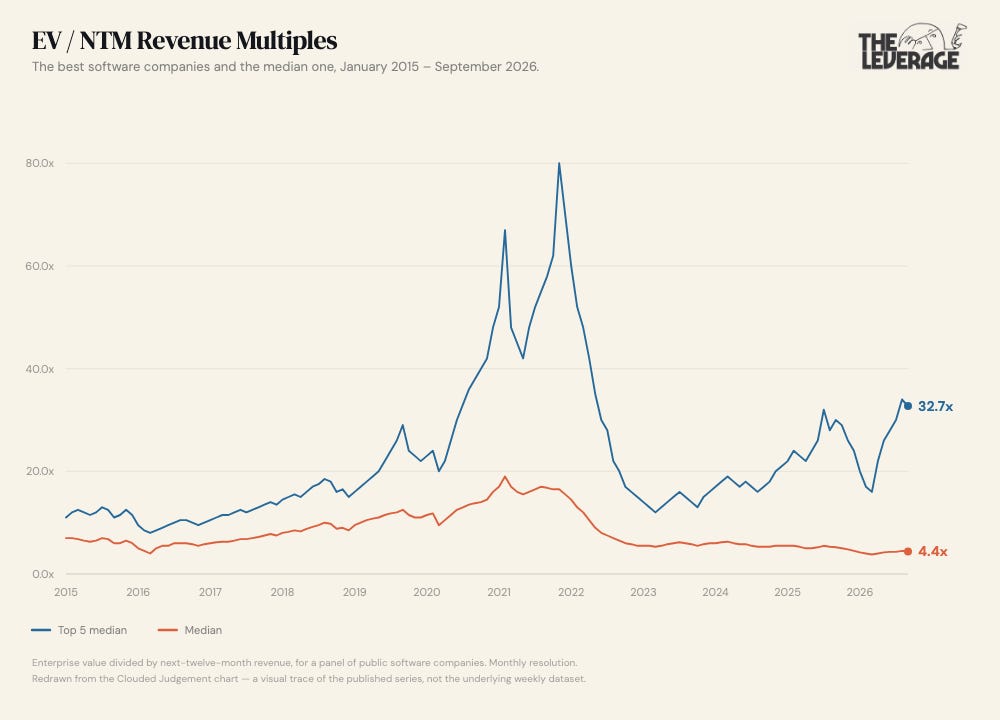
I’ve written before about the widening divide between the best and the rest, and it shows up nowhere more starkly than these multiples. I’ve argued that if you put a hedge fund analyst and a venture capitalist on a game show and asked them to fill in the question, “a company’s valuation is primarily based on BLANK,” the analyst might say something stupid, like “discounted future cash flows” while the VC would speak a noble truth: “the narrative.” See, a market cap is stock price times shares outstanding, and stock price is a function of demand. Better narrative, more demand. The multiple is the market’s confidence, priced in.
To get at this insight about value per customer, you then just take that number, laden with popular opinion, and divide it by the number of customers. That is, effectively, how much value the market ascribes to each customer. There’s a ton of nuance in that calculation, but when you step back and look at the list you get quite a data set:
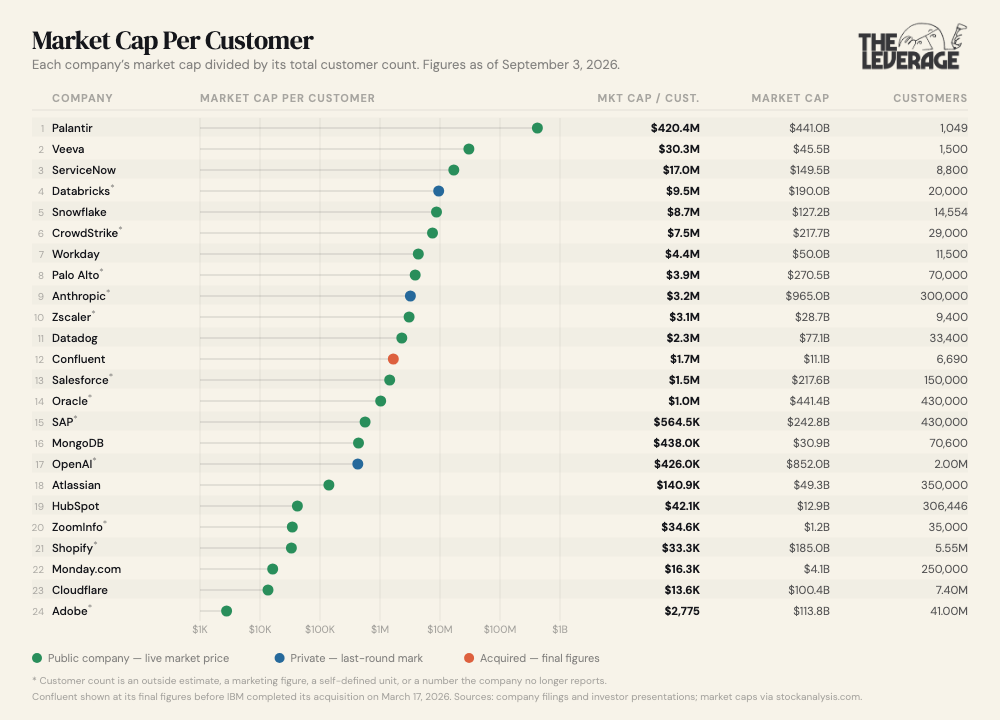
Now, does having a lower market cap per customer inherently mean that you have a worse business? Not at all.
Cloudflare’s number is $13.6K because they serve 7.4M customers; a huge swath of the internet. Shopify’s market cap per customer is $33K because their customer base is a long-tail of over 5M merchants. Adobe sells to individuals, MongoDB is self-serve, SAP has an SMB channel, OpenAI has an API available to anybody.
But it certainly can mean your business sucks. ZoomInfo’s market cap per customer has plummeted from $580K in 2022 to $34.6K today as the stock has slid -93%. The market has just increasingly valued their customers less and less, despite the customer count not changing that much.
Two other data points that help illustrate the value per customer discussion is (1) revenue per customer, or a rough approximation of average contract value (ACV), and (2) net-dollar retention (NDR), or how much that spend is increasing or decreasing. The waters can get quite muddy here because most companies don’t report detailed breakdowns of customer counts. So we’re ball parking in some cases, but the analysis is directionally accurate.
Frequently, when you look at the most highly valued companies, a lot of them have high ACVs (Palantir, Veeva, ServiceNow). On top of that, many of the biggest recent drawdowns in software (Monday, Hubspot, ZoomInfo) are all low ACV companies.
But the most statistically significant indicator of value is high NDR. When you look at the 39 software companies that publish NDR, you see a spread that yields R² = 0.557 between NDR and valuation. For those of you who did NOT enjoy your statistics class, what that means is NDR alone accounts for ~56% of the variation in revenue multiples.
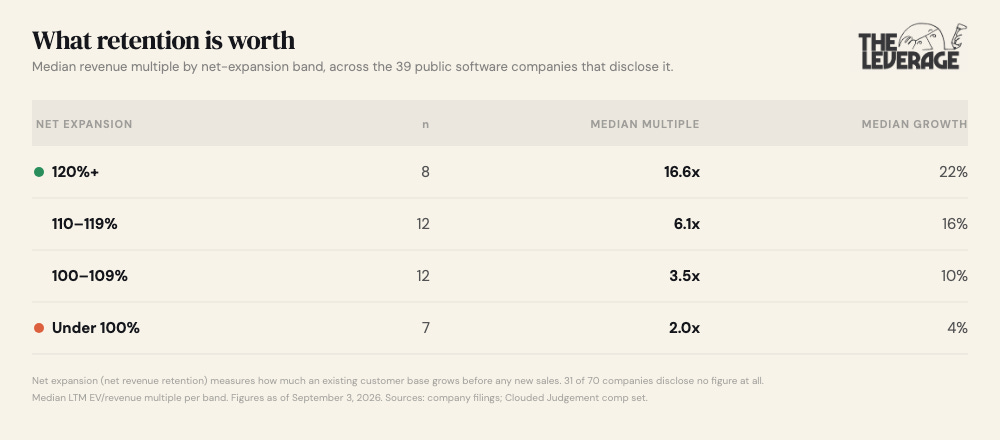
So the derivable rule of thumb, then, is rapidly expanding customers earn you a high multiple, and bigger customers help you keep it. But why?
Is Bigger Better?
Like I said earlier, companies like Cloudflare, Shopify, etc. do fine adding lots of small customers. But the question of company health sits behind the engine that produces each customer and how much value can be extracted. The smaller the logo, the smaller the impact it has on the company’s value.
Even more than size, the issue is scope. Where does that customer go from here? Net dollar retention of 126% means that the average customer, just sticking around, is going to spend 26% more than last year. That’s an appreciating asset! And when the customer is already spending $1M+ a year, that 26% adds up a lot faster than a $20K customer.
The other side of the NDR equation is churn. In June 2026, our friends at CRV gave us a churn rate benchmark to shed some light on the split:
SMB & Self-Serve (e.g. <$10K ACV): 3-5% monthly logo churn (e.g. 31-46% per year)
Mid-Market ($10K to $100K): 1-2% monthly
Enterprise ($100K+): 0.5-1% monthly (e.g. under 11% per year)
So just by nature of selling to smaller customers, you could lose somewhere between a third and half of your logos each year! Talk about running in place. That also informs payback math. Since SMB customers leave fast, you have to earn them fast; typically within 6-9 months. Enterprise customers have 18-24 months to pay back because they’re typically multi-year and larger.
Everything in a company gets shaped around that clock; sales comp planning, customer support, feature deployment time, hiring ramp up, etc. I’ve written before, in the context of how founders should pick which dependencies to serve, that if you want to sell to enterprise customers then getting caught up serving SMBs, it can be death by a thousand costs that slow you down and make everything more expensive.
The Token Tax
I’m not gonna lie. In an age of tokenmaxxing and trillions in AI CapEx, some of this talk of NDR and customer payback feels old timey, the language of a bygone era. But, it turns out, the same underlying principles hold true in the age of AI. In fact, they may be even more true. But it’s not obvious, so stay with me.
The typical thinking around SaaS ACVs was crafted in a world where the marginal cost of serving a bigger customer was approximately nothing. You can sign a customer 10x your typical size and the cost of goods barely moves, so every incremental dollar slides right into gross profit. Higher ACVs are like printing free money.
AI, on the other hand, is far from free. Every inference, token, and agent loop costs something. Where traditional SaaS consistently puts up 75-85% gross margins, AI-native products were expected to generate ~52%, on average, in 2026. Even as AI labs put up better margins, there’s a steamy debate about whether the billions in model training costs are R&D or forced to recur as a cost of doing business given how competitive the market is. Regardless of where AI margins end in the long-run, we’ve got a long way to go before I’d call the marginal customer free. So today, where a $1M SaaS deal could spit out $800K of gross profit, the same customer using AI-laden products would spit out $520K. That means an AI company needs 1.54x the contract value to buy the same gross profit as a software company.
So the marginal cost to service has flipped. Where SaaS was focused on the cheapest customers to serve at the margin (e.g., staying in your ideal customer profile), AI is focused on the ones burning the most tokens. But in both cases, the real value drivers are in the very largest customers; the whales. If we isolate customers spending $1M+ you see a shockingly similar picture.
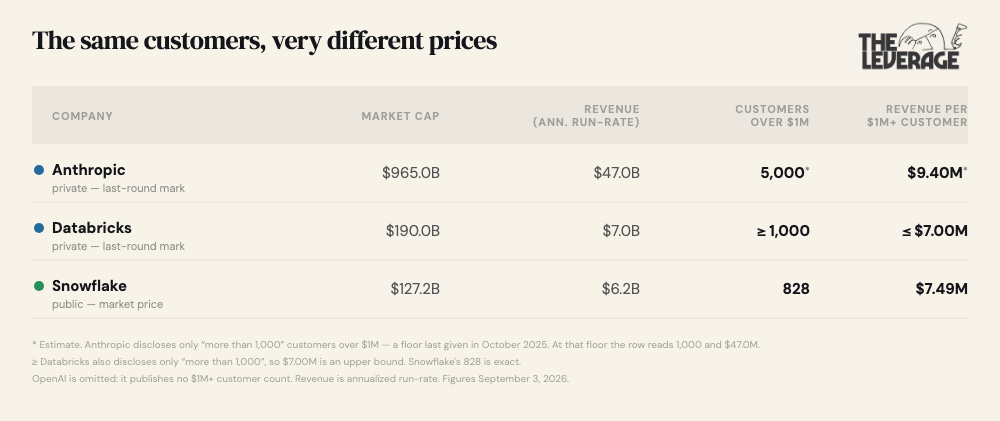
Like I said earlier, we’re muddying the waters because we only have rough customer counts and we’re taking total revenue, not revenue from $1M+ customers. But it gives us some apples-to-apples cuts that are instructive. Take just two examples; Anthropic and Snowflake. Compare their revenue per whale, and then take into account gross profit per whale:
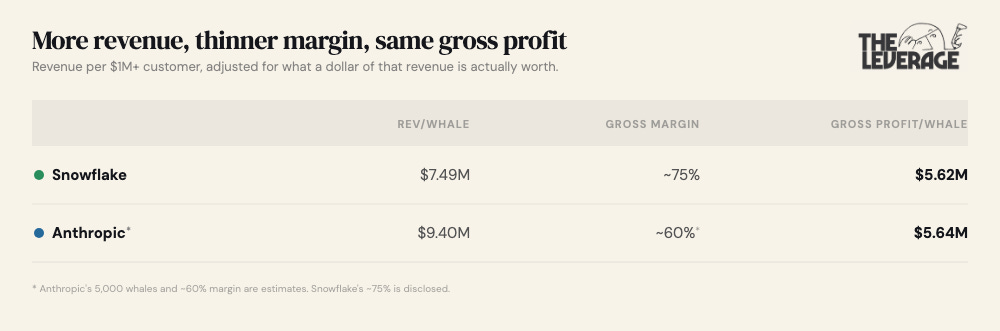
Anthropic earns 26% more revenue per large customer, but it keeps 20% less of each dollar. As a result the underlying economics of AI vs. SaaS are very similar. In a complex function of revenue growth, ACV, NDR, and gross profit, you find a fundamental equation of “value per customer.”
The fact that that equation holds true is a fundamental law of business physics. The larger the customer, the more value they contribute, both in terms of profit and expansion. AI hasn’t thrown out that playbook, contrary to the claims of radical revolutionaries; it’s reinforced it! The bigger question with AI, instead, continues to be one of durability.
Is It Even Revenue?
In the same way that customer logos aren’t created equally, the same is true of revenue quality. Brad Gerstner has pointed to a specific characteristic that much of AI revenue has:
“ERR (experimental runrate revenue) versus ARR (annually recurring revenue). The first is a promotion likely to go away (no valuation multiple) and the other is truly a sticky, high margin subscription (high multiple). Failure to know the difference in software is DEADLY!“
Jamin Ball, one of Brad’s underlings at Altimeter, elaborated saying that there’s very little organizational maturity around how anyone procures this stuff. Companies experiment with functionality and then migrate. They prototype on a specialist tool but then deploy production on an incumbent platform. He frames it as “re-occurring vs recurring.”
How durable is that revenue? Time will tell. But the implications for anyone trying to build a business around Mega-Million Dollar customers is that a high ACV booked out of an experimental budget is still far from ARR that will stick around in perpetuity. Contract size and contract durability are not equivalents. Any AI transformation could evaporate as soon as someone switches their line of questioning from “how are we using AI” to “what is AI costing us.”
It’s true that expansion has the most statistical correlation to higher revenue multiple. And AI reinforces that narrative. We’re seeing experimental revenue in a lot of companies that starts small and expands dramatically. As a result, ACV gets deprioritized. But that doesn’t just deemphasize on the V in ACV but the C. It’s not just downplaying the dollar amount of the value, it’s ignoring that contractual portion of being a contract. “Multi-year?” they say, “It’s barely multi-month. But boy is that spend expanding!”
And there’s a lot of characteristics in the AI GTM that is reinforcing that shift towards small and fast when it comes to the $37B of enterprise generative AI spend. 47% of AI deals go to production against 25% for traditional software, while 27% of AI application spend arrives through product-led growth vs. 7% for software. So things are converting better, arriving more bottom-up, but at ~80% of the contract value with meaningful thinner margins.
We’re pricing this stuff like Palantir but selling it like Hubspot. That doesn’t smell durable to me.
Where Do We Go From Here?
Maybe all of this stuff gets resolved. Contract values increase, margins improve as inference gets cheaper, experimental budgets convert into operating lines, and million-dollar customers turn into ten-million dollar customers. But the wariness should persist. Every square on that frosted logo page is like playing a game of minesweeper. Where there might be a customer about to triple spend, there’s also another customer shifting from tokenmaxxing to tokenoptimizing.
As Ben Graham once said, “In the short run, the market is a voting machine, but in the long run, it is a weighing machine.” A logo wall is a voting machine; everyone and their mother wants Ramp on that logo wall because it’s a vote! A lot of emphasis has been placed on growth; these ungodly levels of ARR scale up. “Fastest time to $100M ARR,” every company breathlessly shouts. And as we’ve seen, that certainly gets you the high revenue multiple. But the size and durability of your customers are what you have left when the growth slows. Every company eventually finds out what kind of engine they’re building when the hype tide goes out.
So whether you’re building the business or evaluating it, your gut should always be to avoid the vanity metrics of voting and focus, instead, on the things that can be adequately weighed and measured. Businesses are engines that turn inputs like capital and labor into outputs like revenue and tokens. Which of those outputs are appreciating assets? And which of them are artificially inflated?
I guess we’ll find out.
