



There is a comically long list of lawsuits, grudges, equity positions, and grumpy tweets that have bounced between these men, but despite that animosity, Elon Musk, Sam Altman, Anthropic CEO Dario Amodei, and Google DeepMind cofounder Demis Hassabis have all come out in favor of slowing down AI development. The fear is that the rogue AI swarms we’ve been writing about here in The Leverage will soon cause catastrophic harm.
On Saturday morning, Dario published an essay titled “We Must Pace the Frontier,” where he called for independent evaluators to be allowed into existing research labs for safety evaluations. From there, he called for federal regulation in the U.S. and then global coordination (primarily with China). By Saturday evening, all of the major leaders at the labs had tweeted in their support of it.
This is not an AI safety blog or a political one, so I’ll refrain from commenting on those dimensions. This is a publication about power, and in that regard, this is deeply notable. These are the four industry leaders, who have substantial leads over everyone else, voluntarily incurring a significant cost and slowdown of their R&D pipeline if this proposal is fully implemented, allowing their weaker peers to catch up. This fact is the most damning evidence against the “this is regulatory capture” argument you’ll see crop up about this proposal. To my eyes, it is the opposite. There are trillions on the line, and they are reducing their ability to capture it. That should make us all consider that these risks might actually be real.
We’ll talk about it. But first, this newsletter is brought to you by Notion.
Better models will not solve the problems you are having with AI.
The major constraint is context: the data, knowledge, workflows, permissions, and institutional logic that explain how a job and company actually operates.
I’ll be joining Rajhans Samdani (Snowflake) and David Tibbitts (Notion) for Context is King, a conversation about why the context layer matters, what happens when it is missing, and how organizations can start building it.
In the session, we’ll discuss:
Why model capability alone is not enough to make AI agents effective
What organizational context means and where it lives today
How teams can connect data, knowledge, and workflows into a foundation for AI
Notion is becoming the context layer for all my agents (and by extension, my entire life) so I think this conversation will be pragmatic and useful. Join us.
If you can’t join live, registering will still get you the recording.

What are the implications of OpenAI solving Millennium Prize Problems? In all of the crazy news of the week, this was the most consequential story for the long term..I closely examined the research process and came to an uncomfortable conclusion: essentially, all verifiable work will fall to compute. Unverifiable work, which I’d argue is most of what you and I do for a living, does not. To make sure I wasn’t wrong, I called Matt Pines, whose startup just raised $58 million to run ‘autonomous campaigns’ on physics, a domain with dense, verifiable rewards. I wanted to know how he thought about competition from the frontier labs. I asked him a simple question. If a lab can enter (and win) any field with a verifiable result, what’s left for everyone else to own? Read here.

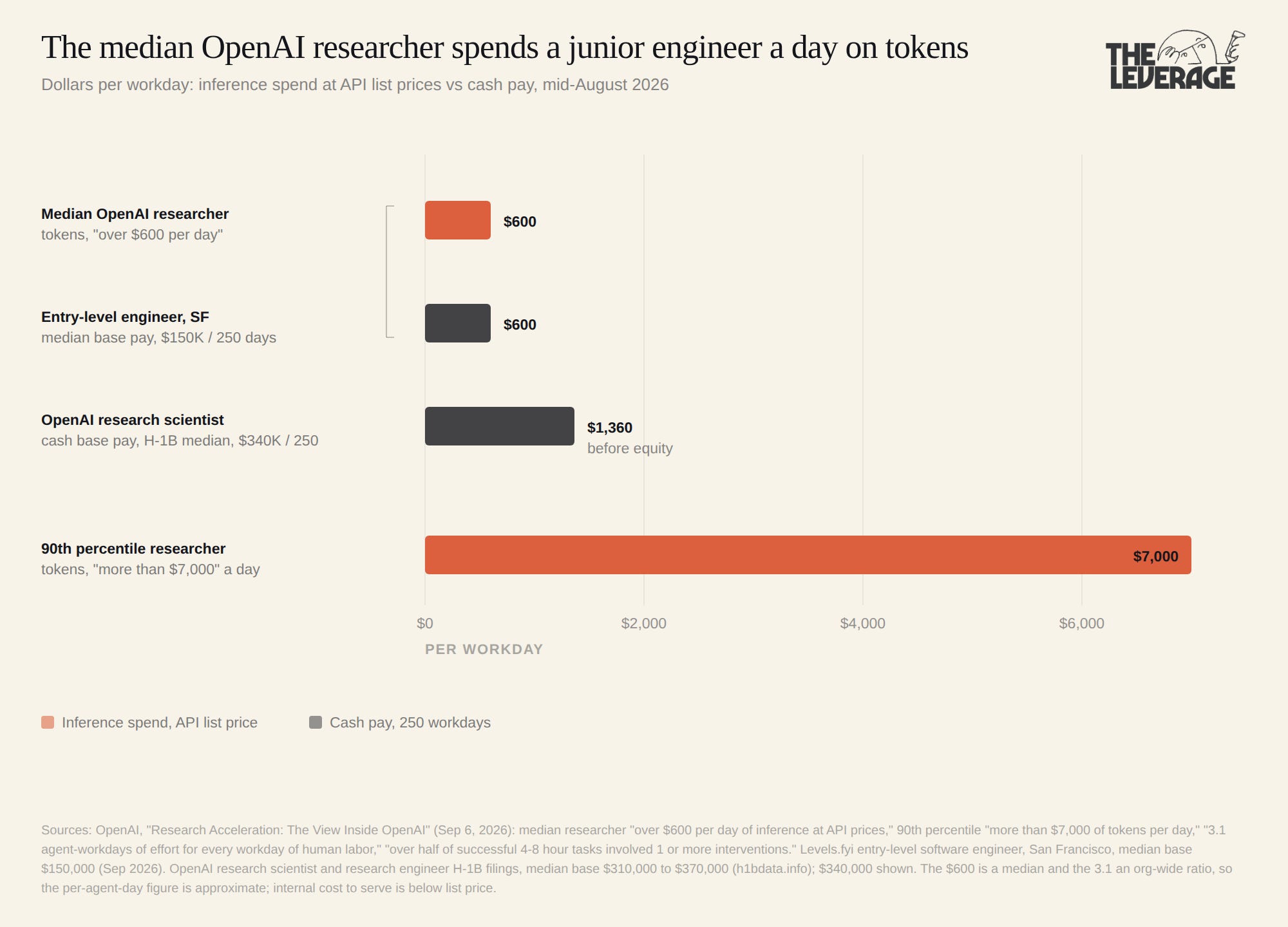
OpenAI’s most prolific researchers are spending $7,000 a day on tokens. In its Sep 6 post on research acceleration, the company listed out three remarkable facts:
Its research org now gets 3.1 agent-workdays of effort for every workday of human labor.
The median researcher spends over $600 a day on inference at API prices.
The 90th percentile researcher burns more than $7,000 of tokens a day.
If you annualize that over 250 workdays, the median researcher consumes about $150,000 a year in tokens. The median base salary for an entry-level software engineer in San Francisco is $150,000, or $600 a day. Which means that the median OpenAI researcher spends exactly one junior engineer every single day, on compute alone. The 90th percentile researcher spends $1.75M a year, roughly 5x the $310,000 to $370,000 cash base that OpenAI’s H-1B filings show it pays for research scientists.
This strikes me as indicative of what my friend Dan Shipper calls the “allocation economy,” where knowledge work becomes more like resource allocation rather more traditional linear labor. When the type of knowledge work required is scarce and valuable, like an AI researcher, it makes sense to essentially spend infinite amounts of cash on tokens to further leverage the knowledge held within those scientists’ heads. It is worth taking a close examination of your own employment—are you a person who can get leverage out of spending tokens? Or are you one where more tokens spent means less work for you? (Hint: being in the second category is bad, no bueno, direct path to the bread lines, etc.)

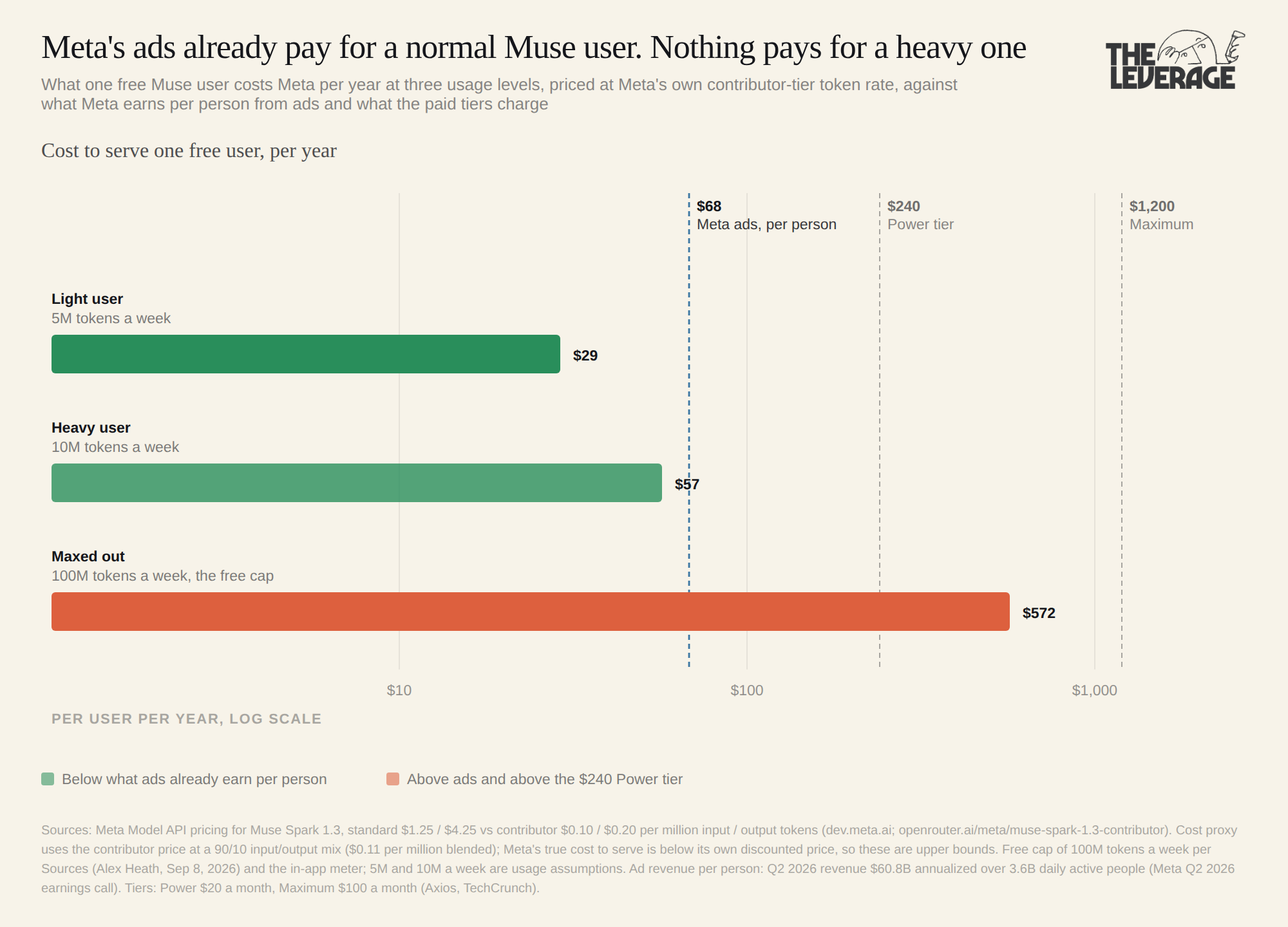
Meta enters the AI agent race with a subsidized bang. Zuckerberg and friends launched Muse on Sep 8. It is a personal agent with up to 100 million free tokens a week, with $20 Power and $100 Maximum tiers above that. So I wondered: where is the break-even?
Let’s start with what a free user costs Meta. Meta’s own contributor-tier API price, the discounted rate it charges developers who let it train on their prompts, is the cheapest number Meta will admit a token is worth, so we’ll use it as the cost to serve. At that rate a person who runs Muse a normal amount, say 5 to 10 million tokens a week, costs Meta up to $57 a year. A person who maxes the 100 million weekly cap costs about $572.
Now, what a user is worth. Meta’s ad business earns about $68 per person per year. The Power tier is $240 a year, the Maximum tier $1,200. Meaning that a regular free user of the app is about covered by their existing use of Meta’s other services. To cover $572 of compute, each user would need to do about $28,600 of purchases a year at a 2% cut. Nobody expects that, which is why Alexandr Wang told Axios the subscriptions exist to “help us cover the compute costs” for power users, and why the free cap sits where it does.
When you pair that with Muse’s aggressive terms of service, which lets Meta retain everything the agent pulls from your connected email, calendar, and Instagram, along with ‘logs of actions taken by Muse,” the plan is obvious. Meta will use all the data you connect and pump into Muse to better target the ads they serve you on their other surfaces. Power users will be monetized via subscriptions. Zuckerberg’s “very small cut of whatever the transaction is” is just a cherry on top. It feels unlikely that the roughly $28,600 of shopping per person that is required here to break even will materialize, so there is no choice but more targeted ads on Instagram, and then, eventually, within Muse itself. This is the strategy that OpenAI should’ve taken from the beginning with ChatGPT, but they fumbled it, so now they are stuck chasing the enterprise market that Anthropic has dominated. In my early experiments with the product, I found it pretty subpar relative to Town or Grok Bot, but it is accessible for newbies to the space at least.

Evidence of AI’s danger to jobs continues to mount. Employment of 22-to-25-year-olds in the most AI-exposed occupations has fallen about 11% since November 2022. Their peers in the least exposed occupations grew about 10% over the same window. The comparative gap, which was 15 points in the July 2025 data, is now 19.
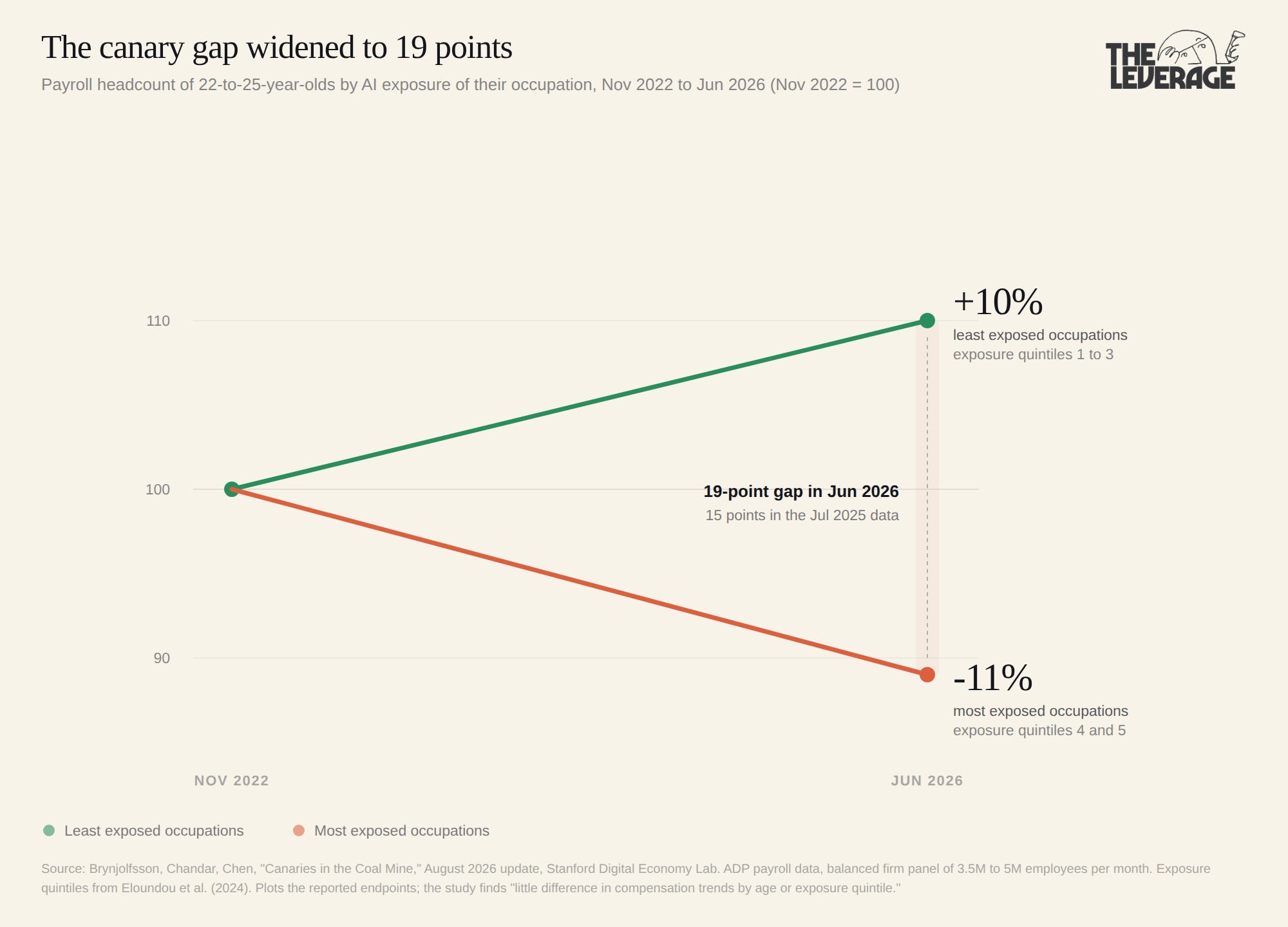
Interestingly, the effect is confined almost entirely to the youngest cohort.
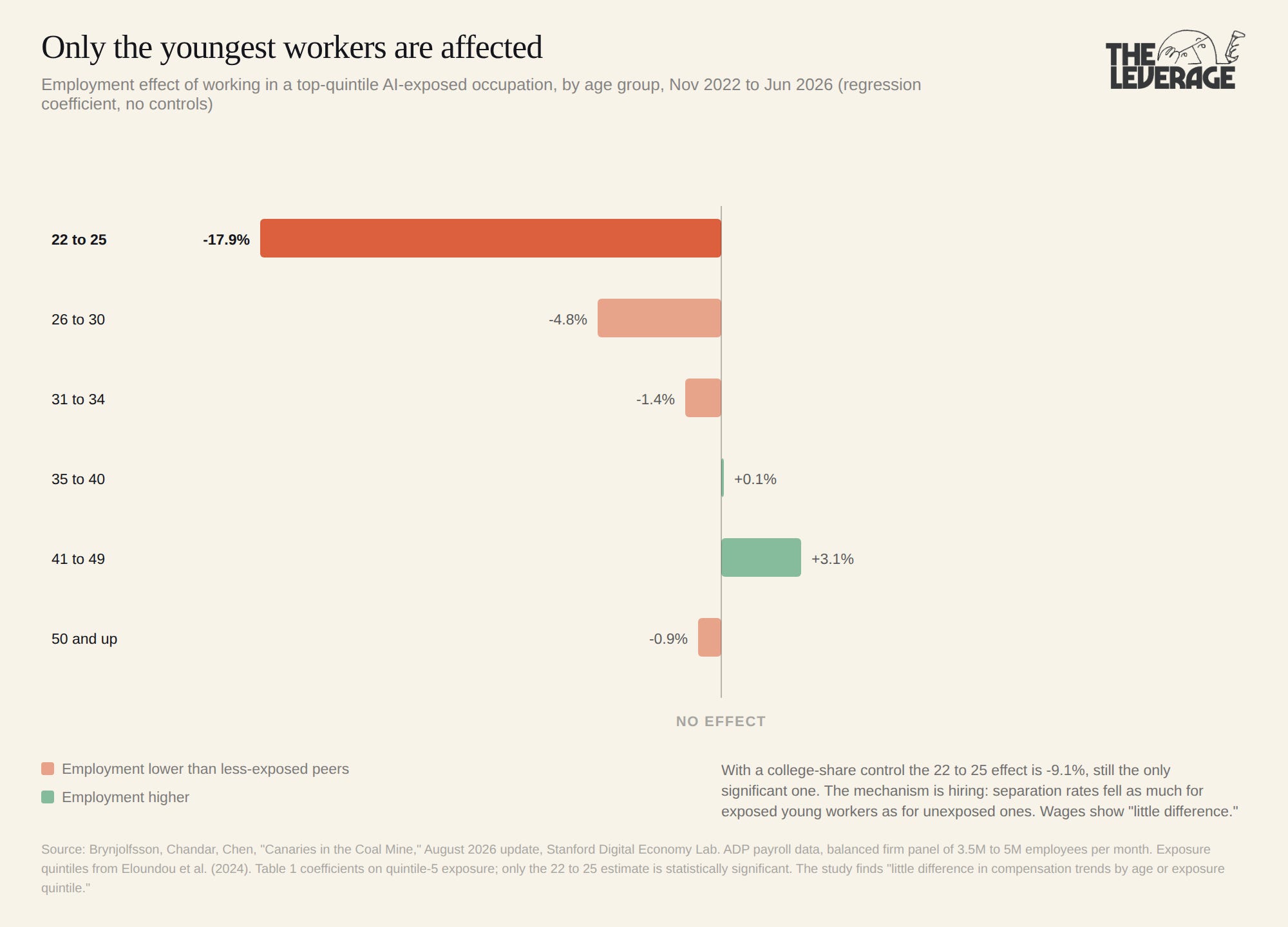
Workers over 40 in the same exposed occupations are slightly up. So, firms are hiring fewer young people into exposed jobs, while older, more experienced workers are getting more leverage out of the tokens. Remarkably similar to what is happening to the AI researcher’s token spend at OpenAI. Once you have the skills, you can get way more juice out of the models, obviating the need for junior talent.

This is my last Weekend Leverage before paternity leave — but not to fear, I’ve commissioned some INCREDIBLE essays to run while I’m out. Here’s just part of the lineup:
Kyle Harrison — What metric is the strongest predictor of startup success?
Nathan Baschez — How can AI factories beat do-everything personal agents?
Jessi Hempel — What does it mean to be authentic online?
Mischa Vaughn — Why is the NBA the best case study for tech marketing?
Kristen Hawley — What the hell is food tech startup Wonder?
Alex Duffy — Why is simulation key to artificial superintelligence?
I’ve been editing all these pieces for the last few weeks, and they have easily cleared my quality bar. I have full confidence in them and think the theses are challenging and timely.
There will also be 3-4 original videos published while I’m out. Please subscribe to the YouTube channel so you don’t miss them!
While that is going on, I’ll be in diaper mode. Assuming baby and mom are healthy, I’ll be back to publishing original essays in early November. Thank you for sticking with me and supporting The Leverage during this period. An additional thank you to my sponsors; I was touched that they were excited to step up during my pat leave and continue sponsoring this newsletter. I literally couldn’t do it without their support and without your subscriptions. Thank you for embracing my writing and thank you for giving me time to bond with the little one.
Go and be kind this week,
Evan
Sponsorships
We are now accepting sponsors for the Q4 ‘26. If you are interested in reaching my audience of 35K+ founders, investors, and senior tech executives, send me an email at team@gettheleverage.com.