



On September 1, a rumor reached OpenAI that a rival lab had solved two of the Millennium Prize Problems. This is a company that can smell a marketing opportunity at 500 miles, like a shark with the blood of competitors in its nostrils. So, of course, the firm started dumping millions of dollars of compute on the questions.
Ironically, the rumor turned out to be wrong on both counts. It was NYU professor Tristan Buckmaster and Anthropic employee Levent Alpöge working independently of their employers, using AI tools including Codex and Claude to crack a related problem, not a Millennium problem itself. But OpenAI had a bazooka to bring to this knife fight: an unreleased model that, according to the company, was significantly more powerful than GPT-6 Astra.
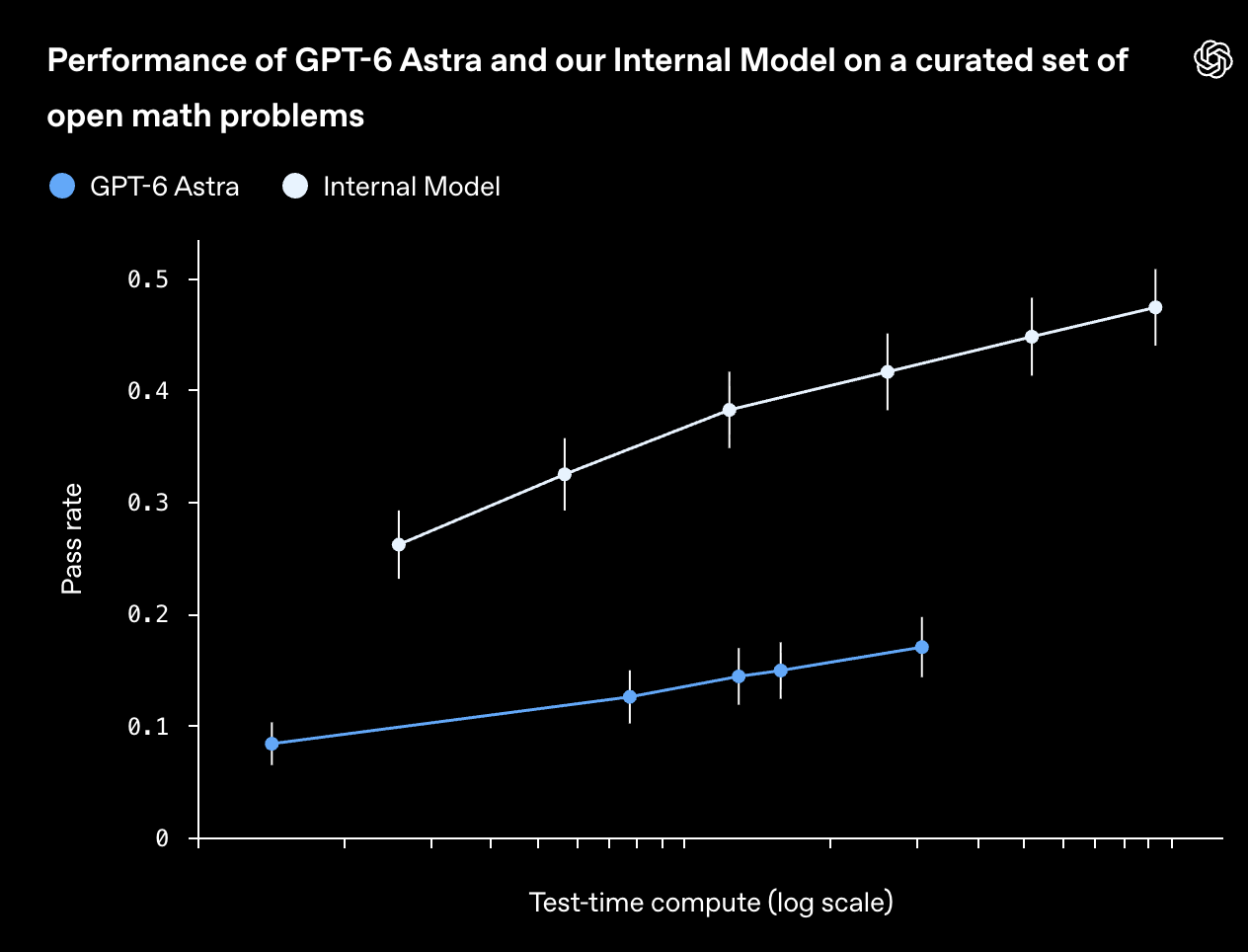
OpenAI put teams of AI agents—instances of the model running in parallel, with the ability to chit-chat with their fellow AIs—to work on all the open Millennium Prize Problems. When roughly 100 agents cracked a related fluid-motion problem in about 50 hours, the human researchers pulled agents off the other problems, fed them that result, and used Codex to pass the best ideas between groups. Buckmaster and Alpöge had worked on Euler equations with an external force; OpenAI’s first result concerned Euler without that force. Both were stepping stones toward Navier–Stokes. By the end, about 10,000 agents were running at once in the group that produced the proposed proof. Over the course of four days, less time than it takes for the strawberries to go bad in your fridge, the agents had produced a proposed answer to a question that had stumped the world’s best mathematicians for the better part of a century. If it holds up, I would consider it the most important proof an AI has ever produced.
The headline version is irresistible: “This only took the AI agents 88 hours! Humanity doomed???” The 88 hours is accurate, according to OpenAI. It then took another 17 hours to translate the proof into Lean, a language that lets software check mathematical arguments, and verify it. Still, please don’t just trust the headlines on this one. What is actually happening is far more subtle (and more important).
What matters is the process that produced the result. Researchers no longer actually did math. They just monitored progress, shifted resources toward promising work and consolidated what different groups learned. Essentially, if you’ve ever rebalanced and gotten really good at playing Sid Myers Civilization or Factorio, congratulations: you are qualified to supervise the collapse of the Millennium Prize Problems.
OpenAI researcher Noam Brown said the effort cost millions of dollars and predicted that work of this caliber would become accessible through ordinary AI use within a year. If today’s frontier reasoning (which as a reminder, just cracked a problem that all of humanity has been unable to solve for the last 90 years) is a commodity within 12 months, maybe the most important question in the world is who profits from this newfangled power. After all, if scientific progress is a question of resource allocation, of knowing where to point the agent swarm hive, then profit is going to be the ultimate determinant of what kind of science gets advanced.
So in this headline three things are revealed:
1) An indication on what the future of work is
2) A warning that the power the leading labs are increasingly holding
3) The value of secrets.
To test all three of my ideas, I called Matt Pines. His company, Physical Superintelligence (PSI), raised $58 million on September 1, the same day the rumor reached OpenAI, to build what he calls the “Standard Oil of physics.” I asked him whether OpenAI was coming for him. He said no. I think he’s wrong, and what makes him wrong is the same thing that makes his company possible.
