


Perhaps it is old-fashioned of me, but I believe a founder has a moral and spiritual obligation to their customers and employees. Yes, they must pay people on time, and yes, they must deliver stellar products, but most importantly, their job is to lead, in all senses of the word. When a CEO fails to do so, even in aspects of their private life, it introduces a rot that can slowly permeate an organization.
In the summer of 2025, Nvidia reported that 22% of its revenue, about $10.2 billion in a single quarter, was billed to customers in Singapore. The very next quarter, that line went poof. The company switched to reporting revenue by where a customer is headquartered instead of where the invoice goes, and Singapore was gone. At the time, I raised my eyebrows. Nvidia said that almost none of those chips were physically going to Singapore. That struck me as weird. Why were they all billed there? What was the chips’ final destination? Maybe some were getting smuggled to China through dummy corporations in Singapore? Still, it was Nvidia, and more than that, it was Jensen, a founder who had a reputation for upright and moral behavior. So I just accepted it.
But Jensen’s tryst puts that accounting change in a totally different light, one riddled with uncomfortable coincidences:
Alice Huang is a former executive at a Singapore-based Nvidia customer called Megaspeed.
The Information then reported that companies tied to her have obtained at least $7.5 billion of Nvidia chips since 2023, many of them restricted from sale to China.
The accounting change that erased Singapore from Nvidia’s filings came shortly after the company put Megaspeed on an internal block list.
Nvidia denies knowing of any smuggling, but simultaneously, reporting from the New York Times showed a picture of Jensen pressuring Trump admin officials to leave Megaspeed off of sanctions.
New analysis shows top Chinese AI models are being trained on Nvidia chips they shouldn’t have access to.
Annnnd that sounds like a very reasonable set of circumstances to kick someone out of their own company. You may believe that Jensen should stay despite these coincidences, or you may think the board did the right thing, but regardless of your preference, I believe the board’s actions are defensible.
I have absolutely no idea what happened here. Maybe there is corporate tomfoolery sprinkled with nation-state espionage, or maybe it is all just a terrible coincidence, but the fact that this is a question at all stems from Jensen’s cheating on his wife. And now that terrible choice (which he apparently made multiple times) will cascade through the entire global economy.
We will get into the implications of all this in a second, but first, this newsletter is brought to you by DeleteMe.

If you read this newsletter, you probably have a public profile. LinkedIn says where you work and what you raised. A podcast or a random blog post will show how you think. Data brokers fill in the rest by offering your home address, phone number, spouse, kids, and property value up for sale. Put those together and a stranger has everything needed to show up at your door, or to prompt inject your AI agent with a story that checks out. Companies figured this out years ago, which is why over 20% of the Fortune 500 pay to scrub their executives. Founders, investors, and operators carry the same exposure with no fancy security team behind them.
I noticed this problem when the scam attempts I was receiving kept getting more personal with my information. DeleteMe removes that information from hundreds of data broker sites and keeps removing it all year, with real privacy advisors you can reach for custom requests. If you are online in any way, I highly recommend you take steps to protect yourself.
I partnered with DeleteMe to get Leverage readers 20% off at joindeleteme.com/THELEVERAGE with code THELEVERAGE.

Nvidia was a company built on deals and trust. One of the hallmarks of Jensen’s strategy was his aggressive investment in customers. I mean, just look at this chart.
By the end of July, Nvidia held $94 billion of equity stakes, up from $35 billion 6 months earlier. It has money in 9 companies that make models, 7 clouds that rent out its chips, and a growing list of applications built on top of both. Jensen was the spider at the center of this web.
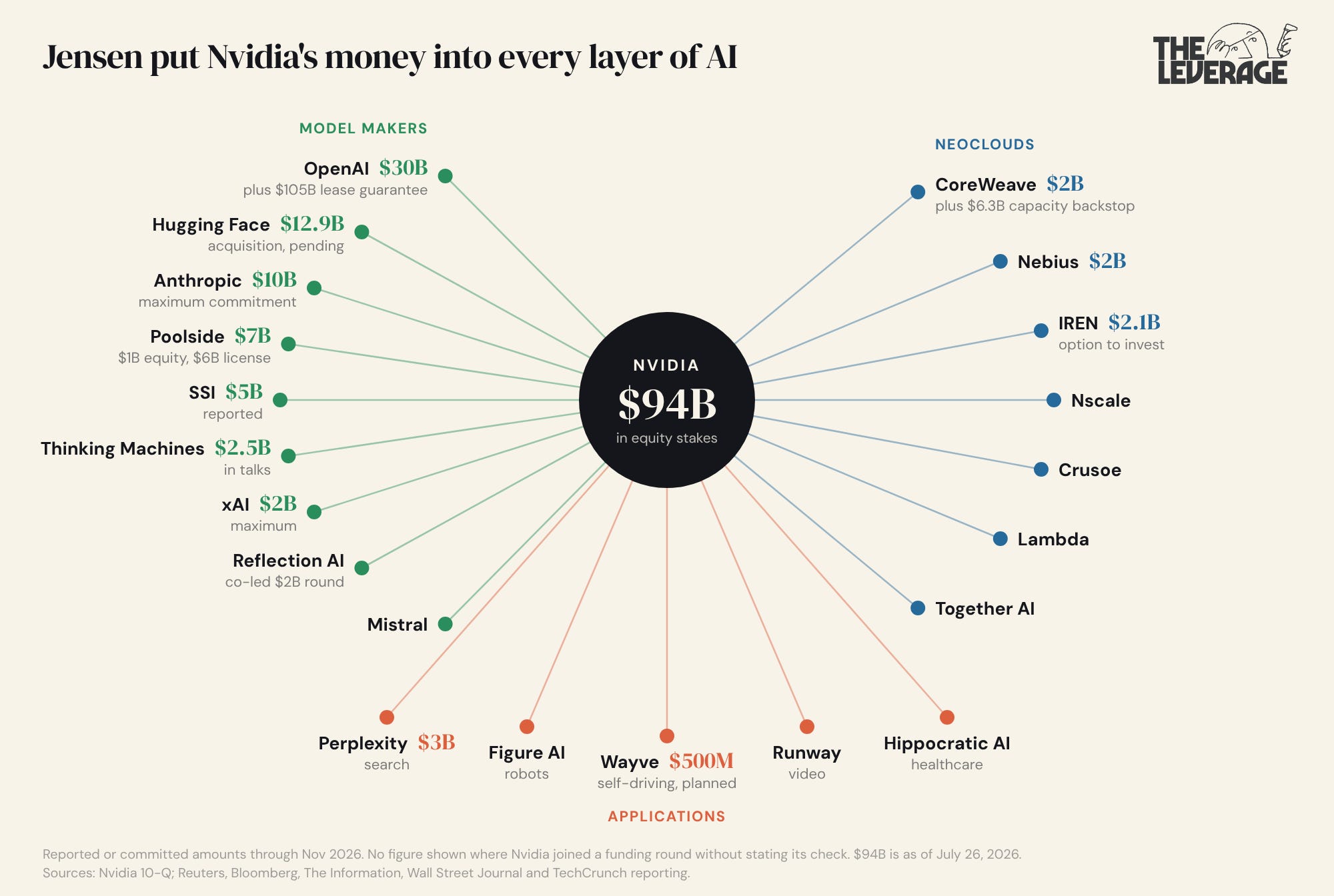
Spider sounds nefarious. I mean it more like a cool, they-write-case-studies-on-your-fly-devouring-business type of spider. Subsidizing select customers is rational when some of your most important ones are trying to build competitors to your product. In the 6 months to July, 3 customers made up 44% of Nvidia’s sales, and every one of its biggest buyers is trying to stop being a buyer. Microsoft has Maia, Amazon has Trainium, and Google has the TPU, all built to reduce their dependence on Nvidia. OpenAI is building its own processor with Broadcom. Anthropic stood up a chip team in August. Jensen was trying to make sure his business survived by investing in open source and in neoclouds.
Just being willing to fire the cash cannon does not allow a company to make itself the center of everything. The linchpin was Jensen’s ability as the founder to close a deal on a call and a handshake. Nvidia has a corporate development team, but Jensen often set the price himself.
Don’t believe me? Here are the receipts.
Groq came to Nvidia to buy 100,000 GPUs, and 3 weeks after the first call, $20 billion was in its bank account for an acquisition. The company had been valued at $6.9 billion 3 months earlier.
The $100 billion OpenAI pact was negotiated one-on-one with Sam Altman, with no bankers, and Microsoft found out the day before signing.
When Salesforce showed interest in Hugging Face, Jensen pushed to close fast at $12.9 billion, more than 80 times its revenue.
He put a reported $5 billion into Safe Superintelligence, a company that has never shipped a product.
When Poolside’s fundraise failed and it lost its compute, Nvidia wrote a $7 billion check to license its technology and hire its engineers.
Over and over again, Jensen stepped up to ensure adequate competition in AI. (Or at least the kind of competition that benefited Nvidia.)
Almost certainly whoever becomes the CEO of Nvidia won’t be given this type of latitude. Shoot, even if Jensen comes back, he won’t be given this amount of latitude. This will ripple through the entire ecosystem. Tens of billions of dollars in liquidity and capital just came to a screeching halt.

Anthropic’s new model rules and is being forced into the most menial labor imaginable. America’s soon-to-be-hottest IPO released Claude Fable 5.2 on Monday. This model is magical and I’m hopelessly addicted. It is hard to do anything else on my computer because I’m having so much fun being creative with it. Then on Tuesday, Anthropic announced Claude Meetings, which adds Claude to a video call as a visible participant that works on tasks while people are still talking. Alongside it came Sheets, Whiteboards, and Data, which join Docs, Slides, Design, and Motion as things Claude makes natively.
I mean, the future is obvious here, right? Claude will sit in the meeting, create whatever digital object the meeting participants agree to, and a company’s speed is thus dramatically increased. With Fable 5.2 and some careful prompting, I’ve been very impressed by the quality of the products and documents I’ve been able to create. None of it is perfect, none of it is publishable to all of you, but it is at least serviceable. As I mentioned in my piece this week, this enables a whole new form of company organizational design.
Fable 5.2 legitimately feels like a shift forward versus every other model I have used, particularly for building software products. It is remarkable, and I highly encourage you to throw it at some problems that have been frustrating you lately.

I’ve watched Singin’ in the Rain four times in the last month. It is a perfect movie. Watching my daughter yell “Yayyyy” when each song finishes has cleansed my soul. This number made me literally jump off the couch and shout “incredible!”
Waking Up is my new favorite meditation app. For many years I grinded my way through Headspace—mostly because I kept forgetting to cancel the subscription and then I refused to subscribe to two meditation apps. Based on a reader’s recommendation, I’ve been using Waking Up and it has unlocked new depths to my practice. I feel stupid for not switching sooner.
Trust me, you need to watch this silent movie about beavers. You are going to turn up your nose, but this was one of the hidden treasures of paternity leave. I cried so hard my stomach hurt. Available on Amazon Prime. Trailer.
Go and be kind this week,
Evan
Sponsorships
We are now accepting sponsors for Q1 ’27. If you are interested in reaching my audience of 35K+ founders, investors, and senior tech executives, send me an email at team@gettheleverage.com.
The telling detail is that the shipping question bothered you even when you trusted Jensen.
A customer’s billing address and its headquarters can both be accurate while telling investors nothing about where the chips ended up.
That Singapore reporting change looks very different in hindsight. Twenty-two percent of revenue billed to one small city-state, then quietly reclassified by headquarters location the quarter after Megaspeed went on an internal block list, is the kind of sequence export-control investigators tend to circle. If companies tied to one person really obtained $7.5 billion in restricted chips since 2023, Beijing got a meaningful slice of frontier compute through a door Washington thought it had shut. Commerce and Congress may want to look harder at end-use checks for transshipment hubs in Southeast Asia, whatever the board's probe concludes about Huang himself. Your point about founder conduct seeping into an organization lands well here, since a culture of looking away tends to start at the top.