


The prevailing doctrine in tech marketing is for everyone to “go direct.” The founder needs to be yeeting opinions on LinkedIn because that, somehow, increases shareholder value. The evidence for this advice is usually consultants trotting out the same 15 anecdotes. What I wanted was a rigorous, quantitative analysis on the nuances of the “go direct” idea. Is it just “raise lots of money?” What platform does this work best on?
Mischa Vaughn was the right writer for the job because he spends entirely too much time online. He even plays the little puzzle games on LinkedIn, and he genuinely likes them. He runs Orchard House, a fractional marketing and creative production agency in the Bay Area. You can follow him on LinkedIn and X.
As a bonus, paid subscribers to The Leverage get access to the full dataset behind this piece. You can dig into all 90 companies and 351 executives, compare the leaderboards, and use the built-in calculator to see how your own company ranks.
But first, this essay is brought to you by one of my new favorite services, DeleteMe.
I spend all of my effort trying to explain how capable LLMs have become. That has unsavory implications, because they have also become powerful tools for criminals. If your information is online, an LLM can find it. A model can pull your address, phone number, and relatives out of public records in seconds, then clone your voice from a short podcast clip, and then call your mom asking for help. Americans reported $16 billion in fraud losses in 2025, up about 25% from 2024, and nearly 1 in 3 of those reports was an imposter scam. That was before this tooling got cheap!
These scams are built off of your personal data, which can be purchased by anyone with a credit card from a data broker. This sucks. So I went looking for a way to help protect myself; DeleteMe is what I landed on. Its privacy experts find your information on hundreds of data broker sites, submit the removals, and keep repeating the process all year. This is because the brokers will repost if you don’t monitor them (again, this sucks). You should be protecting yourself too.
I partnered with DeleteMe to get Leverage readers 20% off at with code THELEVERAGE.
And with that, here’s Mischa.

In the mid-80s a category-five hurricane of attention hit the NBA by the name of Michael Jordan. When His Airness entered the league, the 23 NBA teams were worth a collective $400M. By his first “retirement” in 1993, the then 27 teams were worth over $2B. The lesson Jordan taught the NBA was pretty simple: sell the star, not the team.
One of the first NBA games I ever attended was one that Jordan played in. Now, it was in his Wizards era. But the person at the ticket booth took pity on the nosebleed tickets my brother and I had saved up for when we told him this was our first game, so he hooked us up with seats 20 rows behind center court. That’s how I got to watch a 38-year-old Jordan lead all scorers for the game. When Jordan played on the Wizards the team got as high as 2nd in the league in attendance (for the washed GOAT!). Once he left, the team shot back down to 21st.
The star went away, and so did the following. This effect wasn’t lost on the NBA. It is why they keep coming up with a new “face of the league” every five years or so. Allen Iverson, Shaq, Kobe, LeBron, Steph, Anthony Edwards, Wemby. It’s been a smart strategy, and it’s helped grow the value of the entire league to over $160B in 2026.
Now, I am not so foolish as to say that execs can have an aura at the same level as an NBA star. That’s never going to happen (unless the tech exec in question can dunk or break someone’s ankles on the court). However, it finally appears that businesses are learning to promote their “stars” over the brand. We can blame influencer or creator culture, but this is the state of attention and we’re just scrolling in it.
Why companies are doing this
My argument is that a person gets more engagement than a brand does, and overall, it’s a better tactic for a company to take nowadays. People get more attention from humans AND more from the algorithm. You don’t have to be a social media power user to know that LinkedIn personal pages get more engagement than brand pages, and on X it’s how launches happen and companies get their moment in the spotlight: the founder’s post is the new PR release, and their shitpost or poast that goes viral is the new momentum builder. I’ve watched this playbook succeed over and over and it doesn’t appear like it’s going to stop anytime soon.
This might be a familiar sounding idea, and many have argued that you should “go direct.” However, I have found that this claim resides in the land of anecdata, a nice soundbite where people cite the same 15 founders, and then move on. I wanted to go deeper.
Ok, before we get into numbers, let’s clear up some stuff. This is not an argument that people can get more followers than brands, or that they should. Brand pages for B2B businesses will generally have more followers than the people who work there (more on exactly where that’s true below).
The only outside study I found is small. Refine Labs compared seven of their employees’ profiles to the company page. The employees had 46% fewer followers and still got 5x the engagement. So, I had Grok Bot and other agents pull the top five executives at 90 of the most-hyped private companies around (Ok, I cheated and used the Lenny 100 - thanks Lenny! - plus a few I added), added up their LinkedIn and X followings and lined that up against how much money each company has raised and the followings of the brand account pages.
A note on the data: every company had between one and five executives I could find, but not everyone had a LinkedIn or X account that was active or in existence. Where companies didn’t have that many obvious execs, I tried to find employees that would fit the bill (heads of, leads, etc). Now, my bots couldn’t bring in all the follower counts so I had to roll up my sleeves and do this the old fashioned way by checking 300+ execs by hand. This took time, and the data range was spread across four days (in mid September 2026), but it was the only way.
Also, everything measured below counts followers, because that’s pretty much all you can count across 90 companies and 300 execs (LinkedIn and X just don’t make it easy to count views/impressions across this many accounts), I’m using followers to stand in for attention even though they aren’t the same thing.
Here’s what I expected to find: some companies have figured this out and most haven’t. Here’s what I found instead: Almost everyone has figured it out. And almost everyone has figured it out with exactly one person. Going direct is now the modus operandi.
Two-thirds of a company’s attention goes to one person
At the 87 companies where I could measure at least two named executives, one person holds about 70% of the whole team’s following. At four out of five of those companies, one person holds more than half. Even where there are two real “star” execs, the top two hold about 90% of the following between them and everyone else is a rounding error. And three times out of four, that one person is the CEO.
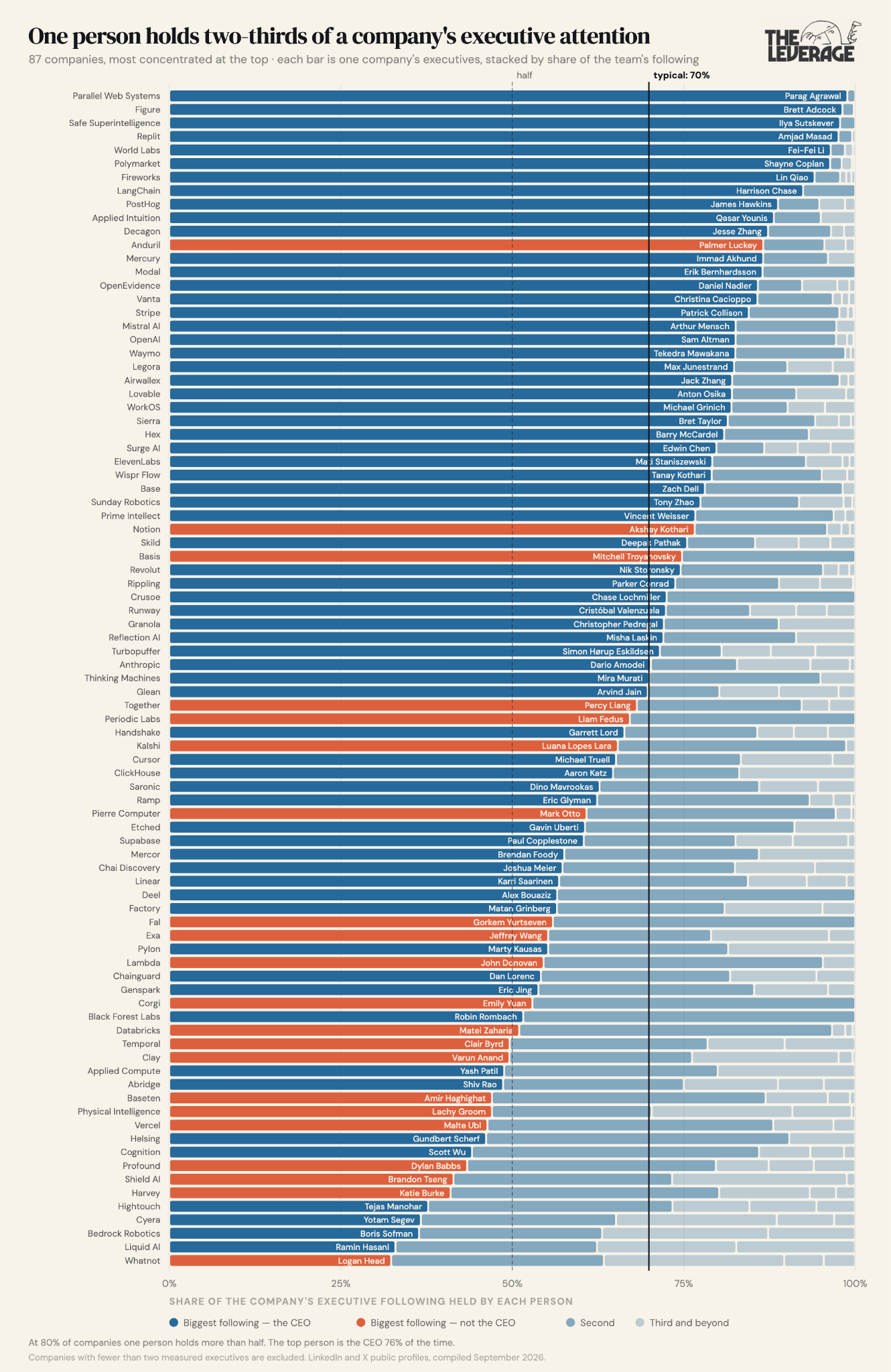
Brett Adcock is 98% of Figure’s executive following. Amjad Masad is 98% of Replit’s. Fei-Fei Li is 96% of World Labs’. Palmer Luckey is 87% of Anduril’s, Patrick Collison 84% of Stripe’s, Sam Altman 83% of OpenAI’s.
So the “sell the star” lesson seems to have landed with these companies. The problem is they only took half of it. The NBA’s actual strategy wasn’t Jordan. It was Jordan, then Iverson, then Shaq, then Kobe, then LeBron. It wasn’t just about the current star, the next star was the plan.
Money doesn’t fix it
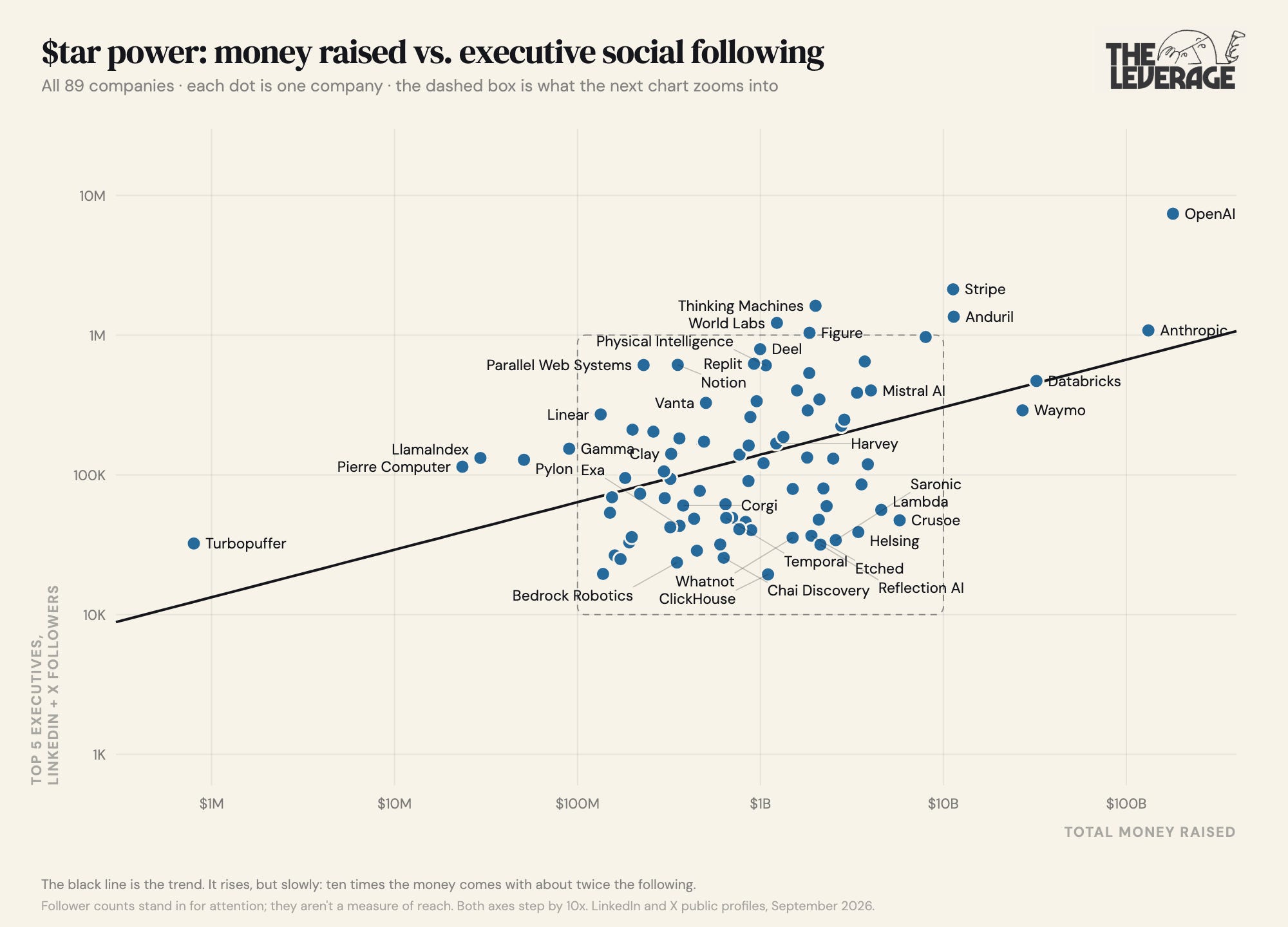
Now, I want to be careful here. I only looked at roughly the top five executives at each company (usually three or four), not the whole leadership team, and a bigger company has a lot more people below that line who might have audiences of their own. And it is true that as companies raise more, their leaders get more famous. The typical CEO at a company under $500M has about 37,000 followers. Past $10B, it’s 239,000.
The trend line just goes up slowly. Compare any two companies where one raised ten times as much as the other, and the bigger one’s executives typically have about twice the following. Which goes to show that money is not always correlated with aura.
And in the middle, where most of these companies live, it’s flatter than that. From $100M raised to $10B, the typical executive bench sits around 90,000 followers and barely moves. Only the six companies past $10B break away.
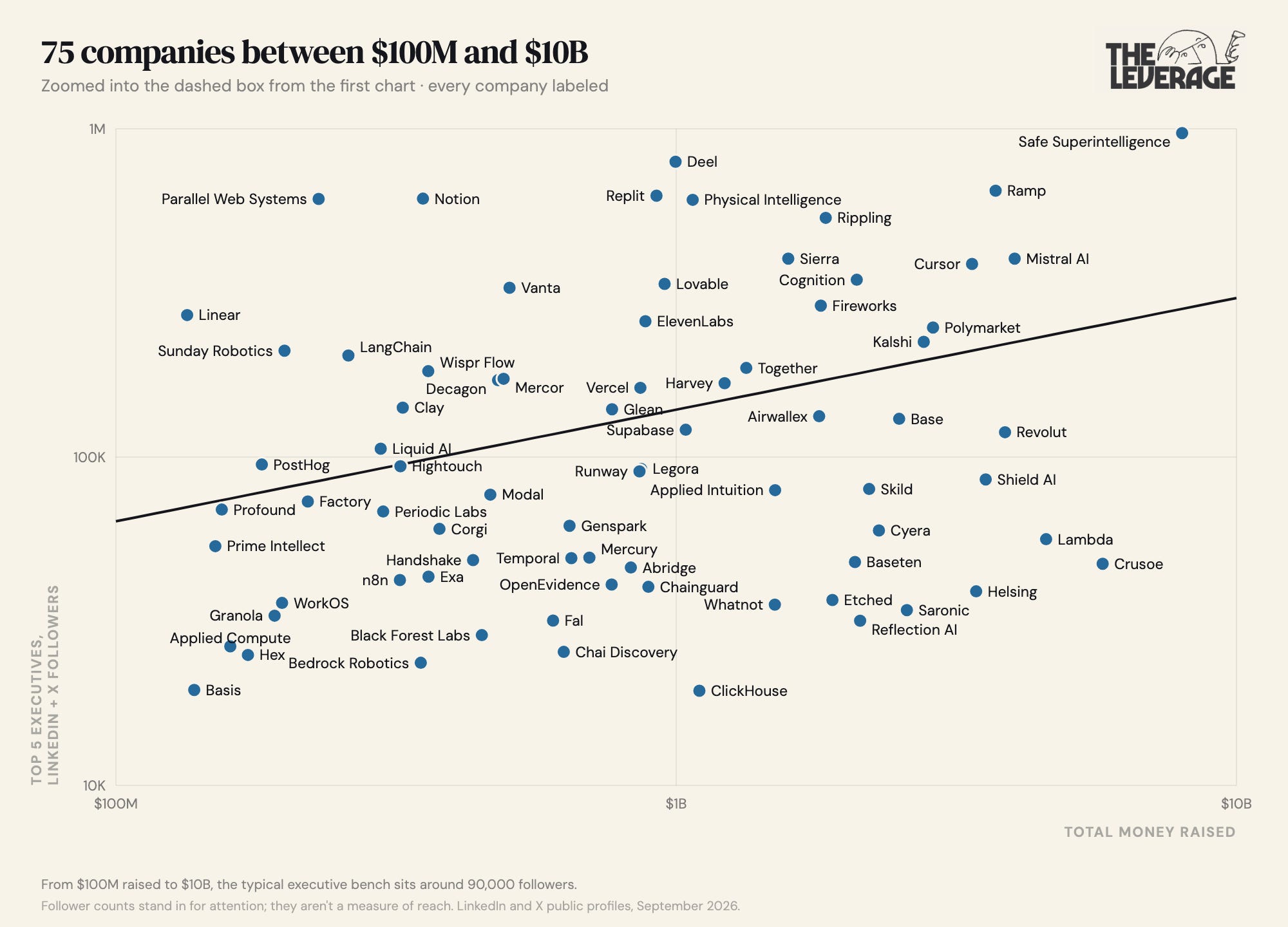
The trendline is the average: what a company’s executive following typically looks like at each level of money raised. Half the companies sit above it and half below, and the distance between a company and the line is where things get interesting. For example: Parallel Web Systems and Notion are miles above the line for what they’ve raised. ClickHouse and Crusoe are miles below it. Money put them at a spot on the bottom axis, but where they landed on the side axis was up to them (and maybe how good their comms team is).
One caveat: the Lenny100 is a list of winners, so nothing here says attention got anyone onto it, and I can’t tell you whether money causes attention or the other way around. What I can say is that being small is not the disadvantage here that it is everywhere else.
Narrative fatigue
The same thing that makes a person out-reach a brand is what can wear on an audience if you aren’t careful. Overreliance on one voice gets old and people tune out.
Cluely founder Roy Lee became a bigger story than Cluely while the company pivoted. He has 256,000 followers on X and 60,000 on LinkedIn. Cluely has 54,000 and 44,000. The attention went to a person, and the business didn’t get as much of a halo from the attention as Roy did. It’s still around though, but the accounts haven’t been active for around several months (on X) now, so things don’t seem to be going great.
This is the Jordan problem the NBA faced. And David Stern knew it. So he started engineering the league and the media apparatus behind it to work on finding the next face to keep the overall following interested.
Where the person beats the page
Earlier I said brand pages will generally always have more followers than the people who work there. Now that every brand page in the set is counted, I can tell you exactly where that’s true and where it isn’t. It depends entirely on the platform.
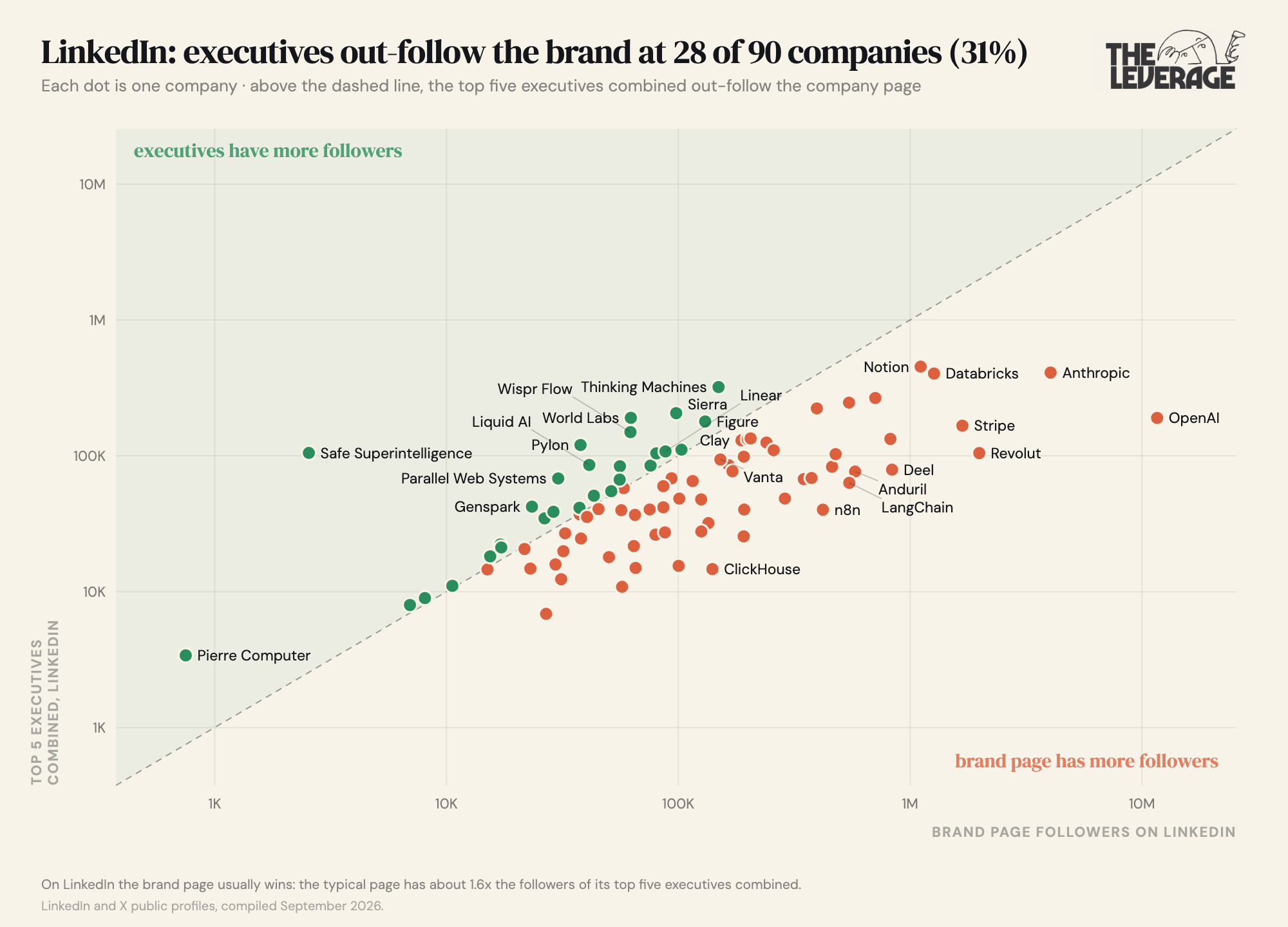
On LinkedIn, the brand wins. At 90 companies, the top five executives combined out-follow the company page at 28 of them, and the typical company page has about 1.7x the following of its entire executive bench. Add up every brand page and every executive and the pages have 4.5x the audience. Only 13 individual executives in the whole set have more LinkedIn followers than their own company (one of them is Ilya Sutskever, whose 100,000 beats Safe Superintelligence’s 2,500 by about 40x, which tells you more about Ilya than about LinkedIn).
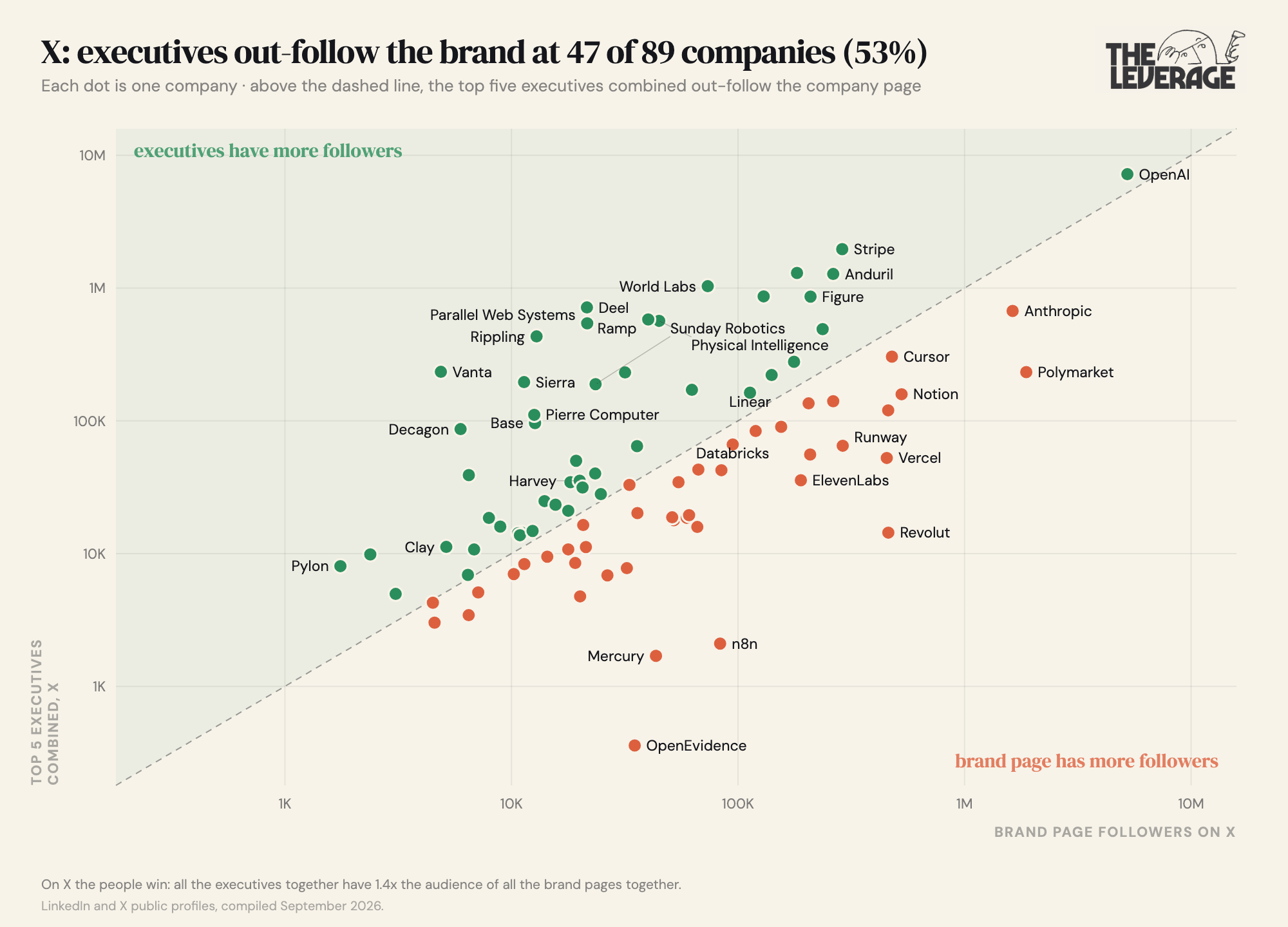
On X, the people win. The executive bench out-follows the brand page at 46 of 89 companies. At 40 of them, a single executive does it alone. Add everyone up and the executives have 1.4x the audience of the brand pages. Fifty-one individual executives have more X followers than their company does. Christina Cacioppo has 48x Vanta’s. Parker Conrad has 29x Rippling’s. Alex Bouaziz has 18x Deel’s.
And the same company usually lands on opposite sides. Of the 89 companies on both charts, 26 have executives who beat the brand on X but not on LinkedIn. Only 8 go the other way. Anthropic, Notion, Polymarket, and Vercel are all bigger as brands than as people on X, while OpenAI, Stripe, and Anduril are the reverse. You only get there by having someone in charge who LOVES to post or is just plain addicted to it.
What to do from zero
Here’s what 90 companies’ worth of data actually says to do.
Don’t wait to invest in your exec following. From $100M raised to $10B, the average bench sits at 90,000 followers. You don’t outperform by sitting on your thumbs. Get those people out there! But also, don’t use this as an excuse to ignore your brand page, especially on LinkedIn.
Plan the second star from day one. Two-thirds of a company’s attention ends up in one person, and half the companies in this set never get a second. The CEO will be first because say it with me they are the Chief Storyteller whether they like it or not. Decide who’s second before the first one gets tired.
And remember, you can have stars that aren’t founders. Clay’s third biggest is the head of marketing. Harvey’s COO has a bigger combined following than their CEO. The point is: work out who else matters to your buyer. If you sell to marketers, that’s a CMO. If you sell to finance, it’s a CFO. And yes, CFOs can be helpful for marketing (don’t let them tell you otherwise).
The window
The NBA reached $160B in value by building the next face of the league before the current one had left the building. It understood that stars draw the attention, but that any single star eventually burns out.
Most companies have learned the first half of this lesson. Two-thirds of a company’s exec following is one person, whether they raised $100M or $10B.
Right now, marketing in this manner is becoming table stakes, especially in B2B as we all beg the LinkedIn algorithm to notice us. And the companies that don’t do it are going to look like oldheads.
A lot of them already do.
Want to see where your company lands? Paid subscribers get the full dataset: all 90 companies, 351 executives, the leaderboards, and a calculator that ranks your own bench against the trendline.
Upgrade to paid, then go find out whether your company has a second star or just a very tired first one.
