


In early 2023, Anthropic posted a job for a “Prompt Engineer & Librarian” that gave a fat salary of up to $335,000. The internet, predictably, went absolutely feral. The media coverage at the time was stuffed with breathless commentary on how the prompt engineer was the job of the future.
A 22-year-old named Alex Albert got the role. An incredible achievement, with a salary that would’ve made 22-year-old me, baby-faced and diploma in Sociology in hand, weep in envy. Yet within a year, he’d already transitioned to a new position. Today he’s Head of Developer Relations at Anthropic. The job title that launched a thousand think pieces lasted a grand total of twelve months.
Indeed data tells the same story. Searches for “prompt engineer” surged from 2 per million in January 2023 to 144 per million by April 2023, a 72x spike in three months. By late 2024, they’d collapsed to 20–30 per million, where they flatlined.
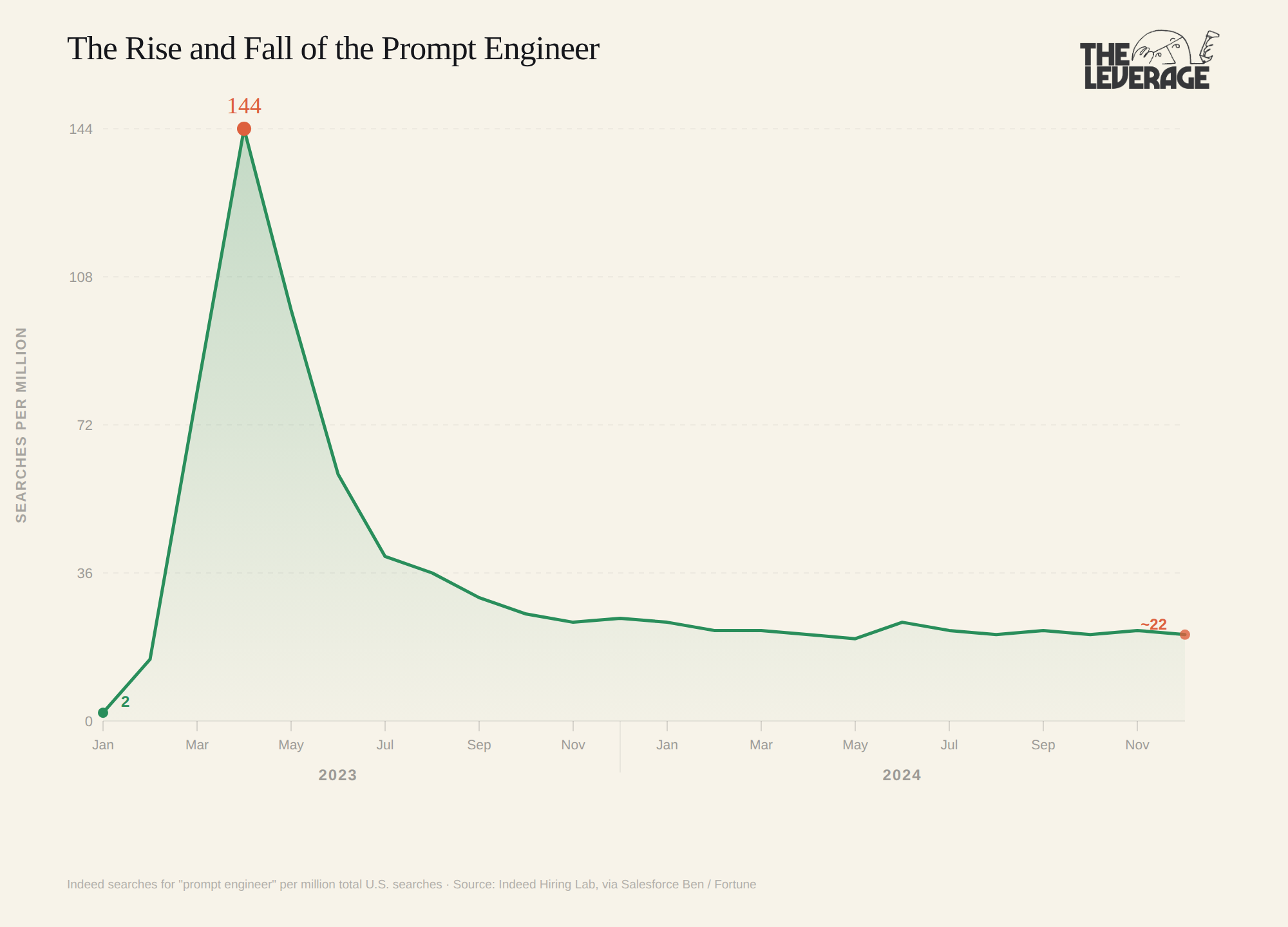
It feels reasonable to call this the fastest hype cycle in labor market history. From “six-figure career of the future” to obsolete in about eighteen months. The most famous prompt engineer in the world already has a different job title. And today’s answer to “what’s the AI-proof job?” is probably a vibe coder. Which, I’ll just say it, people being hired specifically as vibe coders are not long for this world either.
The mistake is that we either look for things entirely resilient to AI (which typically means manual labor) or we look for AI-native jobs, except that category changes every three months. The AI transition is just starting off; basing your career on the signals of today is like registering your toddler for the NBA draft. It is too early to forecast what this thing will look like when it grows up.
But there’s a version of this question that actually has an answer. And the answer is the opposite of what most career advice is telling you right now.
The Education Premium Is Inverting
A 2025 working paper from the San Francisco Fed found that the college wage premium, the earnings gap between degree-holders and high school graduates, has been essentially flat since 2000 after doubling in the prior two decades. The authors attribute the stagnation to demand factors: technology is no longer favoring college-educated workers the way it did in the late 20th century. A separate analysis from the Cleveland Fed went further, projecting that the premium will likely decline in the coming decades if technical change continues to be education-neutral.
The more education you have, the more likely your job involves sitting in front of a screen all day. And the more of your day you spend typing, the more exposed you are.
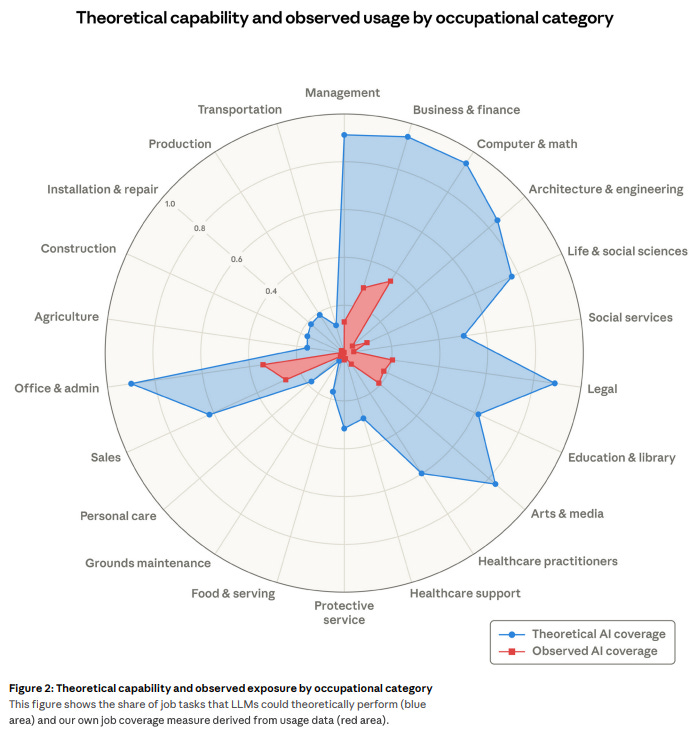
A March 2026 paper from Anthropic has been tracking millions of Claude conversations since early 2025 to measure what AI is actually doing across the economy. They broke every U.S. occupation into its component tasks using government labor data, then measured two things: theoretical exposure (what percentage of tasks AI could handle) and observed usage (what percentage people are actually using AI for). Computer and math workers have 94% theoretical exposure but only 33% observed usage. The gap between those lines is your window. But the gap is closing.
Meanwhile, the trades are in a structural boom. The BLS projects electrician employment will grow 9% from 2024 to 2034, three times the average for all occupations, with 81,000 openings per year. The median annual wage hit $62,350 in 2024, with the top 10% earning over $106,000. And that’s before the AI data center surge fully hit. Fortune reported that the U.S. needs 300,000 new electricians over the next decade just to meet data center demand, while 200,000 current electricians are expected to retire.
The most AI-native career path in 2026 might be becoming an electrician who knows how to use Claude to build a website, funnel demand, and manage their P&L. What a world.
You Need to Become Operationally Dense
This points to something bigger than “learn a trade” (though, genuinely, maybe we should all be learning a trade). The pattern that keeps emerging across every industry I study is that the AI-proof career is about stacking skills from adjacent functions faster than the models can commoditize any single one.
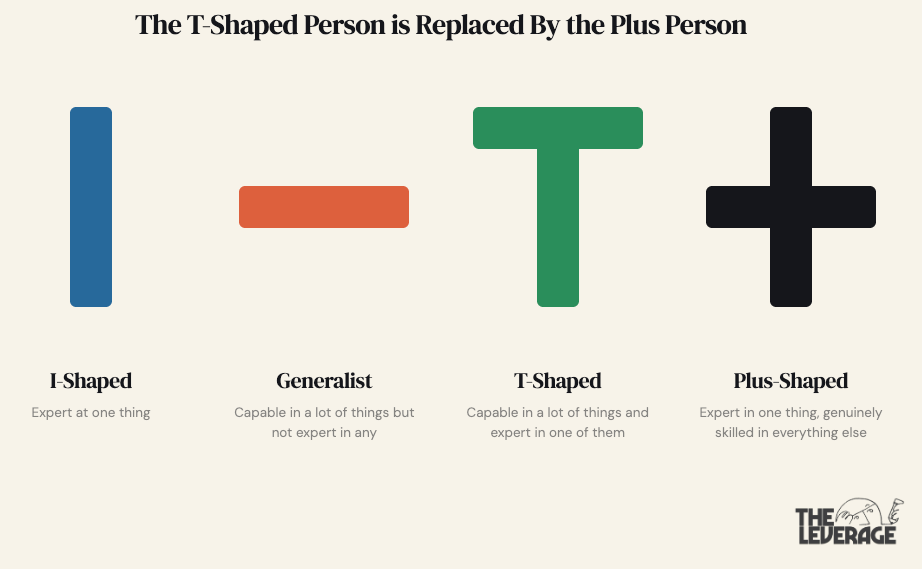
We are in the bundling phase of professional life. Career progression comes from automating depth and increasing breadth with the time that automation frees up. The go-to advice used to be that you should become “T-shaped,” an expert in one thing and capable in a lot of others. AI changes capable to adept.” I call this becoming a plus-shaped person. The vertical bar stays, you still need genuine depth in something. But the horizontal bar gets thicker. AI tools make it possible to operate at a genuinely skilled level across domains that used to take years to learn. The person who can write, design, analyze data, build prototypes, and manage projects isn’t spread thin anymore. They’re leveraged™.
I’ve seen this in my own business. The Leverage just wrapped its biggest quarter ever, and I run it with zero employees. AI handles things I used to do manually, which is somewhat scary, but also, great. Daycare is the most expensive bill I’ve ever seen in my life; please Claude, help protect me from it. Now I can move on to higher-value work.
The unglamorous version of this: you become the person in your organization who can competently do three adjacent jobs. You’re the marketing manager who can also pull her own data, build her own landing pages, and write her own briefs without routing through three other teams. You are operationally dense. When your boss runs the mental math on whether to replace you with AI plus a cheaper generalist, the answer keeps coming back no, because you’ve made yourself a bundle that’s hard to unbundle.
Oftentimes, you’ll see analysts like myself trot out the answers of “taste” and “distribution” as things you have to develop in order to have a successful long-term career. And those will be valuable assets! But not everyone is going to be newsletter writers or creative brand directors. That’s fine. (Actually, that is probably a good thing.) I think that office work will shift toward something less romantic than “taste” and “distribution,” but more durable.
But there’s a specific way to build that density, and there’s a closing window to do it. The Anthropic data shows massive gaps between theoretical AI capability and actual adoption. Right now, knowing how to use these tools well is a genuine competitive advantage. In two to three years, it’ll be table stakes.
The question is: what do you actually stack, and how?
