


My apologies for the late newsletter delivery and for the lack of an essay this week! After the Leverage Launch on Thursday, I got very, very ill. There is even an essay that is 90% of the way there, but alas, I finished the funny tasting breakfast burrito right before the event, and now we have all paid the price. The toll was a significant amount of body weight for me and lack of delightful emails for you, but considering how excited I am for this next essay, the greater loss may have been yours. (That piece will still come out later this week.) Thank you for your patience.
To regular, non-fluid related business.
Does anyone else feel like the tech world just keeps getting faster? Each week I think, “surely we’ve peaked.” And yet, the numbers keep getting bigger, the release pace keeps getting crazier. This week saw some deals eerily reminiscent of 1999, one of the largest tech acquisitions of all time, and data that helped reshape my thinking on the market size of coding models.
But first, this newsletter is brought to you by Town.
My white whale AI project for the last four years has been a to do list that actually maintains itself. I want to sit down at my computer and then have it tell me what to do for the next 8 hours. Every version of this I have built failed. Town is the first product to pull it off and it has changed my life. My magic gerbil Luther (pictured) sweeps my Gmail, Slack, calendar, and meeting transcripts, extracts every task and follow-up, and keeps a single Notion board updated as the source of truth. I have arrived in productivity paradise with an inbox zero and zero thought put towards my to-do list. I explained why it succeeded where my DIY versions failed in What’s the Bet: Town. Readers of The Leverage get 2 free weeks and 2,500 bonus credits (seriously, try this.)

Is Nvidia inventing a bubble from first principles? On Monday, Nvidia announced financing platforms with firms like BlackRock, Goldman Sachs, and KKR to mobilize over $500 billion of third-party capital for AI buildout. The stock fell 2.8% on the news, about $70 billion of value going poof, because “financing platform” sounds like “circular financing” which sounds like the “dot com bubble” which sounds like “uh oh, da market about to go big bad.”
Fight this instinct! Something more nuanced and interesting is happening here.
The first question we need to answer is why Nvidia needs $500 billion of other people’s money when its customers are the fattest cats in the history of capitalism. The answer is that cats have learned how to make cans of tuna tokens themselves. (I apologize for that last sentence. It was terrible/a stretch, analogy over.)
Essentially, their best customers are their biggest problem. The hyperscalers are all designing custom silicon that are directly aimed at Nvidia’s cushy 70% gross margins. Worse, the two most important startups in the world are becoming increasingly less reliant on Nvidia. Anthropic famously splits its training across Trainium, Google TPUs, and Nvidia, and last week stood up its own chip team. OpenAI has been iterating on their own chips for a while now too. (And yes, as we covered, in our last edition, Nvidia is investing in essentially everyone who is also sorta competing with them.)
Nvidia’s reaction is to fund a new set of buyers that are forced to be all-in on its silicon. This is the neoclouds who will benefit from this $500 billion dollars.
The history comparison you find most commentators reach for is telecom in the late 90s. In that era, the nine largest equipment vendors extended $25.6 billion in customer financing. Then 24 of the 30 largest carriers went bankrupt and up to 80% of those loans ignited into ash. So when someone unsophisticated sees that Nvidia’s “financing platform” is 20 times bigger, with a mildly panic-inducing amount of customer concentration, they shriek about bubbles and fraud, and rack up the views on social media. However, this is incorrect for three key differences:
The loans sit on Apollo’s and Blackstone’s books, not Nvidia’s.
Neoclouds are the contract manufacturers, not the telecom carriers of the 90s.
We are likely at only less than 1% meaningful adoption of AI workflows today and it is already the fastest growing market ever.
Point 1 is fairly self explanatory. Point two however requires a little history.
Let’s start with a little known company called Flextronics. It was the first American manufacturer to go offshore to Singapore in 1981, and ran on venture money, taking funding from Sequoia Capital on the way to its mid-90s IPO. They would allow American companies to focus on design and brand while Flextronics would handle the gritty work of standing up factories in Asia. By the 1990s the electronics industry had completely reorganized around this idea. Brand owners like Ericsson would hand off entire factories to contract manufacturers, who took on the balance sheet risk in exchange for volume and single-digit margins. This is much closer to what Nvidia is doing today with companies like CoreWeave.
Contract manufacturers’ gross margin is kept low because the manufacturing knowledge is codified. The brands will tell CMs what to do, step by step, to the point of having binders with 500 pages of instructions in it, while companies like Flextronics would just nod their head in acceptance. It is only when a contract manufacturer starts getting “design for manufacturability” rights, i.e. when they have to invent processes of their own, that they start to improve their gross margin.
You can think of this $500 billion financing platform as validation for Nvidia’s efforts to build the instruction manual for datacenter operations. They have taken and productized a variety of datacenter technology that used to only be the purview of the hyperscalers like Amazon and then productized it for any technically competent team with a powered shell. Meaning that a GPU datacenter run on Nvidia’s playbook is now as legible to a Goldman Sachs underwriter as a warehouse or a cell tower. So now the new generation of Flextronics, i.e. the neoclouds, can easily take on the balance sheet risk for AI model labs.
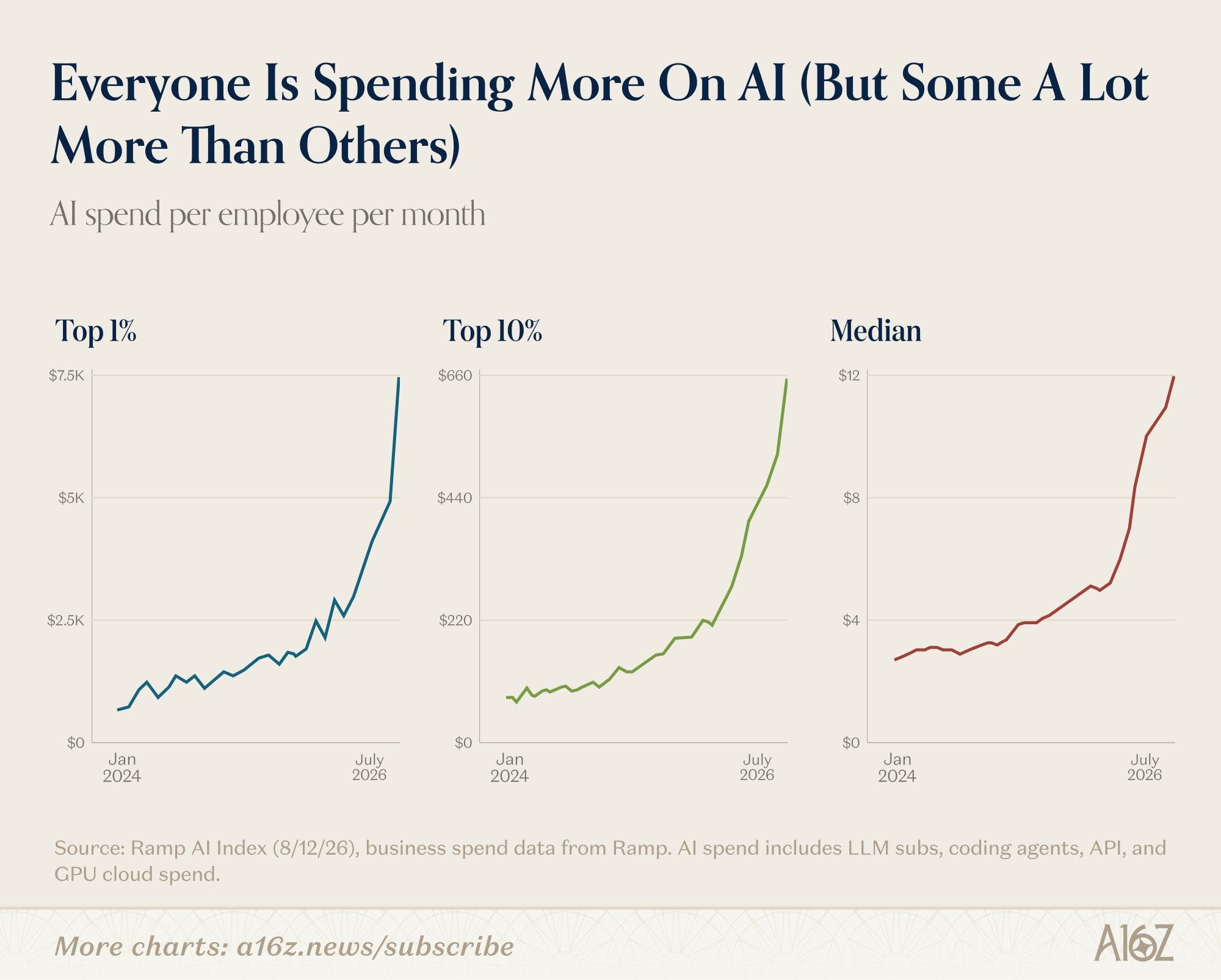
Which takes me to point 3: we are still very, very early into AI adoption. As pointed out by Moses Sternstein in the a16z newsletter, the top 1% of AI users, the ones who are fully utilizing tools like AI agents, are spending about $7.5K a month on AI. In contrast the median is only spending $12. (I’m only spending about $500 a month, how pathetic!)
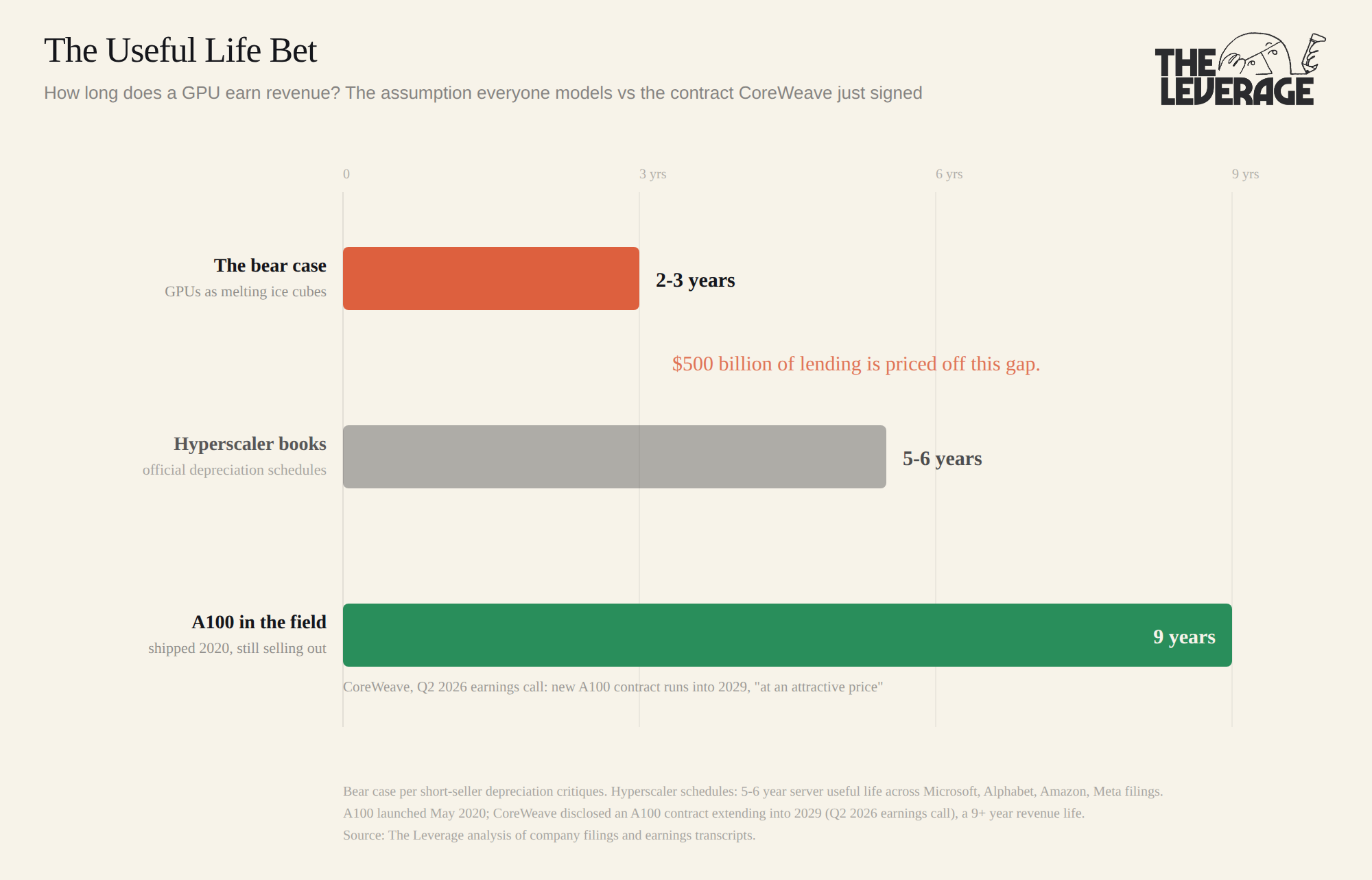
Meanwhile, every neocloud is talking about having booked revenue in the tens of billions, with every single chip they currently have live being used. CoreWeave disclosed on its earnings call this week that it signed an A100 contract running into 2029. This is a Nvidia chip that was shipped in 2020! Nine years of revenue life, against the 4 to 6 years every depreciation model assumes.
My point is that these tools still are clunky, hard to use for regular people, and error prone. Despite that, every chip is spoken for and used, the revenue is to the right, and power users are spending 625x the median.
The biggest reason that this isn’t the 2000 bubble is that everyone is growing revenue just as fast as they are growing users. Valuations are crazy right now but so too is revenue growth. Speaking of high valuations…

Cursor just made moolah while Lovable raised more of it. Vibe coding platform Lovable raised $400M at a $13.3B valuation this week, doubling its valuation since December. The company has roughly 300 employees today, with a plan to grow headcount to 450 this year and ARR tracking toward $600M by the end of August.
Which if you do a little napkin math means that Lovable’s revenue per employee peaked at $2.74M in February ($400M across 146 people) while sitting around $2M today. Incredibly impressive and fits the profile for a true AI-native startup. If you do it on a valuation per employee basis, the comparisons get really interesting.
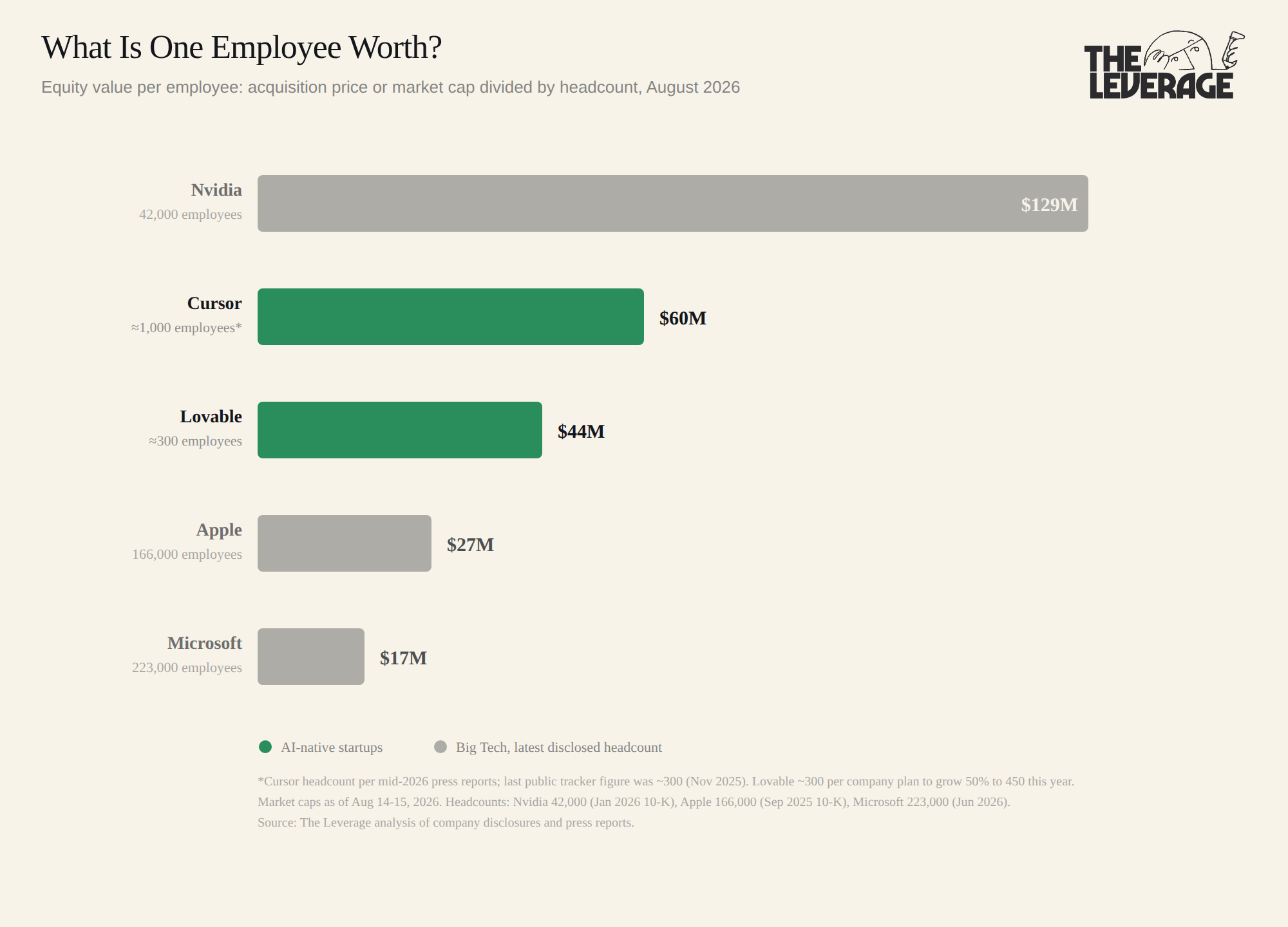
Cursor [disclosure, current sponsor] was at 1,000 employees before being sold to SpaceX for $60B this week. That works out to $60M per employee against Lovable’s $44M. So, why the difference? The most important thing is that companies are bought, not sold. Cursor and SpaceX needed each other. Musk and the gang desperately needed to catch up to Anthropic and OpenAI’s coding models, while Cursor was increasingly finding itself outgunned in the fight for Nvidia compute. By merging, it allows the combined companies to go after coding agents, which may end up being the largest software market of all time.
Lovable has made an enormous amount of progress by being a very friendly UI on top of coding agents. That still deserves a huge premium and is likely less reliant on having its own models to deploy. But still, you can’t help but wonder if Microsoft or Amazon is looking at Lovable and wondering if they should bring them in-house.

Phoebe Bridgers’ new album is her best, richest work yet. I recommend lighting a candle, thinking sad thoughts, and listening to it in the dark while reading the lyrics. The album has the sparse acoustic flavor of her debut album Stranger in The Alps, but goes much bigger and broader with electric, kinetic climaxes. 10/10, this is one I’ll be listening to for a long time.
In The Mood for Love. Wong Kar-wai’s 2000 romance is about the things not said, the touches never felt. There is a reason you’ll find this on many “Best 100 movies of all time” lists—the praise it is given is well deserved. The cinematography and costuming is deliberately constricting, while the color just pulled something out of me. Frankly, romance is one of my least favorite genres, but after watching this, I might have to change my mind. A perfect movie.
Go and be kind this week,
Evan
Sponsorships
We are now accepting sponsors for the Q4 ‘26. If you are interested in reaching my audience of 35K+ founders, investors, and senior tech executives, send me an email at team@gettheleverage.com.