



[An earlier edition of this newsletter had an incorrect link—that is addressed in this email. My apologies!]
I spent Wednesday watching Cloudflare’s stock drop 24% on a record-revenue quarter and trying to figure out what to do with that. The CEO had just told the world that AI made 1,100 jobs obsolete, and the market — which is many things but rarely subtle — basically said “sure, but it kind of looks like you don’t know what you’re doing.” The whole week looked like that. Public company after public company blaming AI for what walked and talked like the cost structure of the SaaS era catching up to itself, while in the next room Sequoia and Kleiner are shooting off nine-figure checks to pre-product labs with nothing but a polycule and a dream. It is a lot of weather happening at once. The title of this email is approximately how it felt.

I’ve spent enough time watching Claude flail in random codebases to know agent quality varies pretty wildly. One minute your AI feels like the next coming of Steve Wozniak, the next it seems to enjoy the taste of lead paint. The difference in AI performance comes down to the technical stack you give it.
Convex is one of the stacks where agents actually fly.
Their product gives agents tight feedback loops, lets them reason locally instead of holding the whole system in their head, and strips out the fluff that eats half an agent’s context window. I’d add a fourth reason: it scales without melting your wallet, so what your agent built last night won’t fall over the moment it gets traffic.
If you’re building anything agentic, or just tired of fighting your backend, try Convex.
MY RESEARCH

Is AI slop actually bad? I hate AI writing. So I decided to be analytically rigorous about my hatred. I ran 3,229 posts from the top Substack publications through and the results made me reluctantly question my own thesis. 25% of the Business leaderboard is AI-generated! Two of the top ten are fully synthetic! I have some thoughts on what that means for every business whose product is "we will tell you something you didn't know," including this one. Read here.
WHAT MATTERED THIS WEEK?

BIG LAYOFFS
The arithmetic of panic. Seven major tech companies announced layoffs this week and yes, every single press release said it was about AI.
The combined headline number — at least 7,300 confirmed positions, plus the leaked 12,000–15,000 at Cognizant — would be the story in any normal week. That is a lot of people suddenly unemployed! And yet, this wasn’t a normal week.
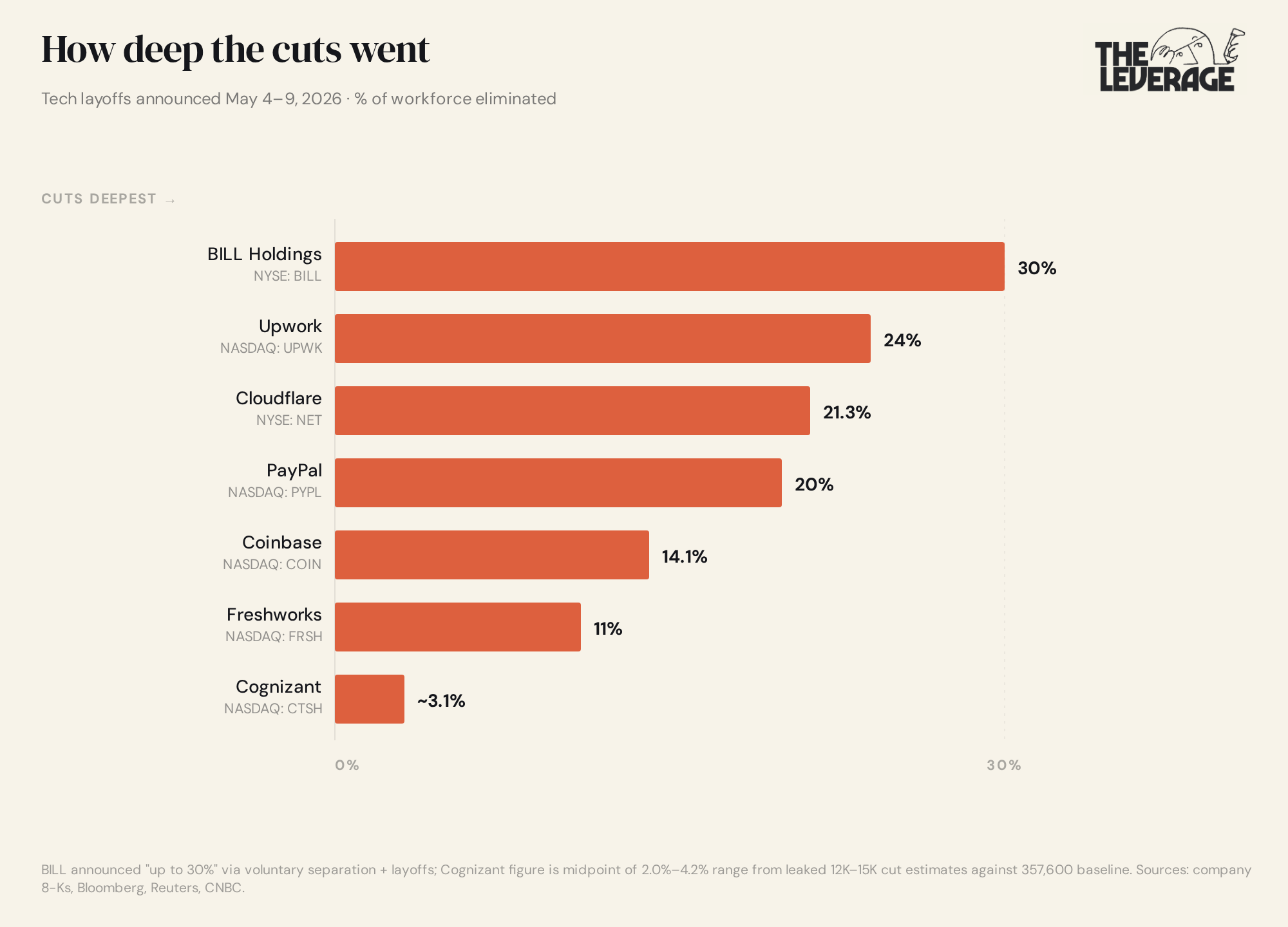
All of them, PayPal, Coinbase, Freshworks, Cloudflare, and Upwork sold their reductions as a strategic pivot — “we’re shrinking because we don’t need these people anymore.” Cloudflare’s CEO said internal AI usage grew 600% in three months and that back-office support roles “aren’t going to be the roles that drive companies going forward.” Coinbase replaced “pure managers” with “player-coaches” and capped management at five layers below the CEO. Freshworks’ CEO admitted, on a quarter that grew 16%, that more than half of the company’s code is now written by AI.
The market, polite as it ever is, resoundingly said “bullshit.”
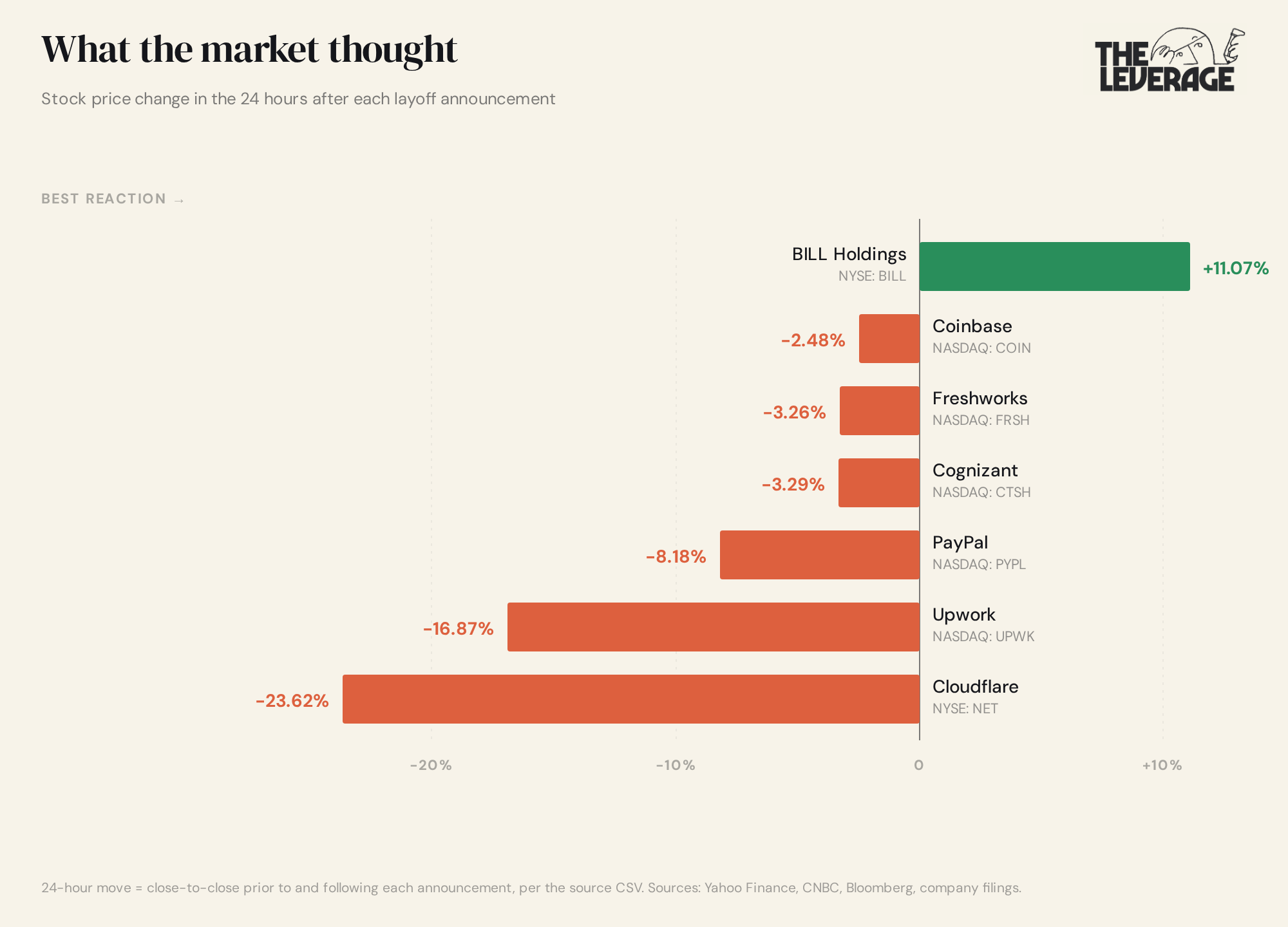
Only BILL got rewarded with an 11% pop. Though my read on it was that the announcement on a $1B buyback was what actually drove the positive swing. Cloudflare, in contrast, got destroyed. Down 24% on the same day it reported 25% year-over-year revenue growth and a record quarter.
Investors just don’t believe these narratives. Or at least they don’t believe in what the layoffs are actually signaling.
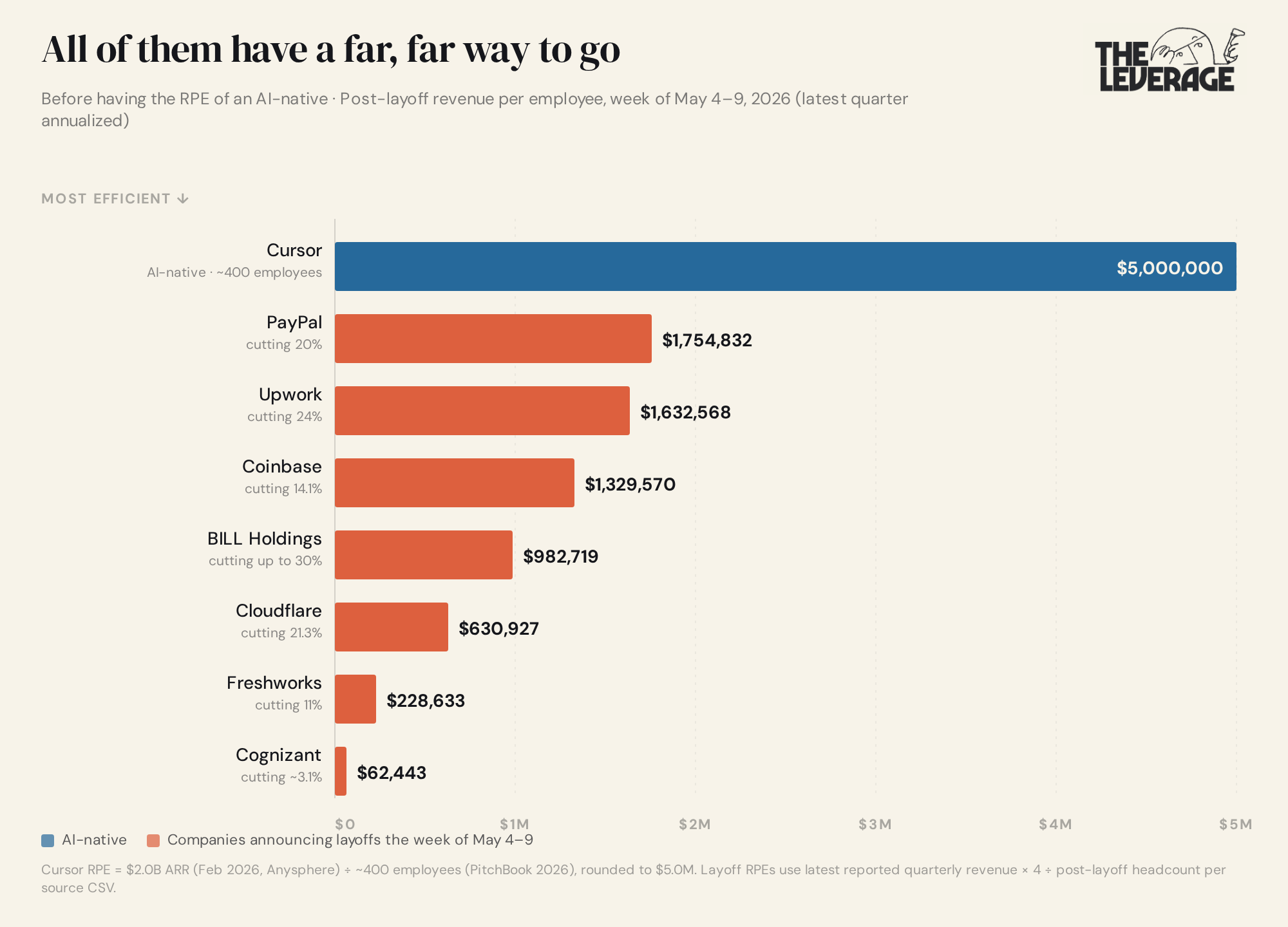
The reason every CFO in tech is staring at AI is because of this chart. Cursor crossed $2 billion in ARR with roughly 400 employees. That is $5 million per employee — and Cursor didn’t have to cut anyone. It is among the fastest-scaling B2B software company in history. To truly be called an AI Native, you just gotta grow incredibly quickly and efficiently at the same time.
Even after this week’s reductions, none of the incumbents come close. PayPal — the best of the layoff cohort — runs at $1.75M per employee, roughly a third of what an AI-native does.
The gap in RPE is why the layoffs aren’t being rewarded. Every CEO on these earnings calls is staring at a cohort of competitors that ship faster, scale cheaper, and compound at multiples bigger. The cuts are an attempt to close that gap but my sense is investors are looking for increased growth rates most of all. You don’t get to $5M revenue per employee by firing 20% of your people. The company has to be structurally built differently.
This week’s moves were a cohort of public companies admitting, on the record, that the cost structure they built for the SaaS era is no longer competitive in the AI one. Whether you believe the AI excuse depends on whether you think any of these companies can actually rewire themselves into AI-native operators after the fact.
BIG TOLLBOOTH
The best way to be an AI native? Don’t even try. This week SAP has moved to ban unapproved third-party agents from its platform. They join HubSpot, Workday, Salesforce, and most recently ServiceNow as the companies locking down and/or monetizing access to their systems of record. What’s really weird is that they won’t really publish the price? And it’s near impossible to forecast?
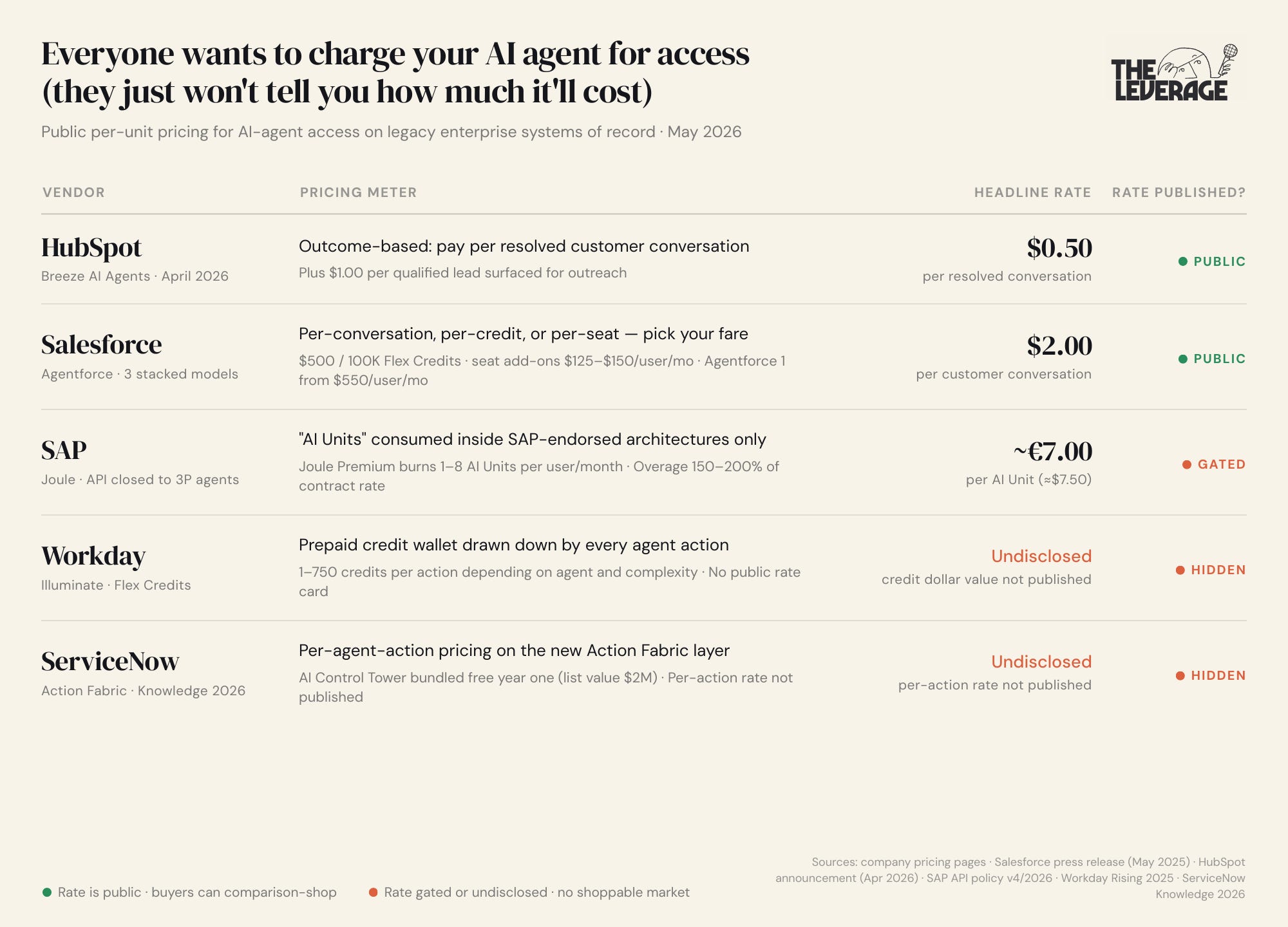
Credit to the select few going outcome-based: HubSpot’s Breeze only bills when the agent actually resolves something, so a buyer can map cost directly to value delivered. The credit systems like SAP’s AI Units, Workday’s Flex Credits, ServiceNow’s per-action meter — go the other direction (that direction is down to pricing strategy hell with the rest of the McKinsey consultants), where every vendor invents a different unit, several refuse to publish a per-unit rate at all, and consumption per task is buried inside the contract.
“Replace employees with agents” only works if the agent can sit at the employee’s desk — and for most of corporate America, that desk is SAP, Workday, ServiceNow, and a CRM, not the new age AI-native productivity tools that support AI Agents. A regional insurer or a mid-sized industrial Workday plus ServiceNow doesn’t have the option to “just migrate.” Those projects take three to five years when they’re funded and prioritized, and the vendors like it that way.
BIG RISK
Here’s to the investors trying to back science experiments. On Monday I got on the phone with Justin Mateen, the Tinder co-founder turned solo GP, who is a seed investor in Subquadratic. The next day, the company came out of stealth claiming a 1,000x reduction in attention compute and a 12 million token context window. They raised $29M at a reported $500M valuation on the strength of a math claim that essentially nobody who wired the money can independently verify.
Mateen told me he had “never been this excited about a pre-launch company,” which means something different coming from a guy backing the same CEO for the third time than it does from some generalist VC underwriting the second coming of Theranos. It’s an interesting bet because you’re just kinda hoping that the team you’re backing is like, smarter then everyone else on the planet and can invent something out of nothing.
Obviously that’s untenable, so investors are laundering the illegibility of science into proxies they can read. Mateen’s pitch to me had four of them stacked like a Jenga tower.
Proxy one: the team is “11 PhDs from Oxford, MIT, and Cambridge,” which is pedigree-as-proof.
Proxy two: he’s backed CEO Justin Dangel twice before successfully, and Dangel literally shut down his own fund to take this job, which is operator loyalty doing the work of due diligence.
Proxy three: the frontier labs “gave up on sub-quadratic approaches a few years ago,” which is the slick rhetorical move of reframing the absence of validation as an outsider advantage.
And proxy four, the tell: an acquisition by a frontier lab “could justify 25% of the company” pricing. Investors are essentially pricing the call option that the architecture might be real.
I have no idea whether this science is real. I have a sociology degree. I can talk to you all day about Weber and Durkheim, but ask me whether sub-quadratic sparse attention scales linearly and I will simply nod and start to politely fall asleep. But there are lots of these types of bets happening in neolabs. The Information estimates that more than $10 billion has now flowed into the neolab category, with $2.5B deployed or discussed across just five rounds in a single month last fall. Ex-Anthropic researchers at Mirendil are negotiating $175M at a $1B valuation with a16z and Kleiner co-leading. Isara closed at $650M on a multi-agent thesis with OpenAI itself on the cap table. And the rumors I am hearing are that there are a few more pre-product labs in the market right now at unicorn-or-better seed pricing.
Still though, I kinda love this? Venture capital used to be called “adventure capital.” Backing wild science experiments on the basis of people’s vibes is much cooler then funding yet another B2B SaaS company.
TASTEMAKER

An essay that troubles me. I’ve been a long-time reader of Anthropic Co-founder Jack Clark’s newsletter. In his May 4th edition, he published an essay arguing that “there’s a likely chance (60%+) that no-human-involved AI R&D - an AI system powerful enough that it could plausibly autonomously build its own successor - happens by the end of 2028.”
Ah. Ahhhhhh.
This is bad because we can’t fully control LLMs, and so if we let models recursively self-improve, which is what Clark is saying will likely happen in the very near future, we are in for a world of models smarter than us who ignore our commands. The essay is worth reading in full because whether you agree with him or not, this worldview is increasingly popular in government and C-suites. Buckle up.
As a happy palette cleanser to take your mind off this potential end of humanity event happening in a very short period of time, I recommend this essay on the best free restaurant bread in America.
Go and be kind this week,
Evan
Sponsorships
We are now accepting sponsors for the Q2 ‘26. If you are interested in reaching my audience of 34K+ founders, investors, and senior tech executives, send me an email at team@gettheleverage.com.
The more useful read here is that “AI layoffs” are not really proof that AI has cleanly replaced thousands of jobs. They’re proof that the old SaaS headcount model is getting re-priced in public.
A lot of these companies are trying to tell the market, “we are becoming AI-native now,” but layoffs alone don’t make you AI-native.
For job seekers, I think the wrong takeaway is “tech is dead.” The sharper takeaway is that the generic tech job-search playbook is dead. You now have to be much more precise about which roles are still compounding, the squishier coordination-only roles are going to keep getting pressure. I broke down how I’d approach the search in this market here, in case useful:
https://consulting2tech.substack.com/p/your-90-day-plan-to-land-a-tech-offer