


This week we have an exclusive interview with Adobe on their partnerships with video generation startups, analysis on China’s edge in robotics, and the very surprising way that twenty-year-olds are listening to music.
It is so good to be back y’all, let’s get into it.
MY RESEARCH

New Year, New AI, New Me. Here’s the problem with New Year’s resolutions: they assume the issue is timing. As if you’ve been waiting all year for the right moment to start, and now—finally!—the calendar clicks over and you can begin. The issue is that you are still you, and no new month will change that. So, I wondered if it was possible that AI could make a new person entirely. This article details my experiment.
Does AI persuasion work? We have multiple studies that show that an AI, given 10 minutes, can be more persuasive than any other technology. Simultaneously, the unit of advertising is changing from an impression to a conversation that can change your mind—delivered by an AI that knows you, remembers you, and can tailor itself to you in real time. I wondered what would happen if I had an AI pitch all of you. Read here.
NEW! VIDEO ESSAY! The Smile Curve of Robotics. Too often conversations about robots devolve into scare tactics around job loss. I think this is an inaccurate way to view this technology. Instead, it is worth considering where the new jobs appear, and what new types of companies will be profitable. Watch it here.
WHAT MATTERED THIS WEEK?

AI LABS
X.AI raised $20 billion and celebrated by creating untold horrors. Of all the startups making large language models, Elon Musk’s post-OpenAI rebound lab is the one that I find most baffling. With this latest round of funding, the company sits at a roughly $230 billion valuation. Its models score in the same ballpark as leaders like OpenAI and Anthropic. And most impressively, it has scaled its datacenter production at a speed that everyone thought was impossible. To do all this in a few short years is staggering.
And yet.
The revenue to loss ratios at this startup makes OpenAI’s wild dreams of a trillion dollars in datacenter buildout look like a financial plan put together by Dave Ramsey.
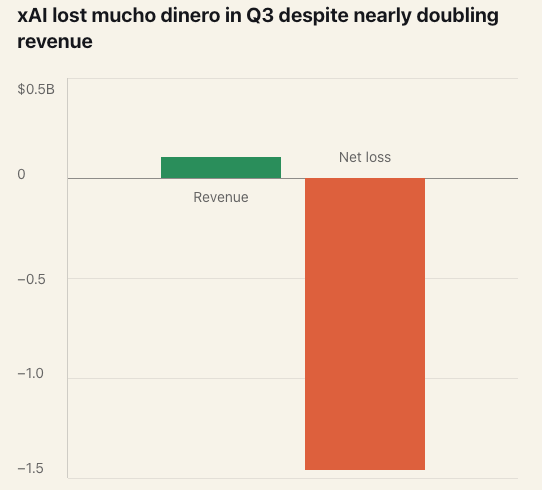
The company is enjoying a $230 billion valuation on the basis of less than a billion in revenue. I can sorta understand the rationale here. You throw in the value of the datacenters, the social network of the platform formerly known as Twitter to be a distribution/monetization layer, and the magic premium that being Elon Musk gets, and the valuation isn’t that nuts.
Still, this announcement happened the exact week that Grok had to turn off its image generator model for most users because it was being used to create non-consensual pornography. You just had to tag Grok on X, say “put her in a bikini”, and suddenly they would be near naked. This sucks! Yes, free speech is real, and you could already do this with existing tools, but the pairing of technical ease and Twitter’s distribution is something wholly terrible and different. The safety controls on Grok were so poor that people were even using it to create CSAM (child sexual abuse material). One researcher found that on X, “6,700 images every hour that were identified as sexually suggestive or nudifying, compared to 79 new AI undressing images per hour on other top websites.” The only truly viral day Grok has ever had in its existence is when it released an online sexbot with a “spicy mode.” This is an app making essentially no money, whose primary use case appears to be porn.
What are we doing here? This is a blight on the technology industry and every investor involved here should be giving themselves a long look in the mirror.
PUBLIC TECH
Adobe Is Betting Models Become Dumb Pipes. Are They Right? Over the break, Adobe announced a new partnership with video generation company Runway. Here’s the core of Adobe’s AI strategy, stated plainly by Hannah Elsakr, their VP of GenAI Business Ventures, in an exclusive interview with The Leverage:
“Models are going to commoditize just like cloud services commoditized and just like storage commoditized over time. That’s going to happen. Right now, in the visual generative AI space, models do have what I would call personalities. Different models are good at different things.”
If the first sentence is right, Adobe wins. They become the aggregation layer—the place where you access Runway, OpenAI, Google, Luma, and Adobe’s own Firefly through a single subscription. Model providers become interchangeable suppliers competing on price while Adobe captures margin on workflow integration and enterprise trust. In tech strategy nerd speak, we would call this “commoditize your complements.”
The Runway partnership is the clearest signal of Adobe’s strategy here. Adobe is now Runway’s “exclusive launch partner”—Gen-4.5 debuted inside Adobe apps before anywhere else. Elsakr’s framing was blunt: “Where are the video professionals working? They’re working in Adobe.” By extension, they aren’t working in the editing tools that model labs have offered up.
But her second sentence—about model “personalities”—reveals the tension. Differentiation isn’t commoditization. The question is whether those personalities persist, converge, or can be smoothed out by Adobe’s workflow software.
As always, the truth is to be found in where the money goes. Adobe runs everything through “generative credits”—a unified currency across all AI features. Partner models cost more credits than Adobe’s in-house model of Firefly. And the early signal is working, the Adobe team told me that credit consumption grew 3x quarter-over-quarter in fiscal Q4. It is still a small amount, Adobe’s “AI-first ARR” for products (Firefly subscriptions, Firefly Services, Acrobat AI Assistant, GenStudio) just crossed $250 million, roughly 1% of total revenue. But it suggests the engagement-to-monetization flywheel is starting to spin.
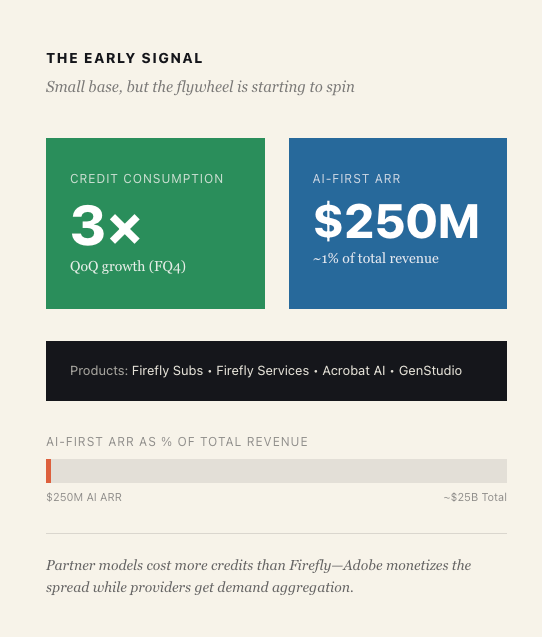
Model providers accept this arrangement because Adobe offers demand aggregation—and because creative tools are no longer the only prize. Video and image generation models are training grounds for robotics and world models, markets exponentially larger than Hollywood post-production. Venture capital is a TAM-seeking missile. Runway and Luma are content to cede Adobe some market share for creatives; they’re using it to fund the path toward something bigger.
BLEEDING EDGE OF POSSIBLE
China is dominating in robotics manufacturing. While the total production numbers are tiny relative to the hype, just a measly 13,000 total, it is already reminiscent of earlier technology waves where China was great at manufacturing, but the core R&D wasn’t as good.
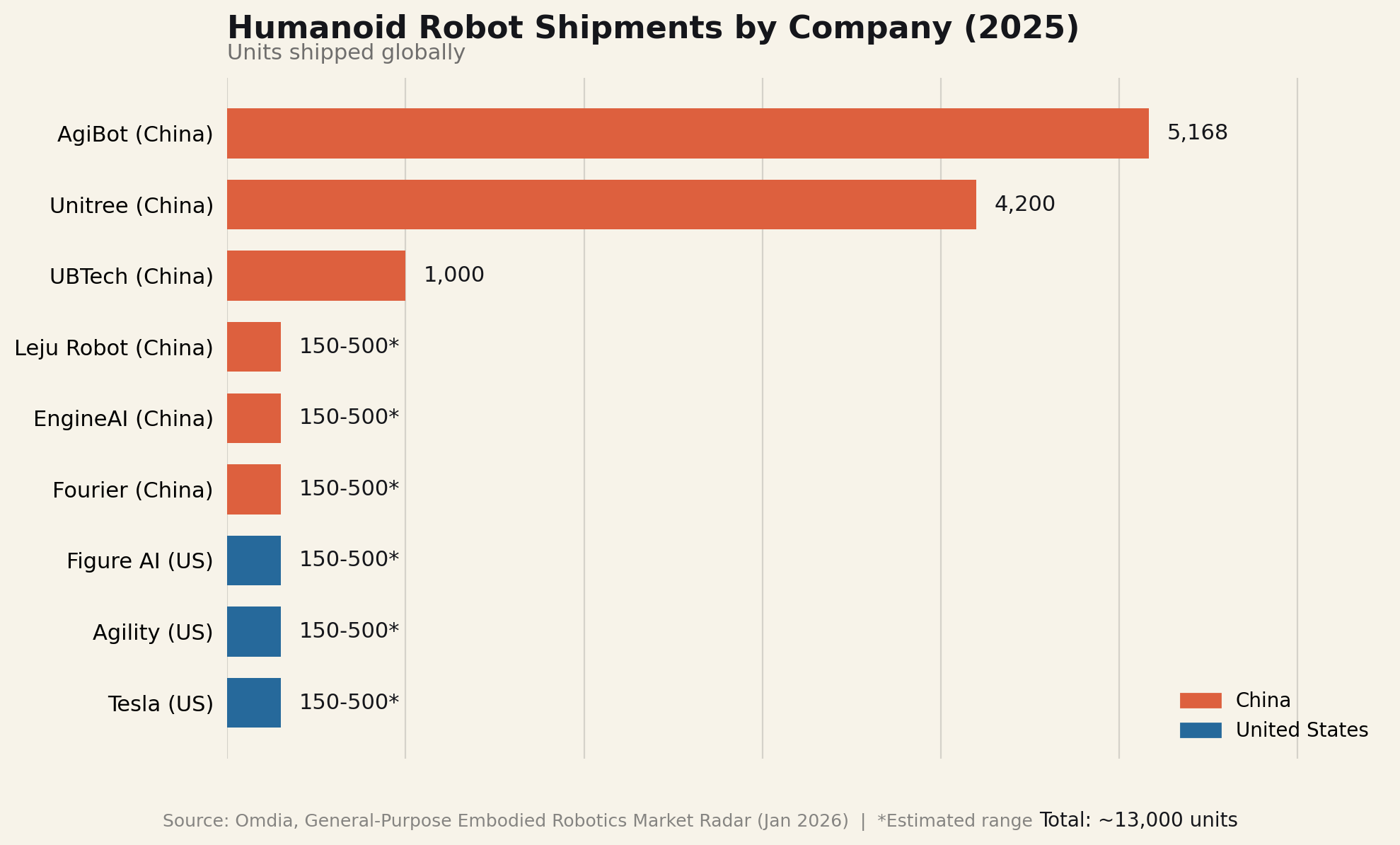
I am deeply unconvinced that this will happen the same way it did with smartphones. China is an incredibly different country this time around, with a more robust industrial policy and a better manufacturing base than the United States. Just last year, the country saw 40 humanoid robots formed! In the U.S., I can think of <25 serious competitors and <15 in Europe.
TASTEMAKER

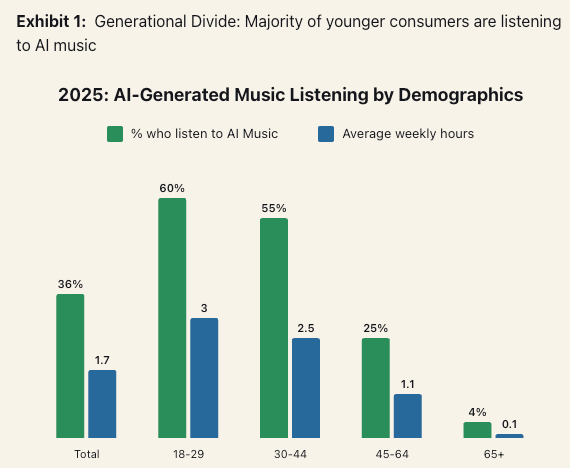
AI music is already bigger than you think. 60 percent of 18-20-year-olds are listening to 3 hours of it per week according to a new analysis from Morgan Stanley. This listening is done mostly via short-form video or playlists on YouTube, but I think the fact that the number can be this high and the world isn’t really changing all that much is telling. Unless you care about the individual artisan as a craftsman, or if there is some social element of where a friend recommends it to you, people don’t seem to notice if something is from AI.
I am more and more convinced that the most performative form of marketing over the next decade will be something I call “process positioning.” Here, founders will be selling how you make things just as strongly as what benefit the product offers. Customers need to see and feel the passion, energy, and non-AI effort that goes into making your product, otherwise the default assumption going forward will be that it is an easily replaceable slop good.
This is a silly example of this, but I think one of the reasons that the Lord of The Rings movies have been so durable is because of their extensive “behind the scenes” features that they published with the blu-rays back in the day. It is one thing to know that they put hundreds of people in makeup and chainmail. It is something wholly different to watch the video of two guys casually explaining they sat in a room for two years assembling a 10km length of plastic rings to form armor for the films.
In tech marketing, the 2025 meta was highly polished launch videos. I think that is going to sputter a bit—instead, anti-polish, gritty and real videos showing how hard something was to make will reign instead. Hold me to this prediction! In the meantime, you should watch the extended edition of Fellowship and you’ll appreciate it all the more.
Have a great week,
Evan
Sponsorships
We are now accepting sponsors for the Q1 ‘26. If you are interested in reaching my audience of 35K+ founders, investors, and senior tech executives, send me an email at team@gettheleverage.com.