


There is a version of the AI story where LLMs make the internet suck. In our already too corporate, too frictionless world, LLMs act as an intellectual slip-n-slide where we all go schloooom down the tarp into a world of mass attention consolidation. Platforms own our data and use that to make the stuff they think we want.
The good version of the AI story is one of wild, borderline dangerous, individual empowerment. LLMs become a loving companion that helps us ladder up our creativity and intellectual capabilities. It helps us become the exact version of us we want to be, free of the influence of corporate overlords. That future looks awfully similar to what I saw last week at The Leverage Launch. While at the event in SF, I talked with dozens of people who, despite some of them never having coded in their lives, were able to quickly whip up beautiful, interesting sites that represented their interests. (Thank you again to Cursor for sponsoring.)
I want to run Launch back in Austin, NYC, and London next year! Please respond if you would be interested in coming so I can get a sense for if we need to do a Leverage world tour.
This week, we had the “GPT-3” moment for robotics, Patreon is trying to punch Substack in the throat, and why a billion dollars doesn’t even get you a seat at the AI lab table anymore.
But first, this newsletter is brought to you by Span.

Let me say something heretical—you are spending too much time worrying about what model to use. New research from Span suggests bigger returns can happen by changing different aspects of your AI use.
Span analyzed agent use across 103 engineering teams and scored every session on 3 variables teams already control: prompt clarity, environment readiness, and quality stewardship. The associations were large. A 1-point gain in prompt clarity correlated with roughly 27% lower token cost per merged AI-authored line. A 1-point gain in environment readiness correlated with roughly 88% more merged code per human turn. A 1-point gain in quality stewardship correlated with roughly 39% fewer review cycles.
When they told me these stats, I didn’t believe them at first. These gains are huge. But it makes intuitive sense. Model selection happens a few times a year while you use those 3 levers for every task. They wrote a report that helps you understand how to significantly improve your prompts and coding agents that you can read below. I’ve started saving mountains of tokens since applying its advice!

Who actually gets rich when everyone can code? Lovable users are now spinning up a million new projects a week while the App Store has roughly 2 million apps in it, total. This has me thinking, surprisingly, about the origin of hip-hop. New production technology means that suddenly new types of art can be invented. For hip-hop it was stuff like the turntable, cassette tape, and the Roland TR-808. Are coding agents the same thing for apps? Is software the next great form of media? I mapped the five places all that value could end up, and showed how you can benefit. Read here.
The government thinks the newest AI models are too dangerous for you. I have spent four years and over a million words building 7 frameworks to navigate exactly this moment, and I walk through them in this video. Watch here.
I built myself a new home on the internet. Quoting myself generously, “I care about technology as a human enterprise. I’m spending my one wild and precious life in this industry because I believe we sit at the elbow of the J-curve; a moment of pessimism and despair, politically and economically intense, that hits right before we (potentially) usher in wild abundance. By a strange artifact of history, that future is being decided by a few hundred businesses, mostly in Silicon Valley. Understand those companies and you understand what happens to the rest of us…I write and code and speak and throw parties, all to nudge my community toward a future worth building.” See the website here. (Make sure to click around on a desktop, lots of hidden delights in this thing including magic mushrooms, a secret cow, and being able to blow out candles.)

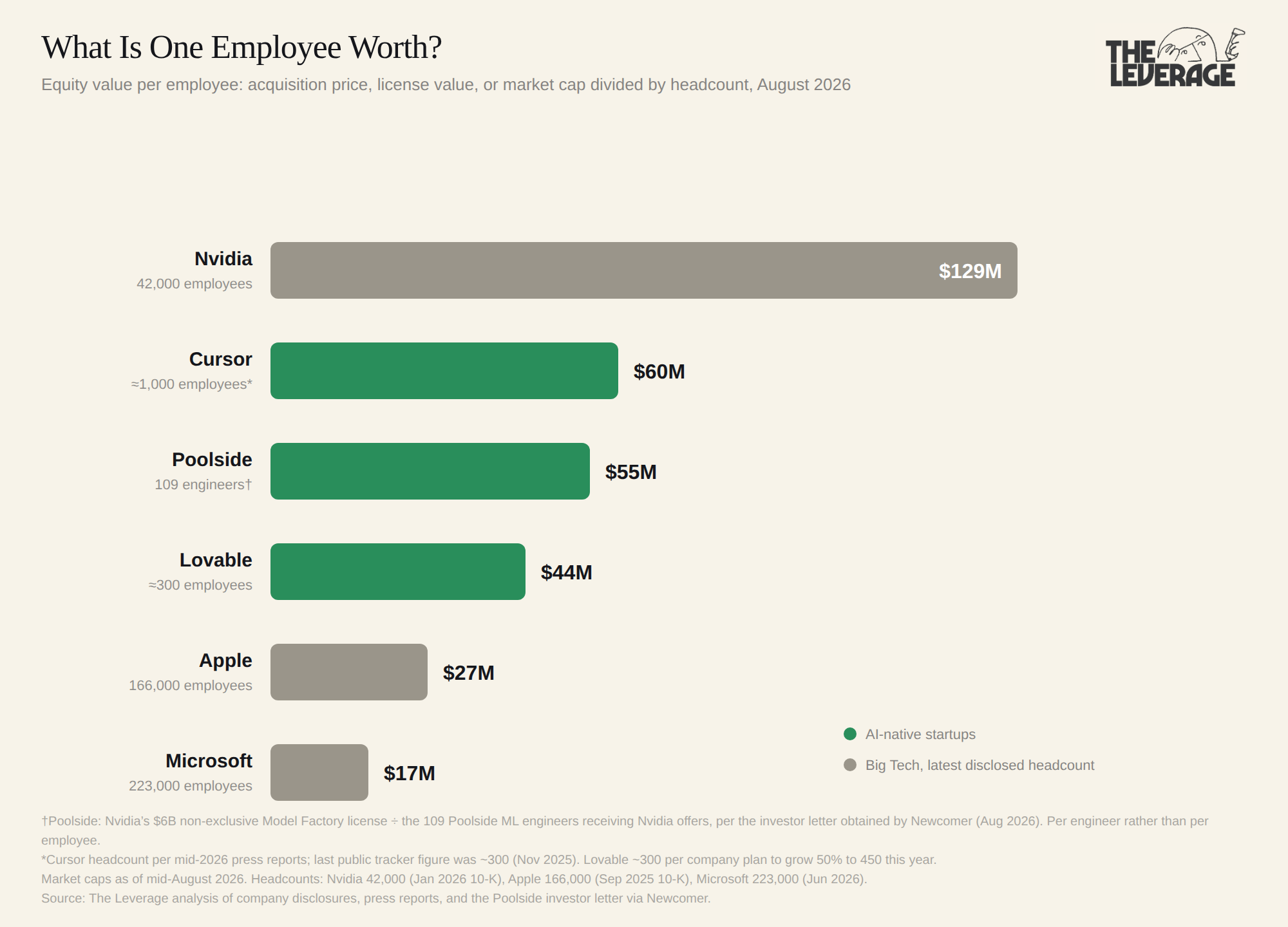
Nvidia is paying $6 billion for a startup that couldn’t scale. The company is paying Poolside $6 billion for a non-exclusive license to its Model Factory, hiring away 109 of its engineers, and cashing out existing investors at $76.20 a share. Our napkin math would tell us that Nvidia paid roughly $55 million per brain, right in line with the $60 million per employee SpaceX paid for Cursor. (I updated last week’s leaderboard accordingly.) The market for frontier AI talent now clears at prices that would make even the Dodgers squeamish.
But what really caught my eye was a sentence in the letter Poolside’s founders sent investors about the deal, “The compute needed to be at the frontier of the current model recipe is going vertical, and as the world accelerates along the axis of Recursive Self Improvement this will only become more evident.” This is crazy! A company with hundreds of millions in the bank and a killer founding team is saying that they are priced out. It sounds nuts, but the data bears that out. I plotted Epoch AI’s cost estimates for frontier training runs and this chart is essentially the map for why Poolside gave up. (Note the logarithmic scale!)
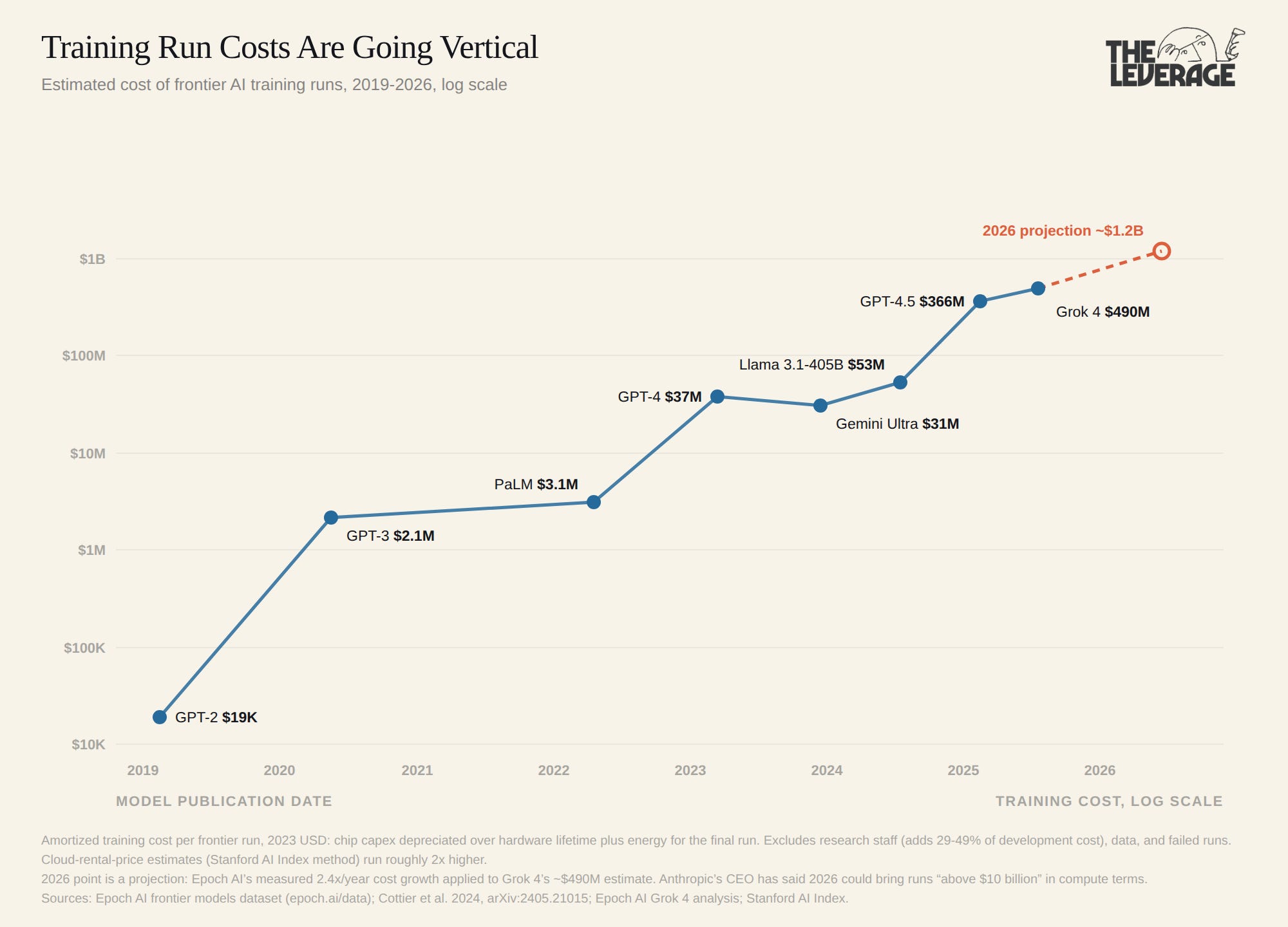
This is just the cost of training. Add in the data, the researchers, etc and I bet the cost would be inflated by another 50-100% depending on generation. If this chart continues, by the end of 2028 we may see a model that costs $10B to make.
What’s even crazier is that Anthropic saw Poolside’s collapse three years ago. In April 2023, Anthropic’s fundraise was predicated on this prediction, “We believe that companies that train the best 2025/26 models will be too far ahead for anyone to catch up in subsequent cycles.” It is now 2026 and those nerds were very, very right. Anthropic is reportedly eyeing a two trillion-dollar IPO while Poolside, a lab founded by serious people with serious money, just cried uncle.
The uncomfortable question this should raise is whether any other coding neolabs should bother to exist with scaling laws this strong.

Robots are having a GPT-3 moment. Unitree went public last week and the stock closed its first day up 460%, hitting a $50 billion market cap on 2025 revenue of roughly $252 million. For those people doing some math on their fingers right now, yes, that is about 200 times sales and P/E ratio nearing 1,300. Yeesh! I covered this company at a $9 billion valuation two weeks ago.
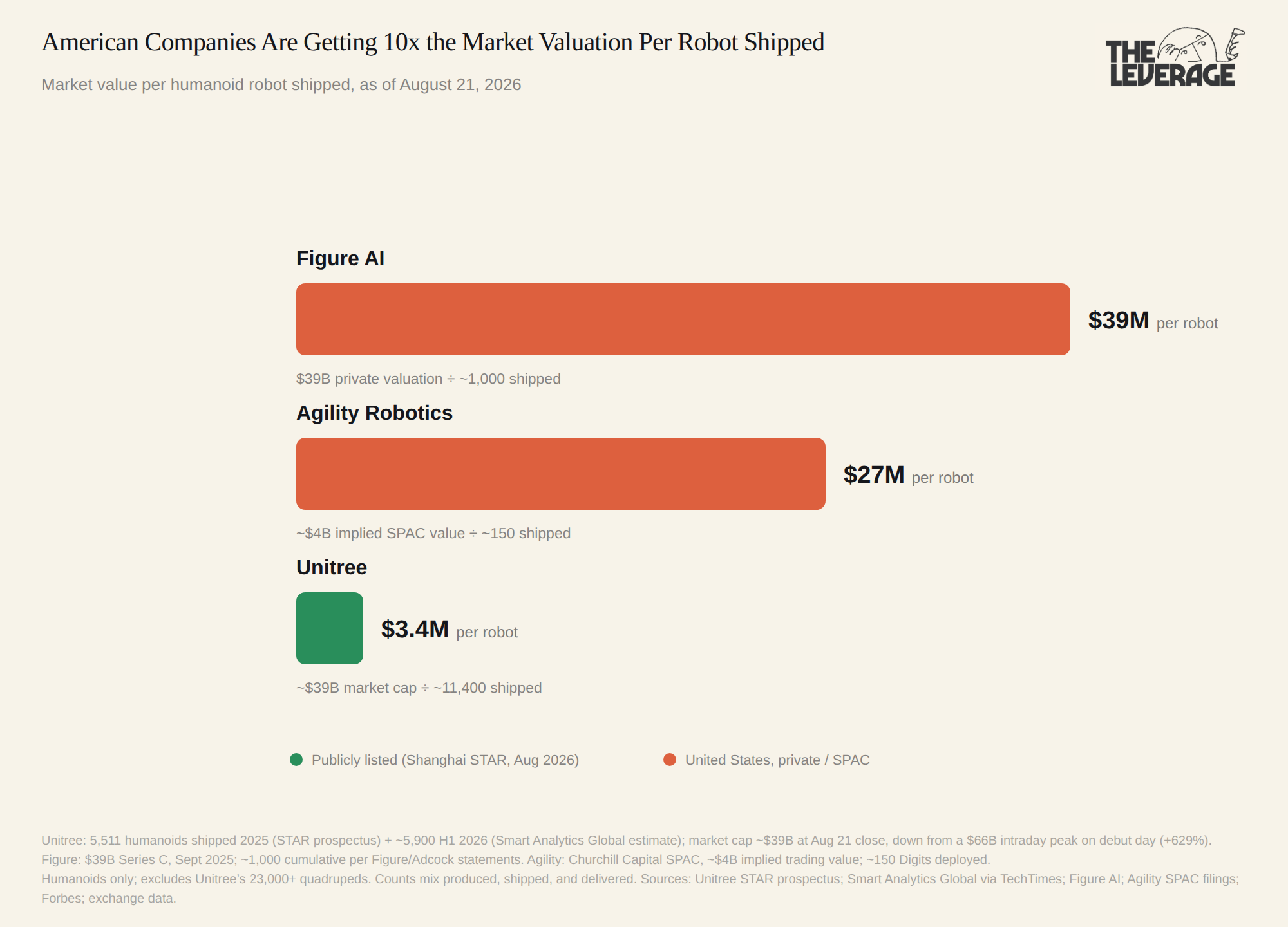
If you divide market value by robots actually shipped, something weird happens. Unitree, the company that is actually shipping bots to customers, trades at $3.4 million per delivered humanoid. Figure, an American robotics manufacturing startup, valued at similarish $39 billion, is priced at $39 million per robot.
Whatever you think of a specific company’s valuation, there is some underlying science to back this hype (science ironically being published by other companies). This week Generalist AI released GEN-1.5, a robot foundation model that learns new tasks from 3 to 12 seconds of demonstration, hitting 59% one-shot success across diverse tasks and 83% after five minutes of data. In short, it is very generalizable and requires little data to do real-world tasks relatively well. Google DeepMind’s Ted Xiao said the leap felt like using GPT-3 for the first time. Robotics researcher Chris Paxton called it “possibly the real GPT moment.”
I have been banging this drum all year: we are (were?) at the GPT-2 stage of robotics. I’m not quite at the point where I can officially tick that GPT number up, but the demos we are seeing prove that scaling laws work in robotics similarly to LLMs. The Unitree multiple only looks insane if you think robotics capability is static. To give you a sense of how bullish I am, I wish there were a prediction market where I could bet that robotics will be a defining issue of the 2032 presidential election. We are very much on track for that future!

Patreon just became Substack. (As predicted.) Patreon announced 30+ new features last week with a new algorithmic feed, short-form video clips, and a short-text post format. Squint and its Substack. Squint at Substack, think hard about how much you love Mao, and it’s TikTok.
If you buy the “coding agents mean we can ship 10x the number of features” argument that I believe, then one way we could look for evidence of that is seeing if competitors start shipping copycat features faster. So I charted launch dates for some basic features from the major creator economy companies and, uh, 2026 is looking spicy. You can watch three companies with three different founding religions converge on one product.
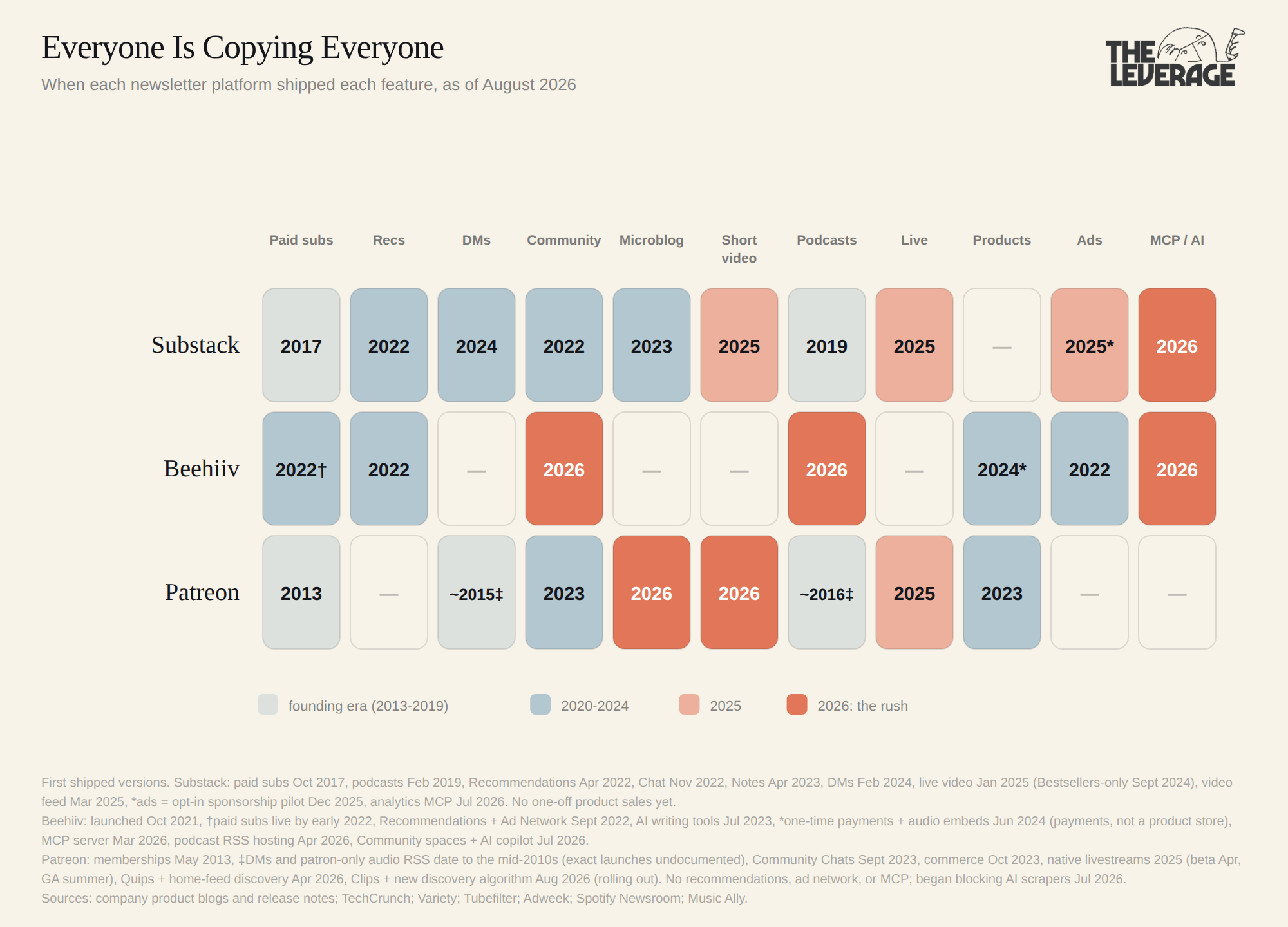
Newer fans of mine might find this surprising. Not the OG fans, though! You know that this competition is a law of nature I wrote down back at Every in 2023: “I can know, with certainty, that over the next three years both Beehiiv and Mailchimp will move closer to [Substack’s] capabilities, while I move closer to theirs: Substack will improve its graphics, Beehiiv will copy some of Substack’s discovery features, etc.”
TAM is the ultimate adjudicator for product roadmaps. It will force startups into profit-maximizing shapes, and for creator platforms there is exactly one shape that justifies raising venture capital dollars: convince creators to port their audiences from other platforms into your owned algorithmic discovery network, then lock them in with fees and switching costs. Substack found it. Beehiiv found it. Now Patreon, the company I once argued should buy Substack, has been squeezed into it too, feature by feature, layoff by layoff. If only they had bought Substack when I told them to!
In the creator market, and in SMB products generally, the most valuable thing you can offer any merchant under $50 million in revenue is demand generation, and they will accept a staggering amount of fees and humiliation to get it. Ask anyone selling on Amazon or an independent restaurant eating DoorDash fees. On a meta level, in a world where AI makes the software itself cheap, the product is no longer the product. Distribution is. Patreon CEO Jack Conte is right that the current web is a failed promise for creators, but his only fix is to build a smaller, more ethical version of the demand generation machine that broke it.

The Samurai and The Prisoner is a summer banger. This film is like when you order the special at the restaurant that sounds terrible but the waiter talks you into it. The ingredients shouldn’t work—a period piece that is also a whodunit that is also a rumination on honor that is also a samurai movie that is also a thriller—but somehow, when blended together, it makes for an incredible-tasting film. I loved how it was very deliberately not made for western tastes; there are much longer takes and slower pauses than I would expect in a Hollywood style of editing. One of my favorites of the year. Trailer.
Go and be kind this week,
Evan
Sponsorships
We are now accepting sponsors for the Q4 ‘26. If you are interested in reaching my audience of 35K+ founders, investors, and senior tech executives, send me an email at team@gettheleverage.com.