



Wonder is a company that has baffled me for years. They have bought a variety of failing food “tech” businesses (Blue Apron, Grubhub, etc.) added in some original recipes, and somehow turned this island of misfit toys into one of the fastest-growing companies in the world. After three Wonder restaurants opened up near my house in Boston, I decided The Leverage community needed to understand what this company does. So, I commissioned the best person in the world to investigate it for us.
Kristen Hawley is a freelance journalist and founder of Expedite, a long-running newsletter about restaurant technology and the future of hospitality. Her work regularly appears in outlets including Fast Company, Eater, Food & Wine, and now, The Leverage. She lives in San Francisco. You can read more and subscribe at Expedite.news.
First though, this newsletter is brought to you by Lovable.

Our daughter has a care team consisting of her grandparents, her daycare classroom, the people who work with her each week, and two parents who just had a newborn. All of us need the latest information on her progress. It was impossible to keep track of all the changes, tests, and interventions.
So I built an app to solve that, with legitimately the least amount of effort I have ever put into software. I told Lovable, a software creation platform, what I wanted in plain English. It wrote a plan before it wrote code, then it just built it. It had all the typical whiz-bangs of sign-in, a database with real access rules, one page of instructions, an email to everyone every 2 weeks, the stuff that an actual software app would have, not just vibe coded slop. Crazily, it only took 46 minutes and two prompts from me. The total cost was 10 bucks.
I keep being told AI will let me do more. This was better. Building an app with Lovable got me to do less. Subscribers to The Leverage get $5 off their first month of Lovable Pro.
And with that, here’s Kristen.

Once upon a time in suburban New Jersey, an internet billionaire had an idea: What if, instead of driving to a restaurant for dinner, the restaurant drove to you? It would bring more than food; third-party delivery services like DoorDash had already cornered that market. Instead, this business would prioritize food quality and innovative preparation, tapping famous chefs for iconic recipes and training staff to recreate near-restaurant-quality experiences from tiny-but-powerful kitchens installed in the back of Mercedes Sprinter vans that would park in the driveway. Then they deliver it to the front door.
Wild, right? That was the point.
Wonder quietly debuted in May 2021 and the ambitious idea won over enough investors to net half a billion dollars in funding by the end of that year. Early tests in one affluent New Jersey suburb showed promise; after just a few months, Wonder had delivered meals to more than half of the town’s residences. Famous chefs, including Bobby Flay and Nancy Silverton, licensed recipes to Wonder and the company meticulously recreated them inside its tiny van kitchens. Wonder bought up more vans to serve more suburbs. The plan was to purchase a thousand more. It was a heavily funded wildly ambitious moonshot — a big, bold bet on the future of convenient, accessible, (hopefully) delicious food.
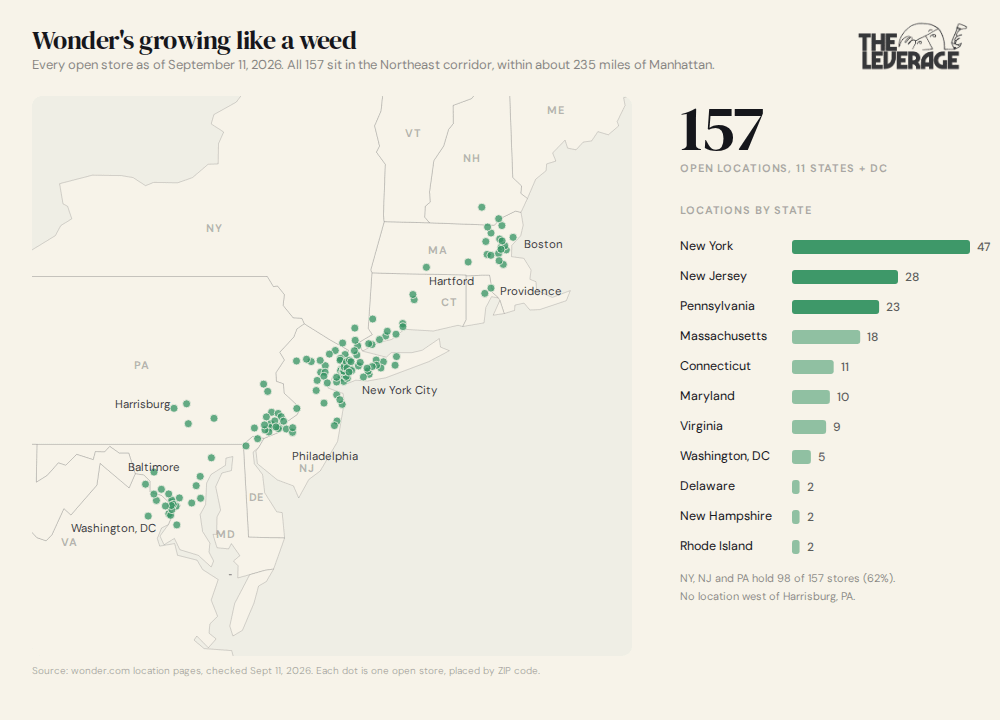
It took less than two years for that bold bet to be proven a dud. In January 2023, Wonder entirely scrapped the van plan and wrote off $100 million to pivot to permanent storefronts. Each physical location hosts multiple restaurant brands. All of them are fine-tuned for a takeout- and delivery-heavy business. The first permanent Wonder location opened in Manhattan a month after it ditched the vans. Today, it has about 150 locations in the Northeast with plans for many more, including a major expansion into Texas next year.
But a network of restaurants doesn’t make a moonshot, and Wonder was thinking big. The company made its first buy outside of restaurants in September 2023, scooping up seriously distressed meal kit company Blue Apron for $103 million. (It was once worth almost $2 billion.) It’s since announced over $1 billion worth of acquisitions that includes a NYC-based courier service (Relay), the third most-popular delivery network in America (Grubhub), a restaurant rewards app (Claim), a food media outlet (Tastemade), a bowl-building robot (Spyce, formerly owned by Sweetgreen), plus two independent restaurants and one small chain. I’ve joked with restaurant industry friends about what company Wonder might buy next; I know at least a couple pitched themselves as potential targets, hoping for an offer.
Wonder has continued to aggressively fundraise to support its growth, with rounds totaling over $3 billion, including a $650 million round this summer. The whole concept from its creation has been a spectacle, full of unexpected twists and iterations as it becomes one of the fastest growing food companies on the back of cheap capital and crazy ambition.
Marc Lore, Wonder’s founder and CEO and a self-described “moonshot seeker,” is also an e-commerce legend. He sold online retail companies Diapers.com and Jet.com to Amazon and Walmart, respectively, in deals that totaled almost $4 billion. But Lore is a relative newcomer to the restaurant industry. That hasn’t stopped him from aggressively pursuing his increasingly futuristic vision to change how we eat. If anything, his outsider status seems to have emboldened him; he’s promised a Wonder IPO as early as next year, potentially targeting a $30 billion valuation. Recently, he sold his controlling stake in the Minnesota Timberwolves and Minnesota Lynx NBA and WNBA teams, reportedly to focus on the public offering.
But what is Wonder beyond a growing list of restaurants and a series of increasingly ambitious ideas backed by a few billion in funding? Its longtime mission statement is “to make great food more accessible.” The process, though, has proven more complicated.
Wonder, the restaurant:
Around the time of Wonder’s Blue Apron acquisition, it said each of its store locations was on track to generate $4 million in annual sales. Wonder hasn’t shared average unit volume for its retail locations since — though Lore told me in late 2024 that stores become “quickly profitable” after opening. That’s better than most major fast casual chains; Chipotle’s average restaurant generated about $3 million in sales last year. An average Sweetgreen generates about $2.5 million in revenue annually; an average Cava around $3 million.
The company has said it will open over 100 stores this year. Wonder’s physical footprint is growing so fast that it’s hard to keep up. I drafted this story during a visit to my Central Pennsylvania hometown, and when I looked up from the screen I noticed a flyer announcing the opening of a local Wonder in a stack of mail on my dad’s kitchen table. I held it up and asked if he’d tried it yet.
“No,” he said, “but I’ve gotten like four of those coupons in the mail. I can’t figure out what it is.”
I started to explain. Think of a Wonder location as 30 different restaurants inside one kitchen, I told him. Customers use Wonder’s app to order items from any of Wonder’s concepts for takeout or free delivery — thanks to its Grubhub acquisition, it can now tap a network of couriers to fulfill orders.
I tried to explain the company’s larger vision and its vertical-integration-by-acquisition-of-failing-companies strategy, how owning all the parts of an order from ordering through food prep and distribution can potentially boost profits, but he interrupted me.
“But is the food any good?” he asked.
I paused, then realized I didn’t have a solid answer. The few times I’ve ordered from a Wonder in New York have been… fine. I don’t remember any particularly remarkable menu items, but I have no complaints.
Reviews on Google skew broadly positive. Evan and I used Codex to scrape nearly 30,000 Google reviews across Wonder locations, which average 4.4 stars. (By Evan’s metrics this is ‘not great,’ by my gut instinct informed by over a decade of reporting on restaurants and maybe too much sympathy, I say, ‘room for improvement.’)
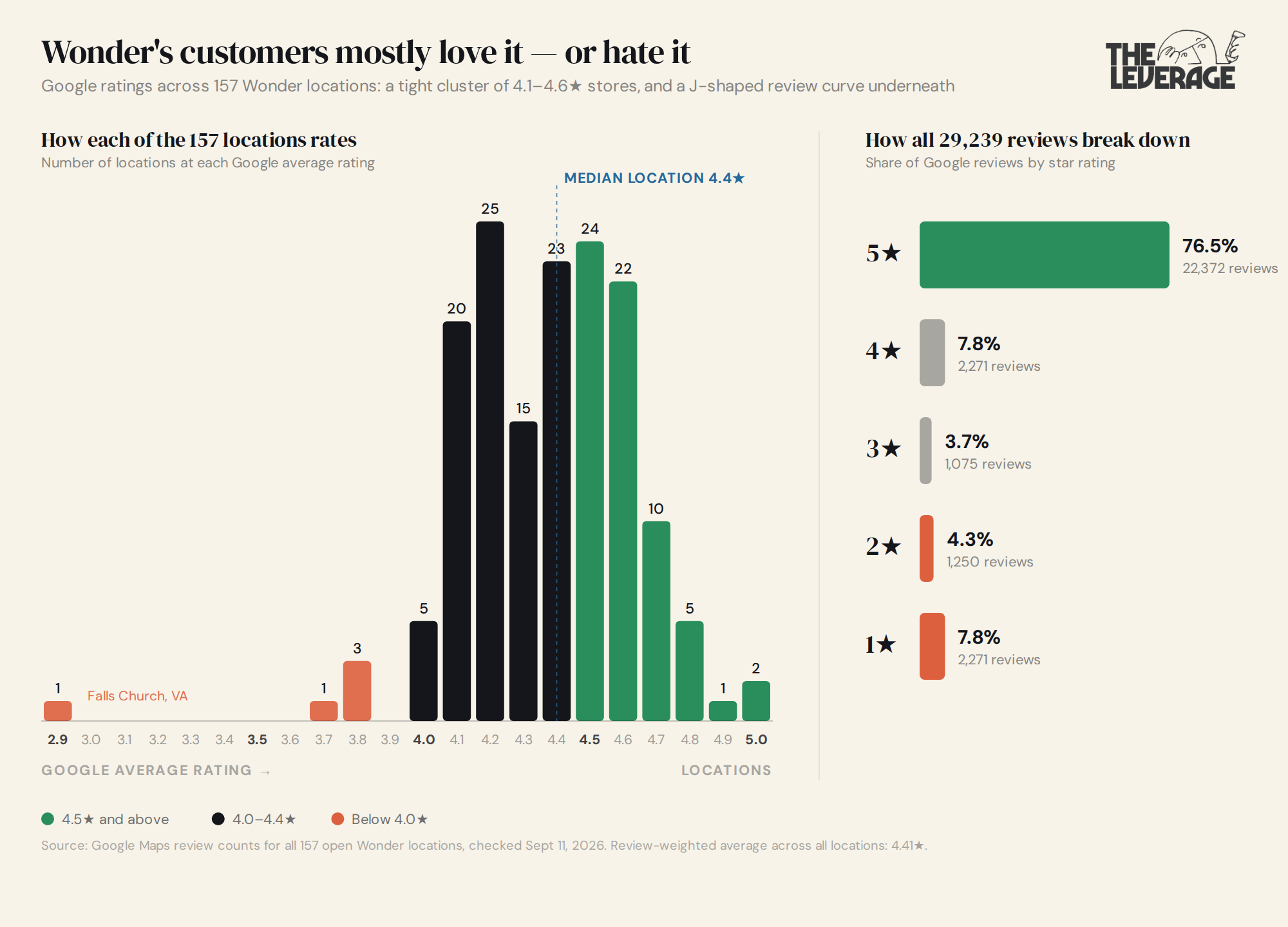
Over 8 in 10 reviews are four or five stars. It’s impossible to know if Google’s reviewers are rating food quality, delivery quality or a mix of the entire experience.
Chefs who partnered with Wonder by licensing their restaurant names and recipes for distribution praised Wonder’s recipe development process. When I spoke to them for an Eater story in 2024, they described a culinary team that worked to meticulously replicate their recipes with some ingredients measured down to the microgram — that’s one-millionth of a gram, a near-infinitesimal quantity.
Since then, Wonder has invested in more of its own concepts, launching generic but specific brands like El Diez Mexican Bowls and Happy Tuna sushi. Wonder has Italian food, Indian food, pizza, poke, Greek, Chinese and more, all being slung out of a restaurant the size of a nail salon.
What it can’t build, it buys. Wonder reportedly spent “$6 million to $10 million to well upwards of that” (I know, that’s a wide range; I suspect much of that payday came in the form of Wonder’s stock) on its most recent acquisition, a wildly popular, single-location sandwich shop in Manhattan called Salt Hank’s. It has bought an eight-restaurant barbecue chain and a single-location fried chicken spot. The allure is in their easily replicable, easily scalable menu items. Salt Hank’s will arrive inside some Wonder locations this fall, just a few months after the ink dried on the deal.
Of course, those concepts are only easily scalable inside Wonder’s physical and digital verticalized infrastructure. The slick storefronts, modern kitchens (Once, in an interview, Lore described a Wonder kitchen to me as “a micro-fulfillment center”), and trendy restaurant brands are a huge part of Wonder’s story, but there’s a lot more under the hood.
Wonder, the vertically integrated logistics machine:
Wonder is expected to generate about $2 billion in revenue this year. If it’s true that Wonder locations have managed to keep average unit volume consistent at $4 million in annual revenue, the actual restaurants should be grossing about $630 million annually. Meaning that the majority of the company’s revenue will come from its acquisitions. The year Wonder acquired it, Grubhub generated $1.6 billion in revenue.
Wonder, of course, has ambitious plans to squeeze more revenue from its restaurants. Last year, Wonder acquired Sweetgreen’s bowl-building robots for $186.4 million, which transformed a handful of locations into giant salad vending machines. Sweetgreen’s execs had praised its potential and promised future success, but it didn’t materialize fast enough.
The company has big plans for the bowl bots, which Lore has said will help keep prices low and restaurants open later. (He also said the robot can build 500 bowls an hour, which means roughly one bowl every seven seconds, which is… a lot of bowls.) It has plans for other bots, too; Lore has teased plans for an “infinite sauce machine” that can make 500 sauces hourly from 152 raw ingredients.
The faster restaurants automate, the faster they’ll move. During an appearance at a Wall Street Journal event, Lore teased Wonder Create, a service that lets anyone — influencers, marketers, you, me — spin up a restaurant brand, logo, and menu in just a few minutes. Dishes are made from ingredients Wonder’s kitchens have on hand, and the concept’s creator gets a cut of the sale. The company hasn’t shared a launch date for this idea either.
Wonder, the moonshot:
Here’s another twist: Lore isn’t the only internet billionaire chasing a tech-driven food future. Uber founder Travis Kalanick recently folded CloudKitchens, a ghost-kitchen-slash-real-estate company, into a larger initiative called Atoms that raised $1.7 billion in just one funding round. Like Wonder, Atoms has a lot going on. But the crux of Kalanick’s thesis on the future of foodservice is that physical automation — robots that prep, cook, package, and deliver food — can drive the price of a delivered meal below the price of groceries.
I guess we’re about to find out what kind of restaurant disruption and automation billions of dollars can buy. Wonder projects a net revenue of $3 billion in 2028 and close to $5.5 billion by 2030, when it should finally start turning a profit. It’ll reportedly spend $2.7 billion to get there.
The fairy tale of a totally seamless meal experience hasn’t fully materialized yet, but Wonder is definitely chasing its happily-ever-after. When I interviewed Lore as part of a project for Fast Company last year, he was buzzing with excitement over his long-term vision for Wonder.
“We’ve built an AI platform that knows you better than you know yourself. [It] knows your food preferences, knows your food sensitivities, knows your health goals, knows your budget, and is able to, basically, autonomously feed you,” he said. Ideally, these “autonomous meals” will arrive exactly when you’re hungry and contain exactly what you want or need. He’s also talked about creating personalized nutrition profiles for people based on a blood test and developing customized meal plans.
“You probably think that’s crazy, right?” he asked, grinning.
I do. At this point, I also think it’s completely believable.