



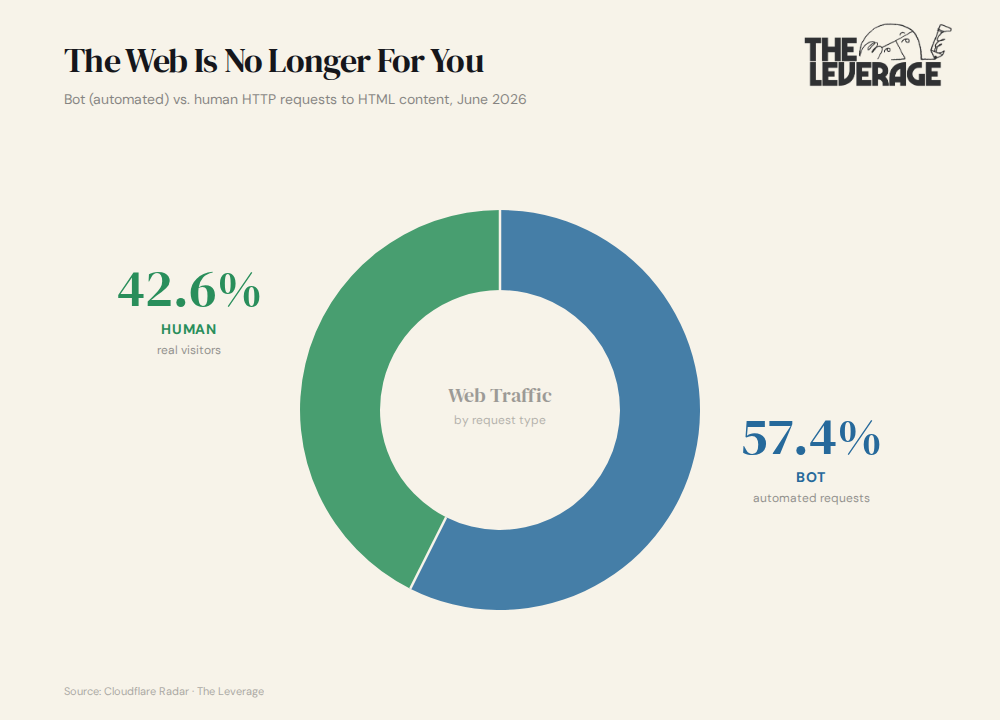
This week, the CEO of Cloudflare announced that bots had passed human traffic for the first time in the internet’s history. By their count it’s 57.4% bots to 42.6% humans. We, by which I mean the human readers of this essay, are now digital minorities.
Many of the economic assumptions of our world are constructed on the basis of humans being the ones who look at, and operate computers. Facebook sells ads because they have eyeballs looking on websites they control, and the brains behind those eyes are convinced to buy stuff with the ads they show. Content providers like me put stuff online assuming we can monetize a reader relationship through subscriptions or ads. This has done enormous good (independent media companies like mine can exist) and enormous harm (engagement, rather than truth, becomes what systems like Instagram’s algorithm optimize for).
In our current internet, like as of the moment you are reading this, that old economic equilibrium is kaput. Irrelevant. Toasted and buttered bread. Aka, cooked. AI agents search differently, they use the internet differently, and most importantly they monetize very differently.
For example, if you wanted to read about the SpaceX IPO, you as a human being might have an hour to scan this publication’s deep dive on it plus a few other articles. If you ask an AI agent to tell you about the SpaceX IPO it’ll scan 50-100 essays on that topic, synthesize them somehow, and then give you the results. My essay would likely be in that mix! But because the agent acts as a digital intermediary between me, the company producing the good, and you, the potential user, I see no revenue. Worse, I have no long-term relationship with you. My top of funnel shrinks and my revenue is materially worse.
This, in many ways, is fantastic for consumers. While an AI would not produce an analysis as good as mine today, it might in the future. In the meantime, the AI will get some stuff right and is much cheaper than a subscription to The Leverage.
If you amplify that same process across all the providers of information or services with digital components, the end result is a radically different type of internet.
I think that change will manifest in two ways:
Skills
Economics
Skills
A few months ago, I met with a reader who said he had built a Claude Skill of me.
He told me about it at a dinner party, in a nonchalant sorta way, similar to mentioning your newest productivity hack. What he did was simple. He took my published essays, ingested them into a Skill, and started asking it for advice as if it were me. With a sorta embarrassed laugh, he told me he used it every day.
Frankly, I flipped back and forth between strangely honored and furiously pissed off. He hadn’t stolen anything. My writing is published online. Shoot, he is even a paid subscriber! He examined everything I’d published and built a tool that replicated the value of consulting me at zero marginal cost. He paid Anthropic a few cents in inference while giving me nothing. There was no theft! He simply did what the new physics of digital business allows anyone to do. I was annoyed because it still felt like intellectual identity hijacking.
Large language models can essentially do two things—understand a bunch of text and then produce something in response to that text. In the case of the internet that means they can ingest all sorts of information, then construct documents, software, or workflows in response to that. So, if you put enough of your expertise online, you can theoretically just be made into a Claude skill like I was.
This is only a problem if that creation of the AI is a fully substitutable skill for the products you offer. So if your offer is something relatively simple such as “I’ll write you a feature description” you are in trouble. If your offer is “I will completely rework your comms strategy and narrative positioning, and as part of that, write a feature description” that is wholly different.
Essentially, if the majority of your solution lives online, and it is relatively simple, the skill it took to create that thing is radically less valuable now than it was 12 months ago. Sorry.
Economics
Last fall, on Tyler Cowen’s podcast at the Progress Conference, Sam Altman said something spooky:
“Margins are going to go dramatically down on most goods and services, including things like hotel bookings. I’m happy about that. I think there’s a lot of taxes that just suck for the economy, and getting those down should be great all around. I think that most companies like OpenAI will make more money at a lower margin.”
The key word in his argument is “most.” When an agent sits between you and your customer, the dollars that used to flow to whoever owned the relationship now flow to whoever owns the agent and the rails it runs on. On the old web, your content or software was about forming a long-term relationship. A reader subscribed, the relationship compounded, and you monetized it for years with additional products. On the agent web, your content is an input. It gets retrieved, compressed, blended in a Vitamix with fifty other sources, and handed to a user who never learns your name. In this transaction, there are three parties doing the work:
The compute doing the reasoning
The search layer fetching the inputs
The content itself.
Of the three, content has the least pricing power, because the agent can create a substitute.
The proposed economic fix is to tax the agents. Every time an agent references a source, the source gets paid at the moment of consumption, instead of waiting on a human who may never arrive.
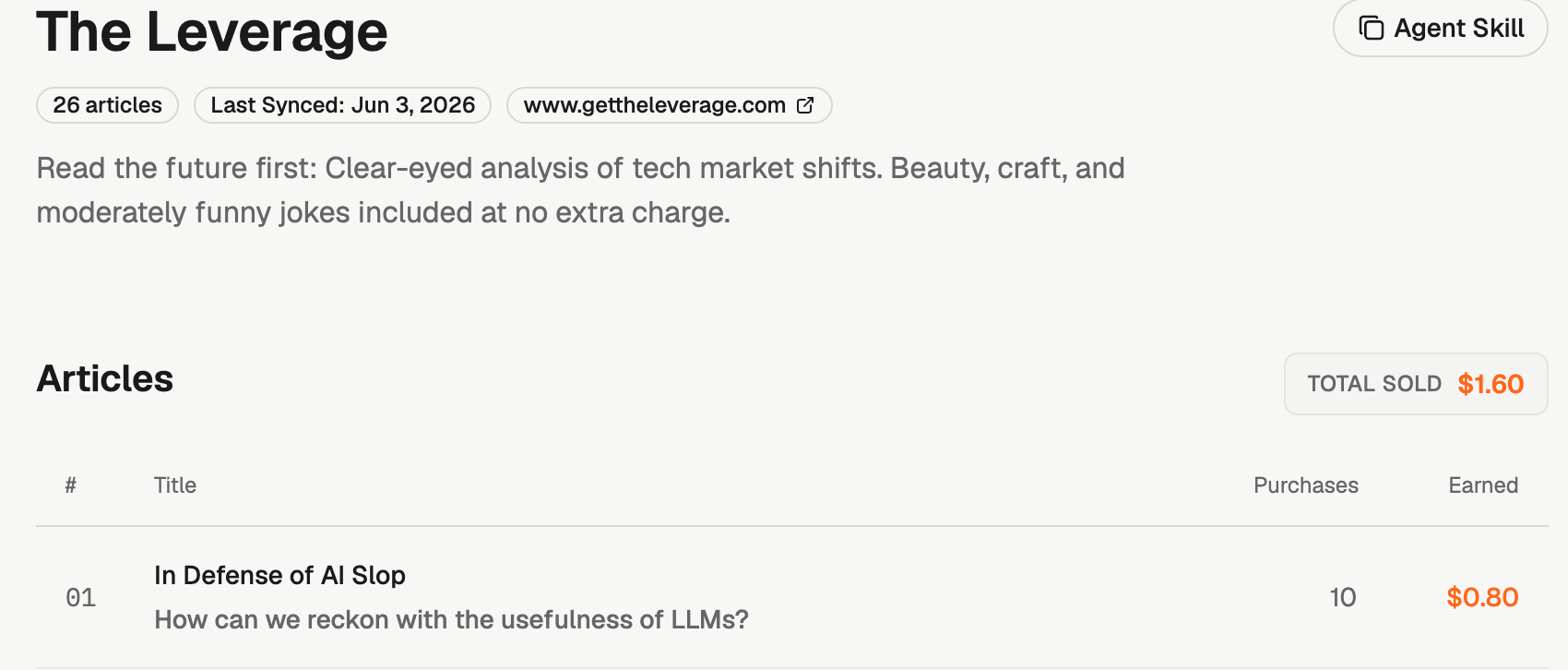
I interviewed the two companies furthest along on this. The vertically specialized version is Dripstack, built by Michael Blau, an ex-a16z crypto investor: an agent pays five to ten cents to access an article, settled instantly over stablecoins, so micropayments too small to bother with normally become economically viable. “People are doing [scraping with agents] anyways and they’re doing it for free,” he told me. “You might as well get paid while that happens.” I started using the service on May 5th. About 30 days later, the results are, uh, how to put this…about 40 cents short of a McDonald’s ice cream cone. 20 agents have scraped my work for total earnings of $1.60.
The infrastructure version is Parallel, the agent-search company from former Twitter CEO Parag Agrawal, now valued at $2 billion. Where Dripstack asks creators to opt in, Parallel already occupies the data chokepoint. Their service is an API that agents call to read the web, which means it can meter every access and divide the take across all three contributors using something called Shapley values. This would pay each contributor for the marginal value they add, averaged over every possible combination of the others. In Parallel’s world, compute (AI agents and the infra powering them) get a slice, Parallel gets their pound of flesh, and then creators of content/software get something too. Both of these companies are doing something noble in trying to get content providers paid, but it is noble in the way that the orphans were being fed in Oliver Twist.

However you divide this up, this is just materially worse for legacy internet businesses. The tax that actually clears is tiny. When I run one research query, it pulls from sixty or seventy sources, which means no single source can charge more than rounding error. In Parallel’s three-way split, content is structurally the smallest claimant, because it is the most replaceable input in the stack. Price tracks how much compute the buyer is willing to spend on an answer. Carra Wu, Parallel’s head of product for this use case, is careful about what that actually signals. “The cost of compute is a signal,” she told me. “It is not the truth itself. It’s the signal we use to say how valuable do we think this is.”
Even if a hedge fund trader pays $20 for a single deep research report on SpaceX, I would make about $11 net if he signed up for a one month subscription to read. And if these royalties never materialize, you get truth silos, where only the twenty publishers large enough to sign bulk licensing deals survive and the rest go dark. If they do materialize, content survives as low-margin feedstock. Neither outcome resembles the business you run today.
And to return to Altman’s point, this extends way beyond content. Software applications that are relatively simple can just be generated. So if a user tells their agent they have a problem that software could solve, today that agent will recommend a product. In less than 12 months, I am willing to bet the agent will just build the product for them. Or how about physical goods whose access is intermediated by the internet? I have many friends who used agents to buy tickets to Christopher Nolan’s The Odyssey in 70mm, one of the hardest things in the world to buy right now. Restaurant reservations, airplane tickets, signing your kid up for summer camp, all of them used to assume some degree of responsibility and friction on the part of users. Those are rapidly ceasing to exist.
And look, I’m not here trying to say the internet as it currently exists, is God’s gift to man. There are many problems around here. My point is that AI agents will introduce a radical amount of creative destruction for digital businesses and I have yet to find a good answer for why what comes after is better at producing truth or goodness for the world.
It is tempting to read all of this and conclude the internet is dying. Instead, we are entering a world of new centers of power. On an AI-first internet, attention is no longer scarce. Pre AI, the attention economy ran on ads and subscriptions because that was the way to monetize eyeballs. Agents have as much attention as there are tokens, which is essentially infinite. So, the constraint relocates, and wherever it lands is where new careers and businesses will be built. I have some thoughts on where that lands, that will come to paying subscribers very soon. Sign up below to receive it.
This is one of your best! Thanks for engaging the topic honestly and not handwaving a bs conclusion. In addition to a creators, it got me thinking about what a company will do with their website. Does it just become an MCP server that advertises what it does to agents searching? Then you'll really have to provide niche and differentiated content, services, or products because the agent can evaluate it quickly against thousands of alternatives. BTW, Yoni Rechtman at Slow Ventures published an open source mcp server to his content. Used it the other day in a strategy session with Claude about my new startup. It was awesome.
I think there will be 2 layers of the internet in the future.
Layer 1: bots, agents, content feeding AI models, booking platforms communicating via MCP, algorithms, quick suggestions.
Layer 2: A slow internet based on real human identity.
reason being optimisation and real human connection cannot co exist in the same space.
Thoughts?