



There is a specific kind of email you do not want to receive in August if you run an HVAC company. This sticky month is your busiest of the year, and if you get a message from your system of record saying, “You have to change your workflows in the next 30 days or else we will turn you off,” you are about to lose tens of thousands of dollars to admin time that should be spent slinging air conditioners.
And yet, roughly 1,000 contractors opened that exact email from ServiceTitan, their system of record, giving them 30 days to rip out a point solution called Podium that handled their messaging.
In a typical pre-AI, 2021 world, that would be all she wrote for Podium. The system of record would have all the data and thus all the power. However, it is 2026, Elon is a trillionaire, your neighborhood playground has been razed to make way for a data center, and Podium did not go gentle into that good night. Instead, within 24 hours of ServiceTitan sending that email, Podium booked over 100 demos from those exact customers.
What the hell is going on? Why is the point solution able to stand up to the system of record?
The simple answer is that Podium is no longer a mere point solution for HVAC employees to text with. ServiceTitan and Podium are now selling directly competitive products — ServiceTitan’s president says they’re building “the AI operating system for the trades”; Podium’s product is literally named the AIOS — meaning that Podium is hoping to become the system of record. Thus, by the ancient blood rules of SaaS combat, one of the two companies has to die in the arena.
But again, those 100 demo requests still don’t make sense. The point solution shouldn’t be able to steal customers from the existing system of record. That just doesn’t happen!
So I called Podium CEO and co-founder Eric Rea to talk about it.
Catching religion
To understand why Podium is able to fight back, you have to understand the history of the Utah startup. Podium is one of the select few companies on the planet, joining names like Notion and Intercom, that have transitioned from legacy SaaS to fully AI-native.
The seeds of that transformation were planted in early 2022. Podium had raised $201M at a $3B valuation months earlier and done, in Rea’s words, “all the ZIRP stuff.” After doing that for a year or so, they realized that “our churn was so high and our burn was so high that you’d either run out of money or customers in 18 months.” Rea was packing for a family vacation when he called his co-founder Dennis Steele, who drove over, and the two of them sat on the floor of Rea’s closet trying to figure out how to keep their business alive. Keep in mind that this is all happening while they have over $100M in total ARR! This was not a small startup but a large company that had gone totally off the rails.
To fix the company, they picked the hard option. Podium conducted a layoff and then spent 18 months rebuilding the company department by department, akin to renovating a house while living in it. It was a crucible, a fire that stripped away the fat and hubris that so many startups accumulated during the ZIRP period. By the end of that rebuild, the company was profitable and ready for whatever came next.
It was right at that moment that GPT-3.5 started to hint at the promise of what AI agents could do. In 2023, they shipped their first agent and caught religion. It was obvious to the founders that agents were the future of SaaS. (This was not a consensus view at the time.) They immediately stopped all product work and pivoted the entire engineering team to agents. This is a bold move that I’m not sure I’d have the risk tolerance for. When I asked Rea how they justified it, he told me that “18 months prior we were going out of business. We weren’t going to fall for sunk cost fallacy, and just went for it.”
Compare ServiceTitan. It launched Titan Intelligence in 2022 — early! — but ran it as a product suite. The company as a whole didn’t get religion — an “agentic operating system,” driven by an AI-first CTPO poached from Figma — until March 2026. That nearly three-year gap in conviction allowed Podium to build their AI-native product suite with an agent-first mentality.
The head start is manifesting itself in two places:
They started making a shit ton more in average contract value. Podium’s contracts went from roughly $6,500 a year in the SaaS era to $30–40K once the agents arrived. Because these agents could handle the work of a customer service representative and the median American CSR costs $42,830 a year, Podium was able to tap into larger budget pools. To be clear, ServiceTitan also sells voice agents that do something similar-ish to Podium’s, but it is an incumbent product, built and sold in an incumbent way — a marginally worse product bolted onto the very expensive ServiceTitan system-of-record platform. Neither company is selling its own models — both rely on tech from places like OpenAI — but tech debt and legacy define destiny.
No SMB wants to click around in a product. Podium designed their system of record (in this vertical it’s called a field service management platform, or FSM) to be agent-first. Today, that means that an HVAC rep will just tell an orchestrator agent named Operator what they want, and Operator goes and does it — scheduling, routing, whatever else is needed. In contrast, ServiceTitan’s version of Operator is called Atlas and, by ServiceTitan’s own copy, is a “sidekick” that lives inside the existing dashboard. When you refound around agents for SMB operators, the dashboard becomes the legacy interface you check occasionally.
Podium became a lean company that could make sub-$10K-a-year SaaS contracts profitable, right at the moment it got the chance to 5x contract size with those same customers. Then, like magic, LLMs started solving the UI and UX problems that made systems of record painful for SMB operators to use. It was a kismet meeting of capitalism, technology, and a wild embrace of risk for the Utah company.
The old law of SMB SaaS was, as Rea put it, “You either die a point solution or live long enough to see yourself become a platform.” I also believe this. However, The Leverage is on record arguing that product roadmaps should have a 10x increase in ambition and speed because of coding agents. So what that platform is — what software you should build it on — can radically change. The platform that used to be a simple revenue-generation tool can become an all-encompassing “do everything for me” product.
So rather than seeing Podium, or even ServiceTitan, as that, you should view the new system of record as this:
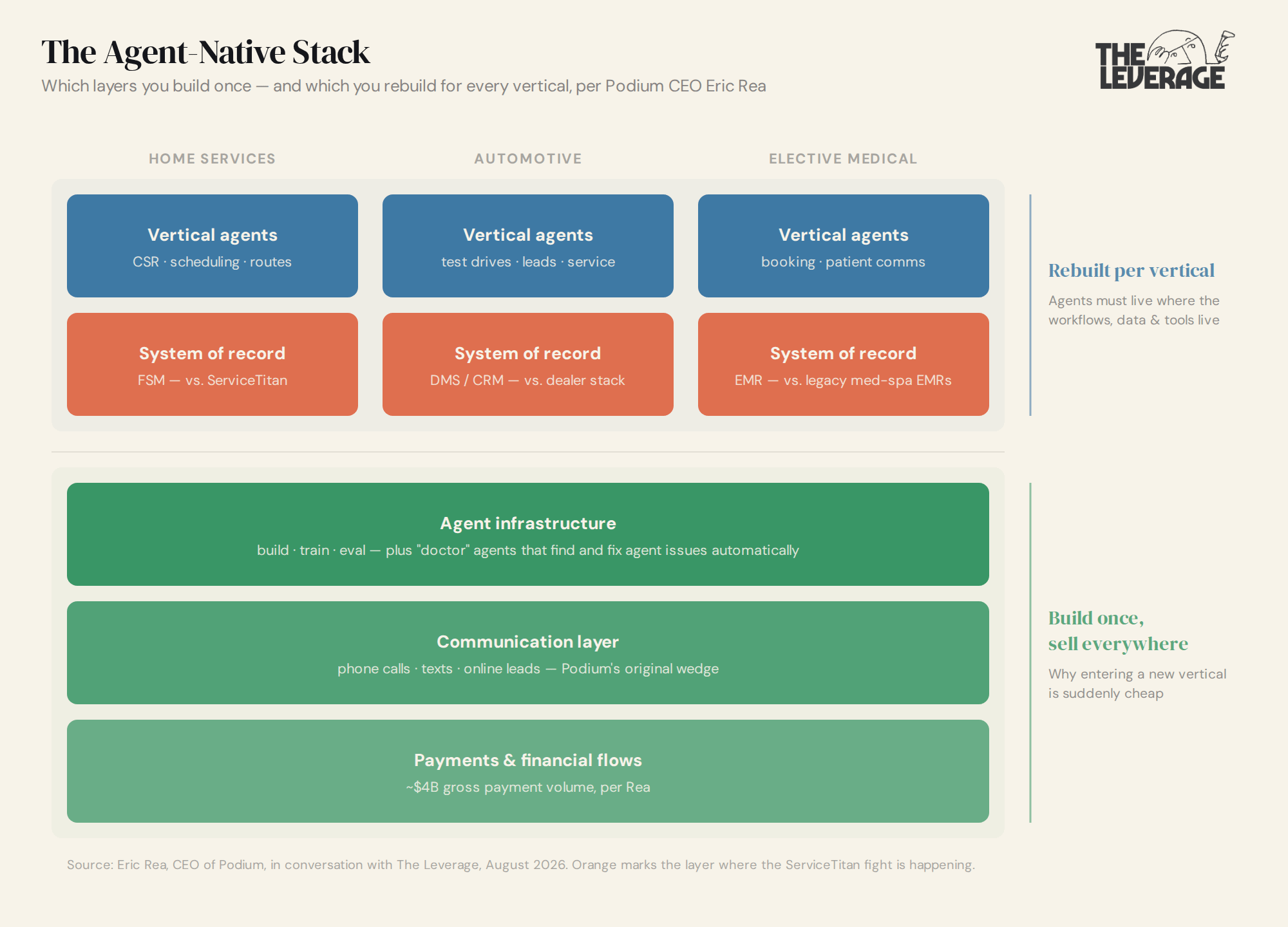
Coding agents mean that system-of-record migration is suddenly much easier. Rea told me a transfer used to take 3–4 months on average; it now takes about one. They just had a large customer transfer their system of record to Podium in three days. That dramatically reduces the legacy moat for SaaS incumbents. The moat moves: the platform becomes a combination of agent infrastructure, communication tools, and payments/financial flows.
I find myself convinced by his argument, meaning that there could be a radical evolution in software over the next few years. Podium is a case of SaaS theory becoming a competitive reality. Here’s how it shakes out…