Domino’s Pizza Explains the AI Economy
The Weekend Leverage, Nov 29th

Over the weekend, the technology world has been devouring a 167-page investor update letter from the 25 year old investing wunderkid, Leopold Aschenbrenner.
He is the highest-profile, most “AI-pilled” asset manager on the planet. Over the summer his asset value peaked at $45 billion, but is currently sitting at around $10 billion (ouch). The document is one of the wildest I’ve seen in my career; he calls for gold to lose most of its value due to asteroid mining in the 2030s, real estate to lose most of its value because robots can make buildings cheap, and says that the Mona Lisa is the best asset to be holding in the AI world to come.
Sure!
You can imagine my father’s look of sad, Southern disappointment as I expressed my vague enthusiasm for Leopold’s ideas over Thanksgiving dinner. This all sounds nuts, but also, it might not be? We’ll discuss. But first, this newsletter is brought to you by Grok Bot.

I’m sure my accountant is good at his job. Probably. Maybe. But trusting a dude who I pay like 5K a year to keep me out of tax jail feels like asking a lot.
Still, who wants to double-check a transaction ledger? Checking your accountant’s work means doing your accountant’s work. I hired someone so I’d never have to do that.
So I built The Accountant’s Accountant, a Grok Bot.
It watches my bank accounts and business card, reconciles every line of my accountant’s P&L, and proactively flags anything that looks off. I don’t trust it to do everything, but I trust it enough to verify anything.
Quit accepting income statements on blind faith and audit your accountant with the Grok Bot below.
Get The Accountant’s Accountant here.

All hail the pizza gods. When I try to explain to people what a world with superintelligence would look like, I’ve been using pizza and steak to make it clear. You see, there have been two standout restaurant stocks in the last 15 years—Domino’s Pizza and Texas Roadhouse. Both of these stocks have returned about 17x over the last 15 years, while simultaneously employing polar opposite strategies.
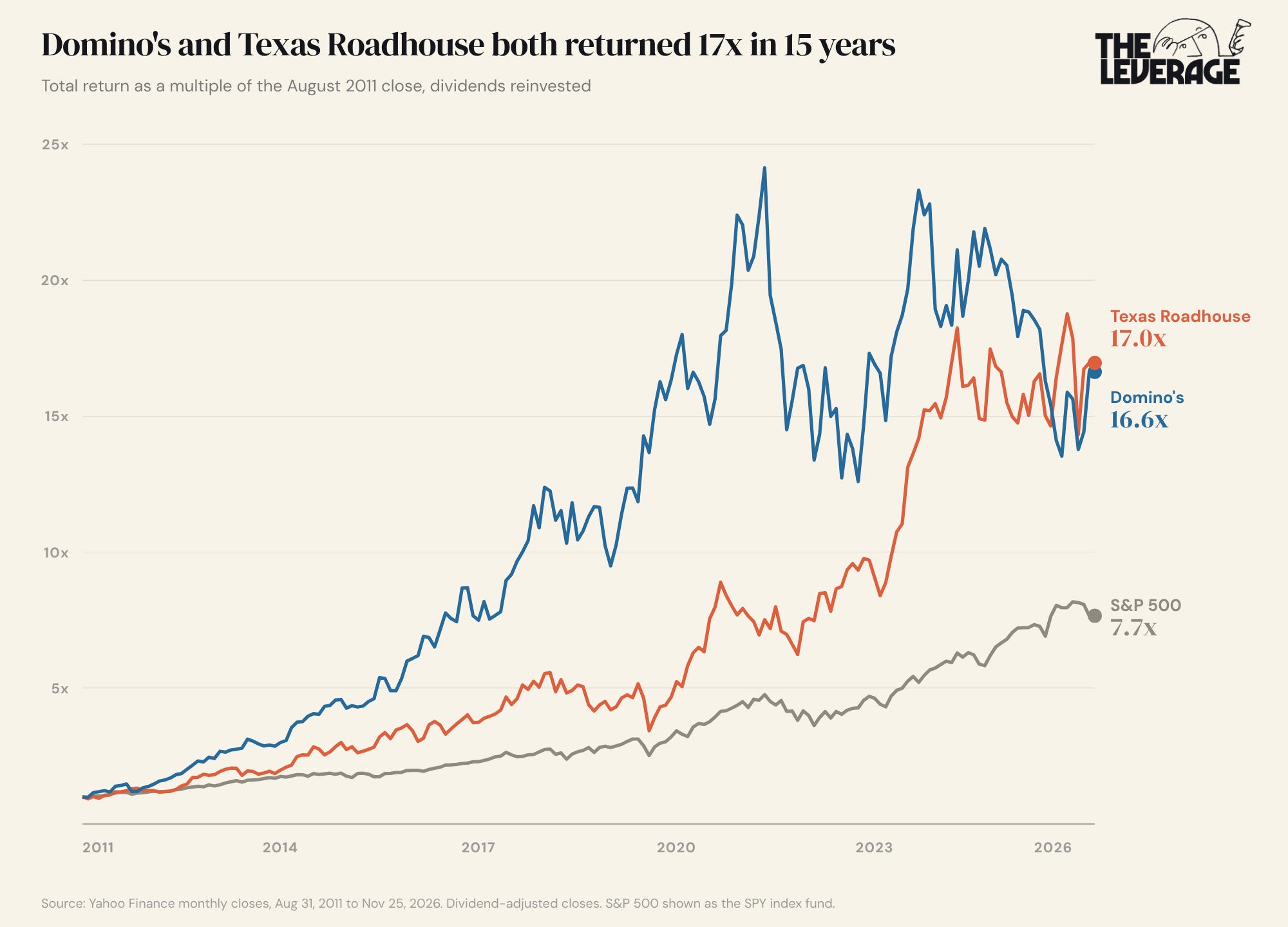
Domino’s is about getting hot circles of cheese into your gullet as quickly and digitally as possible. The store is franchised, impersonal, and a divine gift for overwhelmed parents on a weeknight. Texas Roadhouse is a steakhouse chain where most restaurants are company-owned and operated, with cinnamon butter rolls delivering goodness to every hungry patron, each of whom is treated with warm respect.
You can see where I’m going with this. These stocks are examples of a world of superintelligence because they represent the two likely extremes of what it could look like. Ruthless digital efficiency, staffed by robotic workers we never see, will generate enormous consumer surplus. On the other side, in-person premium experiences will continue to escalate in value and, perhaps, scarcity. Leopold’s letter is what happens when you take the current rates of improvement incredibly seriously. Later this week, I’ll have a breakdown of his letter for paying subscribers that reviews the specific stocks his fund is betting will go to zero and where his ideas won’t apply, so make sure to sign up for paid if you haven’t yet.
For today, my point is that his viewpoints are ones that most people in Silicon Valley have exposure to. Meaning that even if you aren’t an investor in his fund, founders and senior operators are at least considering the possibility that he may be right, and they are changing their companies’ strategies accordingly. I talked with about a dozen founders and senior operators this week, all of whom were struggling to reshape their organizations into being “AI-native” and ready for this world. It’s why this study from Anthropic caught my eye…

Anthropic’s economists interviewed 58 enterprise customers about how AI is changing their work. The researchers plotted about 300 AI use cases by how much value they created relative to how much change the company had to make to get it. The easy stuff, like ad hoc analysis and slide decks (aka MBA work), slotted neatly into how we design our organizations today. However, the truly valuable stuff, like coding agents or customer support agents, required the merging of multiple roles.
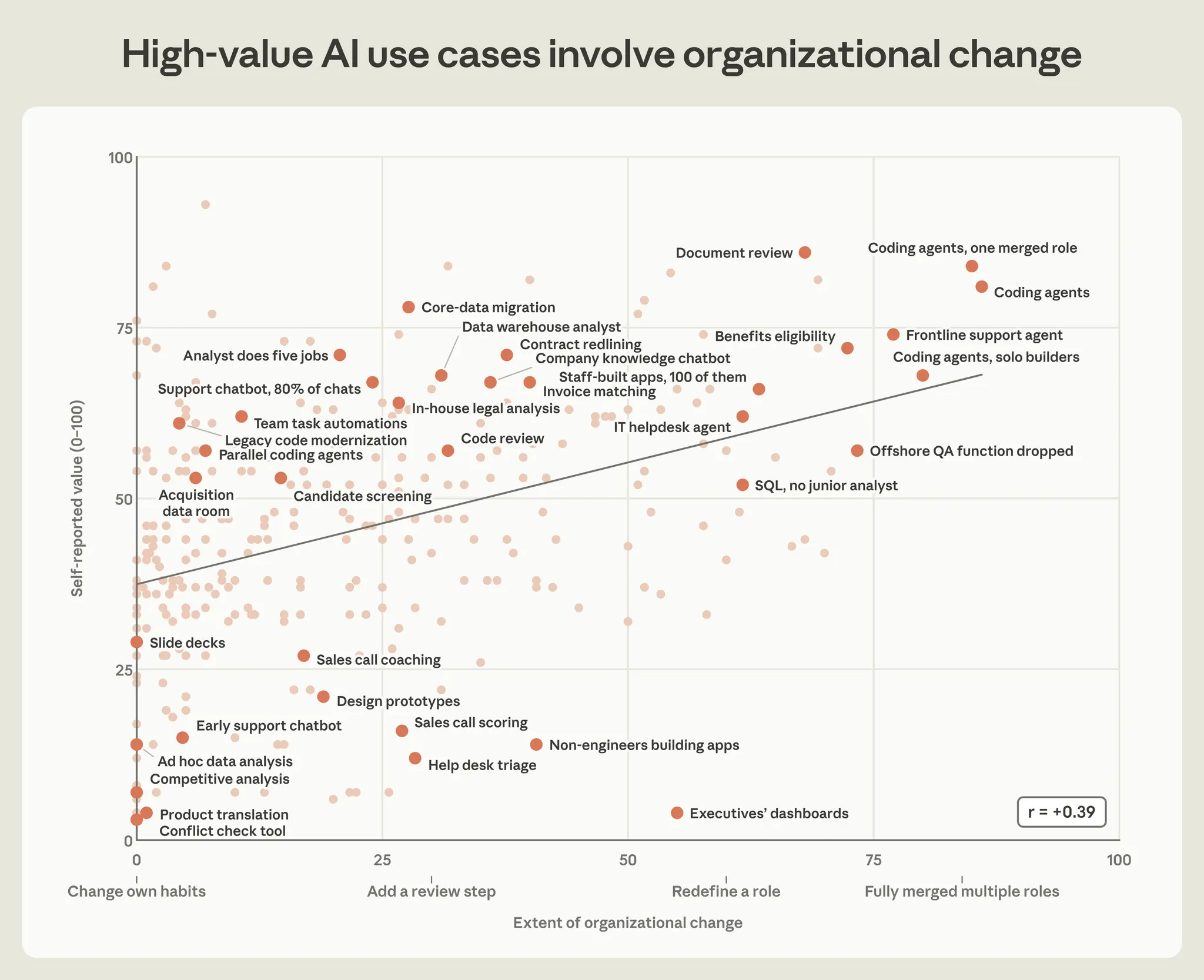
The paper compares it to factories that bolted electric motors onto a line built for steam, where most of the productivity gains didn’t really occur. What actually matters is rebuilding the “factory” around what the new technology could do. The paper’s argument was eerily reminiscent of the thesis @Nathan Baschez made here in October. His view was that the future of work looks more like a redesigned factory of AI agents versus a personal AI agent for every employee.
Side note: One of my promises to you as a publisher is that you will know the future first by reading The Leverage. Here is a clear instance of that happening. Nathan’s essay laid the intellectual foundation by which Notion, one of the best software companies in the world, now defines its product vision. Not bad! And all credit should go to Nathan as the writer, none to his handsome, yet sensitive, publisher and editor on the piece. Ok, back to my argument.
If Anthropic is right here—and to be clear, I think they are—then it actually puts technology vendors in a challenging position. It is very hard to sell “this product will make you way more efficient, but you need to fire half your staff to see its effects.” That just doesn’t work! So you are left with a few choices:
The first is to sell advice, aka be a transformation consultant. Help companies adopt this new technology through training and org design consulting. My former employer Every raised $17.5 million this week at a $110 million valuation to help companies do exactly this with media and consulting. Tribe AI crossed $100 million in annualized revenue on less than $10 million of venture funding to help customers set up AI.
The second is for the model providers to do it. This can either be through a forward-deployed engineer (which I told you last year would end up being tech’s hottest job) or through owned implementation companies. OpenAI’s Deployment Company raised $4 billion in May at a $10 billion valuation from 19 investment firms and consultancies, and is buying implementation shops to staff it.
The third is to vertically integrate and just buy the customer. Thrive Holdings raised $2 billion at a $12 billion valuation in August and now owns more than 70 businesses, including over 50 accounting firms. Long Lake has bought about 30 services businesses and took Amex GBT private for $6.3 billion. I have heard of many other startups attempting similar playbooks.
Perhaps my pizza and steak analogy isn’t the most accurate. Maybe the right food here is Soylent. It is about finding the most efficient way to get a company to achieve its goals, no matter how unpleasant the experience of eating blended sludge is. Leopold’s letter is simply an extremely bold vision of what that future might be, one that looks (tastes?) totally foreign to our modern business palate, but still ends up generating judicious returns.

If you feel like being worried about the future, I recommend this podcast from OpenAI Foundation board member Paul Christiano, who is forecasting a 1 in 3 chance that AI overthrows the U.S. government within a year.
If you feel like not thinking about the future at all, I recommend this breakdown of the editing style of The Odyssey. I enjoyed the film, but found its relentless quick cuts (and the limitations that doing IMAX brings) exhausting.
If you feel like boogying, I recommend this DJ mix.
Discussion about this post