



The newest humblebrag for the chattering class like myself is to discuss how much you are “in the weights.” Meaning, do the AI models know who you are by name? Can they describe your work? As befits my job as blogger and world-renowned sex symbol, I was in the top 15% and was known by most of the LLMs. To see if you are in there yourself, just go here.
Fun as it was, the score struck me as useless. Then, on Friday, I got a strange email. A founder contacted me because he went to ChatGPT and asked, “Who is the best tech business writer who also has an ass you can bounce a quarter off of?” [Slightly editorialized]. My name was on the list. He contacted me about a consulting gig and presto, there is now more money coming to my bank account.
Again, this is not to brag about my benchpress, which is 225 for reps. Nor is it to brag about my prose, which is delectable and high-octane. My point is that distribution is maybe the most important thing to have in the AI age. Attention markets are only going to get more competitive, so being prominent enough online to be noticed by the LLMs is a way to help your career survive. There are also new, dangerous forms of competition coming, but more on that in a sec.
First, this edition is brought to you by Working Smarter, a podcast from Dropbox about making AI work for you.
AI is a wonderful, magical technology that has the unfortunate habit of not having the full picture of what you need or what actually matters to you. Pointing the model at a problem and saying “please solve” is like using a flamethrower to cook eggs. It is just too overpowered. Working Smarter, the podcast from Dropbox, features Dropbox engineers who share how they’re building context-aware intelligence that connects to all the tools your team uses for work—so you get AI that works wherever you do.
What I find interesting about the pod is that this is the gritty work that doesn’t usually get the spotlight, but is absolutely necessary for AI to actually have a positive ROI. Working Smarter puts the builders on the mic to talk about what it takes to build the AI tools behind inference, security, and multimodal search that surfaces what you need fast. If you care about how AI gets built, this is the podcast to listen to.
With episodes on context engineering, multimodal search, agentic AI, security, and more, Working Smarter goes under the hood to show you what it takes to build AI that actually understands you—and how it can help you work smarter, too.
Listen to Working Smarter wherever you get your podcasts, or visit workingsmarter.ai.

OpenAI just shipped a model the government won’t let you touch. This week OpenAI previewed a model that tests nearly as powerful as the Mythos class but costs a lot less to run. The federal government has decided it is too dangerous for the public and is restricting access to a short list of “government-approved partners.” It is genuinely unprecedented and is a sign of things to come. Meaning, the plan you made for your career, your company, your life, is about to get torn asunder as models get better. So, I pulled together the 7 original mental models I have built over four years and millions of words to make sense of moments exactly like this one. Read here.

Apple and Xbox are raising prices, everyone else is soon to follow. The increases ran from 5.7% on Vision Pro to 54.3% on the base Apple TV 4K, and the models most people actually buy clustered in the high teens to high twenties with the MacBook Air rising 18.2% to $1,299 and the base iPad 28.7% to $449. This was a mid-cycle pass-through of component costs, something Apple very rarely does. The cause is the memory shortage created by the AI buildout, with data centers absorbing DRAM faster than suppliers can make it. Apple said it had, “never seen a component price increase this much, this quickly,” and Tim Cook called the situation “unsustainable” a week before the hike. For context, memory prices are up more than fourfold since the end of 2025.
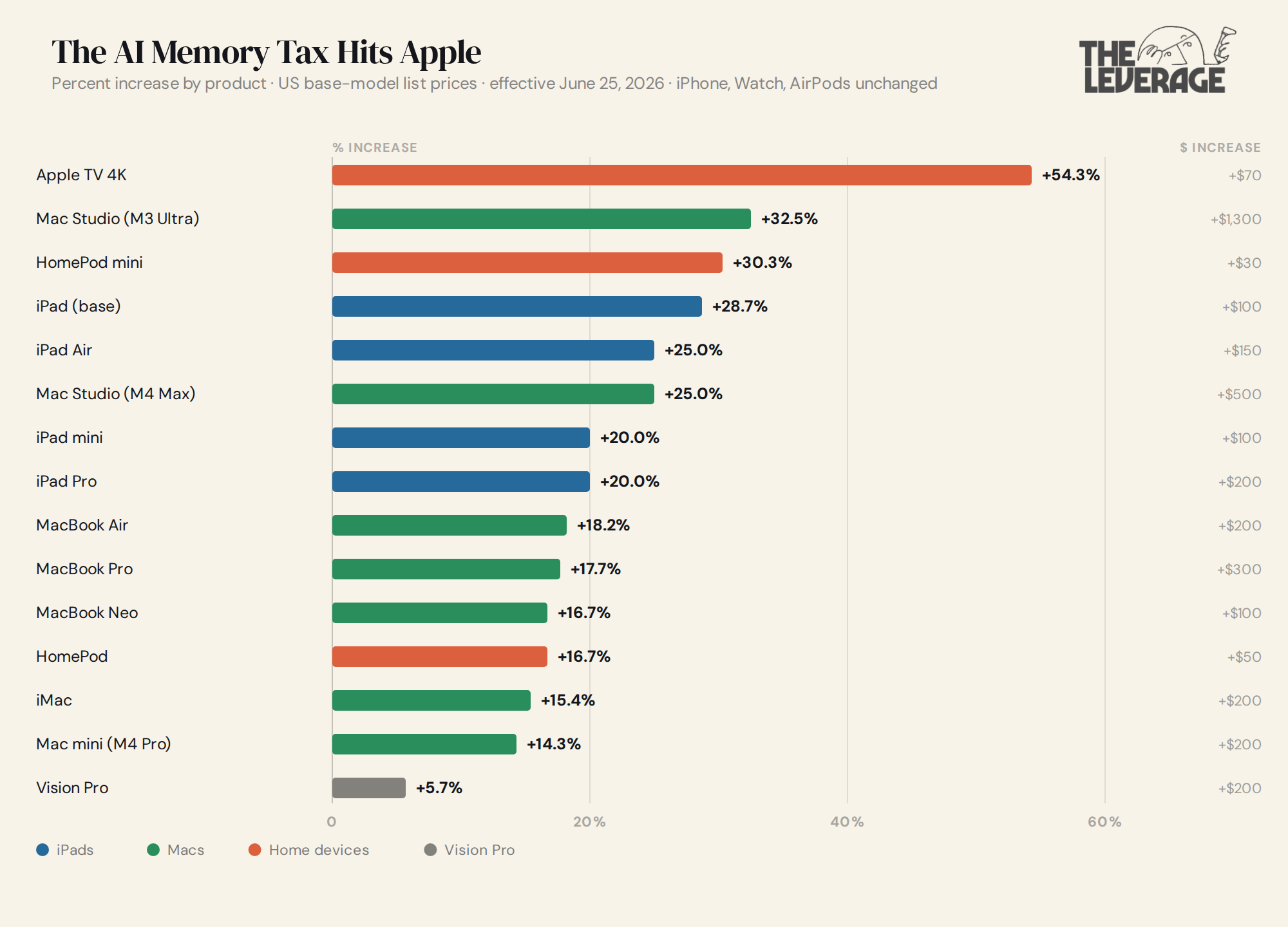
This strategy of theirs is interesting because of how they allocated the price increases despite them all using similar components. Somewhere in Apple’s Cupertino HQ, there is a spreadsheet wizard who crunched the numbers and realized that the purchasers of Apple TVs are so fully bought into the ecosystem they have far less price elasticity. Kudos to that pricing nerd, whoever you are.
Really though, this is a story about anything with DRAM or flash. Phones, laptops, SSDs, graphics cards, game consoles, cars, smart-home hardware: all of them are about to skyrocket in price. Microsoft is raising Xbox prices on August 1 and warning that console memory costs have more than doubled and may double again by late 2027.
Unfortunately, this is not going to end soon. The demand driving this supply crunch is still accelerating. Memory fabs are sold out well into next year, and Microsoft is openly modeling another doubling of memory costs by late 2027. This means two things. First, if there are any electronics purchases in your future, I would recommend pulling the trigger now. Second, people are about to be even madder about AI than they were before.

Claude is for the fellas, AI role play is for the ladies. Earlier this month ChatGPT became the fastest product in history to reach a billion monthly users. What’s weird is that the actual ChatGPT app only gets about six minutes a day while non-AI apps like TikTok get ninety-five.
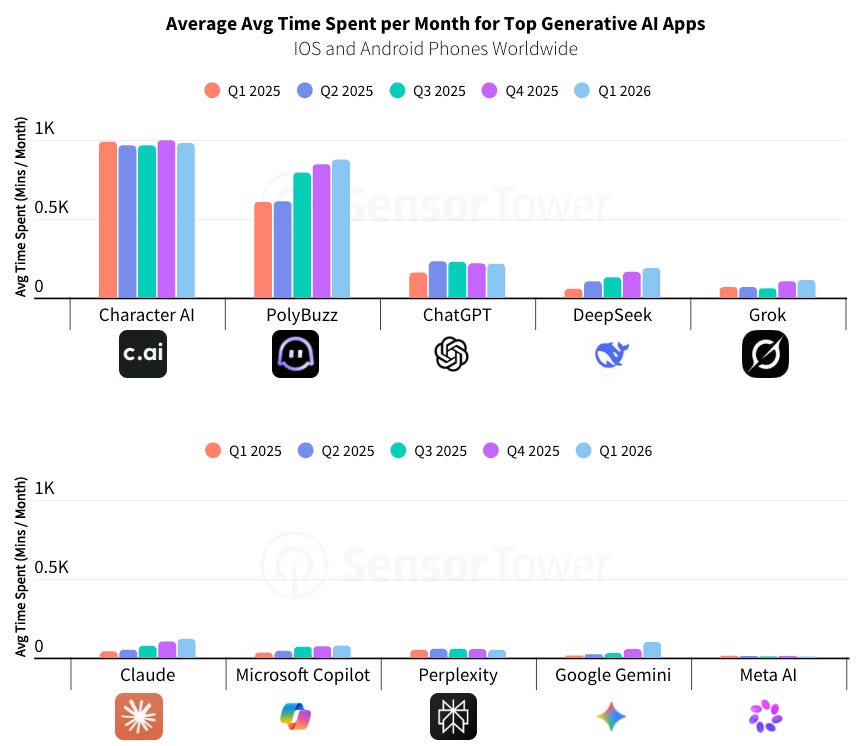
Essentially, there are two species of AI “consumer” apps right now. The first is actual consumer apps that are forms of entertainment. Character AI pulls around thirty minutes a day per user. PolyBuzz, an AI roleplay app most people in tech have never opened, pulls twenty-seven.
In contrast, ChatGPT (the app that just hit a billion users) is about six minutes a day on mobile, DeepSeek five, Grok two, and Claude, Gemini, Copilot, and Perplexity all land under two. Meta AI is a rounding error.
What matters is the form factor. The apps winning mobile time are AI companions, chat and roleplay products engineered for the phone the way TikTok is. The apps losing it are assistants, and assistants live on desktop and web, where roughly three-quarters of ChatGPT’s usage actually happens.
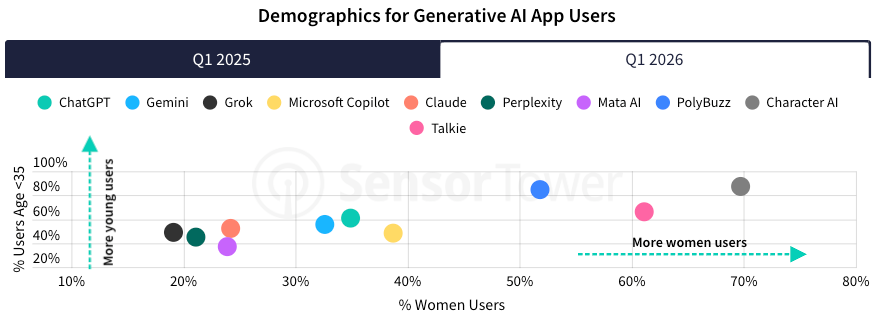
So, ChatGPT is the biggest app ever launched that is also essentially non-existent on smartphones. So there is room for someone (Apple most likely) to build a ChatGPT sized business for the mobile form factor first. My intuition is that it will end up looking like a conversation/roleplay experience and that it will target women first.

Three quick recommendations:
Elon’s Phone: With the DOGE meister as the world’s first trillionaire, I didn’t really have a mental model for what that amount of personal wealth would mean. This app helped me get it. The goal is to spend his fortune as quickly as possible. It is surprisingly hard to do. (Also, this is a really great example of apps as a form of media.)
Lost Boys: My wife and I are unashamed Phoebe Bridger fans. We’ve seen her together 3 times. She is releasing her first solo album in six years, with the first music video dropping this week. Really incredible art direction and editing on this video!
Having children: I took my little girl to see Toy Story 5 this weekend. She ate a bunch of popcorn and fell asleep in my wife’s arms after chortling to herself for 30 minutes. When I was single, I wish someone had publicly said how wonderful, soul-enriching, and amazing having kids is. This is me doing my part to be the change I want to see in the world. Being a Dad is the best thing that has ever happened to me. I recommend it.

Go and be kind this week,
Evan
Sponsorships
We are now accepting sponsors for the Q3 ‘26. If you are interested in reaching my audience of 35K+ founders, investors, and senior tech executives, send me an email at team@gettheleverage.com.